
The primary difference between 1100 and 3003 aluminum is their strength and chemical composition. 1100 aluminum is commercially pure (99.0% minimum) and offers extreme flexibility and corrosion resistance, but low strength. 3003 aluminum contains added manganese, making it about 20% stronger than 1100 while still maintaining excellent workability and corrosion resistance.
Choose 1100 for maximum softness and extreme forming. Choose 3003 when you need better strength while retaining excellent workability and corrosion resistance.
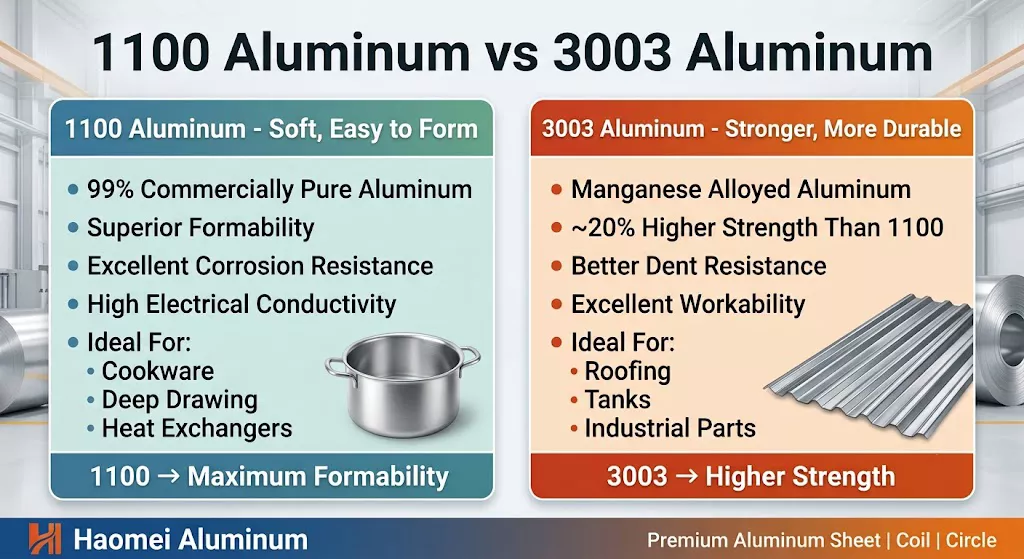
When selecting aluminum sheet, coil, or circle for a project, two common options are 1100 aluminum and 3003 aluminum. Both are non-heat-treatable alloys with excellent corrosion resistance and good forming performance. However, they are designed for different priorities.
The short answer is simple:
- 1100 aluminum is commercially pure aluminum, valued for its high conductivity, corrosion resistance, and soft, easy-forming nature.
- 3003 aluminum contains manganese, giving it higher strength and better resistance to everyday dents and deformation while maintaining good workability.
At Haomei Aluminum, customers often ask which alloy is better for cookware, roofing, tanks, decorative sheet, heat exchangers, or deep-drawn parts. The right choice depends on whether your project needs maximum formability and conductivity or higher mechanical strength.
Quick Comparison: 1100 vs 3003 Aluminum
| Property | 1100 Aluminum | 3003 Aluminum |
| Alloy series | 1xxx series | 3xxx series |
| Main composition | Minimum 99.0% aluminum | Aluminum with manganese addition |
| Typical manganese content | Very low / none | About 1.0–1.5% |
| Strength | Lower | Higher than 1100 |
| Formability | Excellent | Excellent |
| Deep drawing performance | Excellent | Very good to excellent |
| Corrosion resistance | Excellent | Excellent |
| Thermal conductivity | Higher | Lower than 1100, but still good |
| Electrical conductivity | Higher | Lower than 1100 |
| Weldability | Excellent | Excellent |
| Anodizing appearance | Bright and uniform | May appear slightly darker or less uniform |
| Common applications | Chemical equipment, electrical parts, decorative products | Cookware, roofing, tanks, HVAC, truck panels |
What Is 1100 Aluminum?
1100 aluminum is one of the most widely used commercially pure aluminum grades. It contains at least 99% aluminum and has very low amounts of other elements.
Because it is close to pure aluminum, 1100 offers several important benefits:
- Excellent corrosion resistance
- High thermal conductivity
- High electrical conductivity
- Excellent ductility and formability
- Good welding performance
- Bright surface after polishing or anodizing
However, 1100 aluminum is relatively soft. It is not the best option when a component must resist impact, repeated loading, or deformation.
Haomei Aluminum supplies 1100 aluminum sheet and coil in common tempers such as O, H14, H16, H18, and H24, depending on forming and strength requirements.
Typical Uses of 1100 Aluminum
1100 aluminum is commonly used for:
- Chemical processing equipment
- Heat exchangers and heat-transfer components
- Electrical conductors and bus bars
- Decorative aluminum sheet
- Reflective panels
- Nameplates and signage
- Cooking utensils
- Deep-drawn components
- Bottle caps and closures
- General sheet-metal fabrication
For applications requiring a clean surface, strong corrosion resistance, and easy bending or drawing, 1100 is often a practical choice.
What Is 3003 Aluminum?
3003 aluminum is an aluminum-manganese alloy. Manganese is added to improve strength without sacrificing the alloy’s corrosion resistance or forming ability.
Compared with 1100, 3003 aluminum is stronger and more resistant to dents. It is still easy to bend, stamp, roll-form, weld, and draw, making it one of the most versatile general-purpose aluminum alloys.
Haomei Aluminum provides 3003 aluminum sheet, coil, tread plate, circle, and foil products for industrial and fabrication applications.
Typical Uses of 3003 Aluminum
3003 aluminum is frequently selected for:
- Cookware and kitchen utensils
- Roofing sheet and wall cladding
- Storage tanks and fuel tanks
- Chemical equipment
- HVAC ducts and heat exchanger components
- Refrigeration equipment
- Truck and trailer panels
- Traffic signs
- Pressure vessels
- Building decoration
- Aluminum circles for pots, pans, and rice cookers
For products that need better strength than pure aluminum but still require forming or drawing, 3003 is usually the preferred grade.
Chemical Composition: Pure Aluminum vs Aluminum-Manganese Alloy
The most fundamental difference between 1100 and 3003 aluminum is their chemical composition.
1100 Aluminum Composition
1100 is primarily aluminum, with a minimum aluminum content of 99.0%. Small amounts of silicon, iron, copper, manganese, zinc, and other elements may be present, but they are tightly controlled.
Its high purity gives 1100 excellent conductivity and corrosion resistance.
3003 Aluminum Composition
3003 aluminum contains manganese as its primary alloying element. The manganese content is typically around 1.0% to 1.5%.
This manganese addition increases the alloy’s strength and improves its resistance to everyday deformation. As a result, 3003 is better suited to structural sheet-metal applications than 1100.
Strength Difference: 3003 Is Stronger Than 1100
If strength is the main concern, 3003 aluminum is generally the better choice.
The exact mechanical properties depend on thickness, temper, production method, and applicable standards. Still, under comparable conditions, 3003 typically has higher tensile strength and yield strength than 1100.
- 1100-O is very soft and highly formable.
- 3003-O remains formable but offers higher strength.
- 3003-H14 is commonly used where moderate strength and good workability are both needed.
- 1100-H14 can provide some increased hardness, but it will usually remain less strong than 3003-H14.
This difference matters in applications such as roofing, tanks, transportation panels, and cookware, where the material may be exposed to handling, vibration, impact, or repeated use.
Formability: Both Are Excellent, but 1100 Is Softer
Both alloys are known for good formability. They can be bent, stamped, spun, rolled, and welded effectively.
However, 1100 aluminum is softer and generally easier to form than 3003 aluminum.
Choose 1100 When:
- Extremely deep drawing is required
- The part has complex shapes
- Maximum softness is beneficial
- High conductivity is needed
- Surface brightness is important
Choose 3003 When:
- The part still requires forming, but higher strength is needed
- The finished product must resist denting better
- The material will be used in cookware, roofing, tanks, or transportation equipment
For aluminum circles used in deep-drawn cookware, both 1100 and 3003 can be used. The decision often depends on cookware thickness, drawing depth, final hardness, coating requirements, and cost target. Learn more about Haomei’s aluminum circles for cookware.
Corrosion Resistance: Both Perform Very Well
Both 1100 and 3003 aluminum offer excellent resistance to atmospheric corrosion and many common environments.
This is one reason why they are widely used in food processing, roofing, chemical equipment, kitchen products, and outdoor construction.
1100 Corrosion Resistance
Because 1100 has very high aluminum purity, it performs particularly well in many chemical and atmospheric environments.
It is often selected for chemical storage equipment, decorative applications, and components where a clean aluminum surface is preferred.
3003 Corrosion Resistance
3003 also has excellent corrosion resistance. The manganese addition does not significantly reduce its ability to withstand moisture, outdoor exposure, or many industrial environments.
For long-term outdoor applications such as roof panels, wall cladding, and gutters, 3003 is widely used because it combines corrosion resistance with improved mechanical strength.
Note: For highly acidic, alkaline, saltwater, or chemically aggressive conditions, material selection should be based on the actual service environment. Haomei Aluminum can provide alloy and temper recommendations according to your application.
Thermal and Electrical Conductivity: 1100 Performs Better
Because 1100 is closer to pure aluminum, it has better thermal and electrical conductivity than 3003.
This makes 1100 a more suitable option for:
- Electrical conductors
- Bus bars
- Heat-transfer equipment
- Reflectors
- Heat sinks in non-structural applications
- Chemical and thermal processing equipment
3003 still provides good thermal conductivity and is commonly used for heat exchangers, HVAC components, and cookware. But when conductivity is the primary requirement, 1100 is normally the better option.
Anodizing and Surface Appearance
If your product requires a bright, decorative anodized finish, 1100 aluminum often provides a more consistent appearance.
Because 1100 is commercially pure aluminum, it can produce a cleaner and brighter anodized surface. It is often used for decorative sheet, lighting reflectors, nameplates, and polished products.
3003 can also be anodized, but manganese may affect color consistency. The anodized surface can appear slightly darker, grayer, or less uniform compared with 1100.
For decorative finishes, Haomei Aluminum recommends confirming the required surface treatment before selecting the alloy. For example, a brushed, mill finish, embossed, color-coated, or anodized product may require different alloy and temper choices. Visit our aluminum sheet products page for available surface options.
Weldability: Both Are Easy to Weld
Both 1100 and 3003 aluminum have good weldability.
They are commonly welded using:
- TIG welding
- MIG welding
- Resistance welding
- Brazing, depending on the product design and filler material
For fabricated tanks, ducts, chemical equipment, and sheet-metal structures, 3003 is often preferred because it provides higher post-fabrication strength.
For conductive, decorative, or highly formable parts, 1100 remains a reliable welding material.
Price Difference: Is 1100 or 3003 More Expensive?
The price difference between 1100 and 3003 aluminum depends on aluminum market conditions, thickness, width, temper, surface finish, order quantity, packaging, and processing requirements.
In many cases, 3003 may cost slightly more than 1100 because of its manganese content and broader use in higher-strength sheet applications. However, the final cost difference is often less important than choosing the correct alloy for the end-use.
Using a lower-cost alloy that does not meet strength or forming requirements can lead to higher rejection rates, production problems, and warranty issues.
At Haomei Aluminum, we recommend evaluating the total production cost rather than material price alone. The right alloy can reduce cracking during stamping, improve yield, and extend product service life.
1100 vs 3003 Aluminum: Which One Should You Choose?
Choose 1100 Aluminum if You Need:
- High electrical conductivity
- High thermal conductivity
- Maximum corrosion resistance
- Excellent deep drawing and bending
- A bright decorative surface
- Soft aluminum for non-structural applications
Choose 3003 Aluminum if You Need:
- Higher strength than 1100
- Better dent resistance
- Good formability and weldability
- Roofing, siding, tanks, cookware, or HVAC applications
- A cost-effective general-purpose aluminum alloy
In many fabrication projects, 3003 is the better all-around choice. But for electrical, thermal, chemical, or decorative applications, 1100 may provide better performance.
FAQ – 1100 and 3003 Aluminum
Is 3003 aluminum stronger than 1100 aluminum?
Yes. 3003 aluminum is generally stronger than 1100 aluminum because it contains manganese as the main alloying element. It offers better resistance to denting, deformation, and everyday handling damage while maintaining good formability.
Can 1100 and 3003 aluminum be welded?
Yes. Both 1100 and 3003 aluminum have excellent weldability and can be welded using common aluminum welding methods such as TIG and MIG welding.
Is 1100 aluminum food safe?
1100 aluminum is commonly used in cookware, food processing equipment, and kitchen products. However, food-contact suitability depends on the complete product design, surface treatment, manufacturing process, and applicable local regulations.
Is 3003 aluminum suitable for cookware?
Yes. 3003 aluminum is widely used for cookware, pots, pans, rice cooker inner pots, and kitchen utensils because it provides good formability, corrosion resistance, heat conductivity, and higher strength compared with 1100 aluminum.
Which alloy is better for roofing, 1100 or 3003 aluminum?
3003 aluminum is usually a better choice for roofing applications because it offers higher strength while maintaining excellent corrosion resistance, weather durability, and forming performance.
Which is better for anodizing, 1100 or 3003 aluminum?
1100 aluminum is generally preferred for bright decorative anodizing because its high purity allows a more uniform and attractive surface appearance. 3003 aluminum can also be anodized, but its manganese content may result in a darker or less consistent finish.
Products you may be interested in
- 3003 Aluminum Coil
- 3003 Aluminum Plate and Sheet
- 1100 Aluminum Plate Sheet
- 1100 0 aluminum sheet
- 1100 h14 aluminum sheet
- 1100 h18 aluminum sheet
- 1100 h12 aluminum sheet plate
- 3003 h14 aluminum sheet
- 3003 h22 aluminum sheet
- 3003 o aluminum sheet
- 3003 Aluminum Disc Circle
- 1100 H16 Aluminum
- 1100 H22 Aluminum
- 1100 H24 Aluminum
- 1100 H26 Aluminum
- 1100 H28 Aluminum
- 1100 Aluminum Coil
- 1100 Aluminum Foil
- 1100 Aluminum Disc Circle
- 3003 Aluminum Foil
- 3003 H14 Aluminum Coil
- 3003 Aluminum Strip
Users viewing this material also viewed the following
- Aluminum Tread Plate 3003
- 1100 Embossed Aluminum Sheet
- 3003 Embossed Aluminum Sheet
- Hemispherical embossed aluminum sheet coil 1050 1060 1100 for automotive heat shield
- 1100 Aluminum Sheet for PCB (Printed Circuit Board)
- 1100 Aluminum Plate for Heat Sink Applications
- 1100 Aluminum Plate for Printing Plates
- 1100 Aluminum Plate for Building Exterior Cladding
- 1100 Aluminum Veneer Panel
- 1100 Aluminum Plate for Stair Handrails
- 1100 Aluminum Plate for Pressure Tanks
- 1100 H16 Aluminum Sheet Roll for Refrigerator Linings
- 1100 O/H14 Aerospace Aluminum Sheet and Plate
- 1100 Aluminum Plate for New Energy Charging Stations
- 1100 Embossed Aluminum Sheet for Automotive Heat Shield
- 1100 Aluminum Plate for Aluminum Composite Panels
- 3003 Aluminum Diamond Plate
- 3003 Hot-rolled Aluminum Plate
- 3003 Honeycomb Aluminum
- 3003 Aluminum Plate for New Energy Automobile Lithium Battery Power Battery Shell
- 3003+4343 Power Battery Cooling Plate
- 3003 Aluminum Plate for Brazing Water Cooling Plate
- Aluminum Brazing Composite Material 3003+4045 Aluminum Plate
- 3003 Aluminum Disc for Non-stick Pan
- 3003 Aluminum Plate for Mobile Phone Battery Shell
- 3003 Corrugated Aluminum Sheet
- 1100 Corrugated Aluminum Sheet
- 3003 Aluminum Plate for Automobile Fender
- 3003 Checker Aluminum Plate for Stair Anti-slip
- 3003 Tread Aluminum Plate for Cold Storage Floor Anti-slip
- 3003 Ultra-wide Curtain Wall Aluminum Plate
- 3003 Aluminum Plate for Building Decoration
- 3003 Roof Aluminum Plate for Decoration
- 3003 Aluminum Sheet Coil for Thermal Insulation Material
- 3003 Pre-painted Aluminum Coil
- 1100 Color Coated Aluminum Sheet
Recommended Content
- Aluminium 3003 H14 Data Sheet
- What is 3003 aluminum used for?
- 3003 Aluminum Tubing
- 3003 Aluminum vs. 3005 Aluminum
- 3003-H18 Aluminum vs. 3005-H18 Aluminum
- What is the difference between 3003 H14 and 3105 H14?
- 3003 Aluminum vs. 3104 Aluminum
- 3003-H18 Aluminum vs. 3004-H18 Aluminum
- 3003-O Aluminum vs. 3004-O Aluminum
- What is the difference between 3003 and 3004 aluminum?
- 3003-H22 Aluminum vs. 3003-H24 Aluminum
- What is the difference between 3003 O and 3003 H14?
- What is the difference between 3003 H14 and H24?
- 1100 vs. 1050 Aluminium Which Alloy is Right for Your Project?
- 1100-H14 Aluminum vs. 1100-H24 Aluminum
- 1100-H14 Aluminum vs. 1100-H16 Aluminum
- 1100-H14 Aluminum vs. 1100-H18 Aluminum
- 1100-H12 Aluminum vs. 1100-H14 Aluminum
- 1100-H14 Aluminum vs. 1100-O Aluminum
- 1060-O Aluminum vs. 1100-H14 Aluminum: A Comparative Analysis
- 1060 Aluminum vs. 1100-H14 Aluminum: Key Differences
- Comparison of 1060-H28 Aluminum vs. 1100-H28 Aluminum