
When choosing between 3003 aluminum and 3004 aluminum, the difference is not simply a matter of grade number. Both are non-heat-treatable aluminum alloys in the 3000 series, but their different alloying compositions give them different levels of strength, formability and application suitability.
The main difference is that 3004 aluminum contains magnesium in addition to manganese, which gives it higher strength than 3003 aluminum. By comparison, 3003 aluminum is generally more ductile and easier to form, making it a practical choice for applications that involve extensive bending, drawing or shaping.
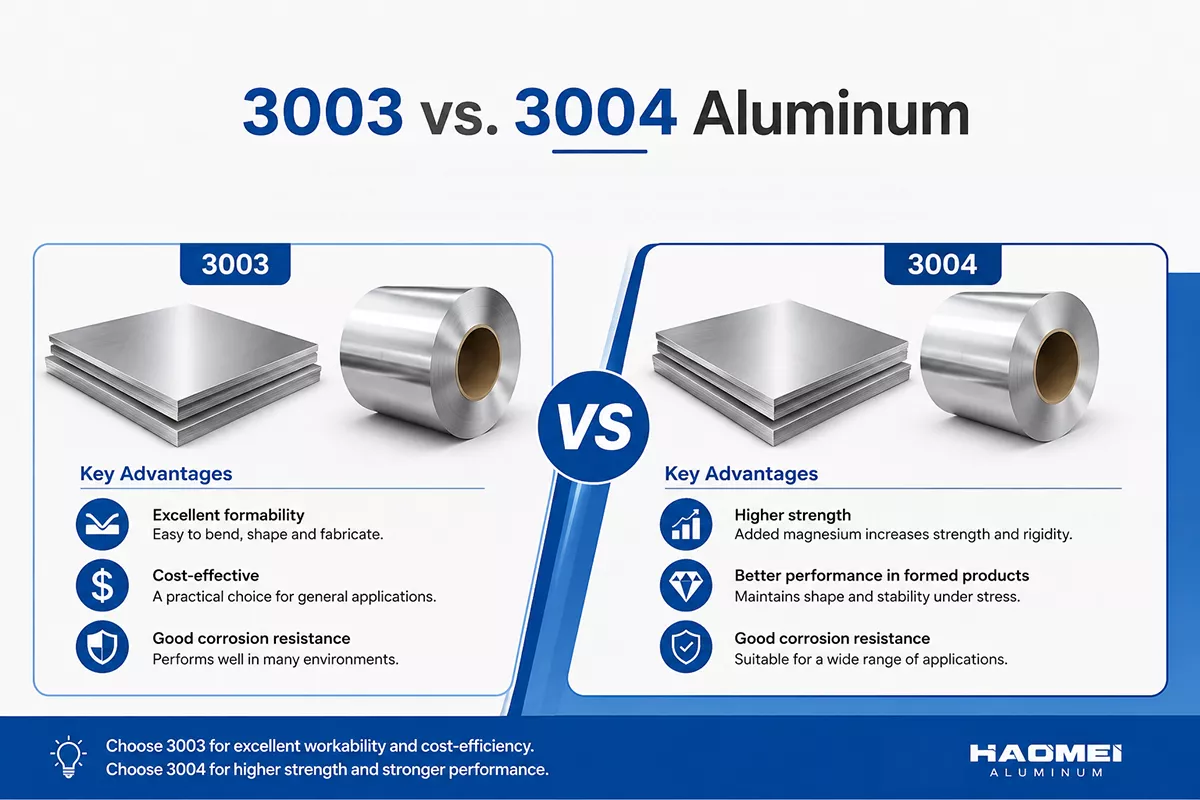
3003 Aluminum vs. 3004 Aluminum
| Property | 3003 Aluminum | 3004 Aluminum |
| Alloy family | Aluminum-Manganese | Aluminum-Manganese-Magnesium |
| Heat treatment | Non-heat-treatable | Non-heat-treatable |
| Main alloying elements | Manganese, with a small amount of copper | Manganese and magnesium |
| Relative strength | Lower | Higher |
| Formability | Excellent | Very good |
| Ductility | Generally higher | Generally lower than 3003 |
| Corrosion resistance | Good | Good |
| Weldability | Good | Good |
| Typical applications | Cookware, tanks, general sheet metal, heat exchangers | Cans, roofing, siding, transportation and formed components |
3003 Aluminum vs. 3004 Aluminum Characteristics
Strength
In general, 3004 aluminum is stronger than 3003 aluminum.
This makes 3004 attractive for applications where the finished part needs greater rigidity, resistance to deformation or improved load-bearing capability.
For applications where structural strength is not the main requirement, however, the higher strength of 3004 may not provide a meaningful advantage. In those cases, 3003 can be the more economical and easier-to-form option.
Ductility and Forming
3003 is generally preferred when formability is a priority.
It can be bent, formed and shaped efficiently, which is one reason it is widely used in cookware, general sheet-metal fabrication and other formed aluminum products.
3004 also has good formability, but its higher strength means that forming conditions need to be considered more carefully, particularly for demanding operations.
For deep drawing or complex forming, the correct temper, tool design and forming method are just as important as the alloy designation itself.
Corrosion Resistance
Both alloys provide good corrosion resistance for a wide range of general industrial and architectural environments.
Neither should be selected solely on the assumption that one alloy is universally more corrosion resistant than the other. Actual performance depends on the operating environment, surface condition, temperature, exposure to chemicals and the design of the finished component.
Weldability
Both 3003 and 3004 aluminum are generally considered weldable alloys.
The final welding procedure should still be established according to the material thickness, welding method, joint design and required mechanical performance. For production work, filler selection and welding parameters should be validated for the specific application.
3003 Aluminum vs. 3004 Aluminum: Applications
Common Applications for 3003 Aluminum
3003 aluminum is commonly used for products that require a combination of corrosion resistance, formability and moderate strength.
- Cookware and kitchen equipment
- Heat exchangers
- Storage and general-purpose tanks
- HVAC components
- General sheet-metal fabrication
- Decorative and formed aluminum components
It is particularly suitable when the manufacturing process involves substantial bending, forming or shaping.
Haomei also supplies 3003 aluminum coil for applications requiring continuous coil processing, slitting or downstream fabrication.
Common Applications for 3004 Aluminum
3004 aluminum is often chosen when higher strength and rigidity are more important while good formability is still required.
- Beverage and food cans
- Roofing and siding
- Storage and building components
- Automotive and transportation components
- Formed industrial parts
- General applications requiring a stronger 3xxx-series alloy
For buyers requiring a stronger material within the non-heat-treatable 3000 series, 3004 aluminum coil can be considered where the specifications and temper are suitable.
3003 and 3004 Aluminum Alloy Composition
- 3003 Aluminum: This is a commercial-grade aluminum alloy with an average aluminum content of 99%, usually containing small amounts of manganese (1.0–1.5%). It does not contain significant amounts of magnesium.
- 3004 Aluminum: Although also a high-purity aluminum alloy, 3004 has a slightly higher magnesium content (0.8–1.3%), which helps improve its strength characteristics. It also contains small amounts of manganese, similar to 3003.
| Element | 3003 Aluminum | 3004 Aluminum |
| Aluminum (Al), % | 96.8 to 99 | 95.6 to 98.2 |
| Copper (Cu), % | 0.050 to 0.2 | 0 to 0.25 |
| Iron (Fe), % | 0 to 0.7 | 0 to 0.7 |
| Magnesium (Mg), % | 0 | 0.8 to 1.3 |
| Manganese (Mn), % | 1.0 to 1.5 | 1.0 to 1.5 |
| Silicon (Si), % | 0 to 0.6 | 0 to 0.3 |
| Zinc (Zn), % | 0 to 0.1 | 0 to 0.25 |
| Residuals, % | 0 | 0 to 0.15 |
3003 and 3004 Aluminum Mechanical Properties
- 3003 Aluminum: Typically, 3003 has poor durability in high-stress environments, with lower performance in shear strength, fatigue resistance, and tensile strength.
- 3004 Aluminum: The addition of magnesium gives 3004 excellent mechanical properties, particularly in shear strength, tensile strength, and fatigue resistance. It performs better in high mechanical stress environments, making it more suitable for demanding applications.
| Property | 3003 Aluminum | 3004 Aluminum |
| Brinell Hardness | 28 to 65 | 45 to 83 |
| Elastic (Young's, Tensile) Modulus, x 10^6 psi | 10 | 10 |
| Elongation at Break, % | 1.1 to 28 | 1.1 to 19 |
| Fatigue Strength, x 10^3 psi | 5.7 to 13 | 7.9 to 17 |
| Poisson's Ratio | 0.33 | 0.33 |
| Shear Modulus, x 10^6 psi | 3.8 | 3.8 |
| Shear Strength, x 10^3 psi | 9.9 to 19 | 15 to 25 |
| Tensile Strength: Ultimate (UTS), x 10^3 psi | 16 to 34 | 25 to 45 |
| Tensile Strength: Yield (Proof), x 10^3 psi | 5.7 to 30 | 9.9 to 40 |
3003 and 3004 Aluminum Thermal Properties
3003 and 3004 aluminum alloys have similar thermal conductivity and electrical conductivity. Their performance in heat and electrical transmission is nearly identical, with the main difference being in their strength characteristics rather than thermal or electrical conductivity.
| Property | 3003 Aluminum | 3004 Aluminum |
| Latent Heat of Fusion, J/g | 400 | 400 |
| Maximum Temperature: Mechanical, °F | 360 | 360 |
| Melting Completion (Liquidus), °F | 1210 | 1210 |
| Melting Onset (Solidus), °F | 1190 | 1170 |
| Specific Heat Capacity, BTU/lb-°F | 0.21 | 0.21 |
| Thermal Conductivity, BTU/h-ft-°F | 100 | 94 |
| Thermal Expansion, µm/m-K | 23 | 24 |
3003 and 3004 Aluminum Electrical Properties
| Property | 3003 Aluminum | 3004 Aluminum |
| Electrical Conductivity: Equal Volume, % IACS | 44 | 42 |
| Electrical Conductivity: Equal Weight (Specific), % IACS | 140 | 140 |
3003 or 3004 Aluminum: Which Should You Choose?
There is no universal winner between these two alloys. The right choice depends on the finished product and manufacturing process.
Choose 3003 When Formability Comes First
3003 aluminum may be the better option when:
- Extensive bending or forming is required
- High ductility is important
- Moderate strength is sufficient
- The product is mainly used for cookware, HVAC or general fabrication
- The manufacturing process benefits from easier forming
Choose 3004 When Higher Strength Is More Important
3004 aluminum may be a better fit when:
- Greater mechanical strength is required
- The finished component needs more rigidity
- The application involves cans, roofing or formed structural components
- You need a stronger alternative while remaining within the 3000-series, non-heat-treatable alloy family
The final choice should also consider thickness, temper, fabrication method, applicable standard and the required surface finish.
What to Consider When Choosing Between 3003 and 3004 Aluminum
For aluminum coil and sheet purchases, alloy selection should be based on the complete production requirement rather than strength alone. Haomei Aluminum recommends confirming the alloy, temper, thickness, width, forming method and final application before placing an order.
For example, a highly formable 3003 alloy may be a better choice for a deeply formed component, while 3004 can be more suitable when the finished part requires greater strength and rigidity. The selected temper can also significantly affect the balance between strength and formability.
- Alloy: Choose 3003 or 3004 according to the specific application requirements.
- Temper: Select the appropriate temper based on required strength, hardness and forming performance.
- Thickness: Confirm the required gauge and thickness tolerance for the finished application.
- Width: Match slit coil or full-width material to downstream processing and equipment requirements.
- Forming Method: Consider whether the material will be used for bending, deep drawing, stamping, roll forming or other fabrication processes.
- Surface: Specify the required surface condition, such as mill finish, treated surface or another customized finish.
- Applicable Standard: Confirm the required purchasing specification and applicable material standard before production.
- Packaging: Select packaging suitable for international transportation, storage and protection against moisture or surface damage.
FAQ – 3003 vs. 3004 Aluminum
What is the main difference between 3003 and 3004 aluminum?
The key difference is alloy composition. 3003 is primarily an aluminum-manganese alloy, while 3004 contains manganese and magnesium. The added magnesium gives 3004 higher strength.
Is 3004 aluminum stronger than 3003 aluminum?
Generally, yes. In comparable tempers, 3004 aluminum is usually stronger than 3003 because it contains magnesium in addition to manganese.
Can 3003 and 3004 aluminum be heat treated?
No. Both alloys are generally classified as non-heat-treatable. Their strength is developed mainly through alloy composition and cold working.
Is 3003 aluminum easier to form than 3004 aluminum?
In general fabrication, 3003 is often considered easier to bend and form. However, 3004 can also be used in demanding formed applications when the correct temper and forming process are selected.
Can 3003 replace 3004 aluminum?
Not automatically. A substitution should be based on the required mechanical properties, temper, thickness, forming method, corrosion conditions, application requirements, and the relevant product standard.
Which is better for cookware, 3003 or 3004?
3003 is commonly used for cookware because of its good formability, corrosion resistance, and suitability for formed products. The final choice should still depend on the product design, thickness, temper, and manufacturing requirements.
Which is better for roofing, 3003 or 3004?
3004 can be attractive when greater strength and rigidity are required, while 3003 may be suitable for applications where moderate strength and easier forming are more important.
What information should I provide when requesting a quote?
Provide the alloy, temper, thickness, width, length or coil weight, surface requirement, quantity, application, destination port, and applicable standard. If the material will be formed, include the forming method whenever possible.
Products you may be interested in
- 3003 Aluminum Coil
- 3004 Aluminum Coil
- 3003 Aluminum Plate and Sheet
- 3004 Aluminum Plate Sheet
- 3003 h14 aluminum sheet
- 3003 h22 aluminum sheet
- 3003 o aluminum sheet
- 3003 Aluminum Disc Circle
- 3004-H19 Aluminum
- 3004-H18 Aluminum
- 3003 Aluminum Foil
- 3004 Aluminum Foil
- 3003 H14 Aluminum Coil
- 3003 Aluminum Strip
Users viewing this material also viewed the following
- Aluminum Tread Plate 3003
- 3003 Embossed Aluminum Sheet
- 3003 Aluminum Diamond Plate
- 3003 Hot-rolled Aluminum Plate
- 3003 Honeycomb Aluminum
- 3003 Aluminum Plate for New Energy Automobile Lithium Battery Power Battery Shell
- 3003+4343 Power Battery Cooling Plate
- 3003 Aluminum Plate for Brazing Water Cooling Plate
- Aluminum Brazing Composite Material 3003+4045 Aluminum Plate
- 3003 Aluminum Disc for Non-stick Pan
- 3003 Aluminum Plate for Mobile Phone Battery Shell
- 3003 Corrugated Aluminum Sheet
- 3003 Aluminum Plate for Automobile Fender
- 3003 Checker Aluminum Plate for Stair Anti-slip
- 3003 Tread Aluminum Plate for Cold Storage Floor Anti-slip
- 3003 Ultra-wide Curtain Wall Aluminum Plate
- 3003 Aluminum Plate for Building Decoration
- 3003 Roof Aluminum Plate for Decoration
- 3003 Aluminum Sheet Coil for Thermal Insulation Material
- 3004 Corrugated Aluminum Plate
- 3004 Aluminum Strip for Blinds
- 3004 Aluminum Plate for Automobile Fuel Tank
- 3004 Aluminum Plate for Aluminum-plastic Board Substrate
- 3004 Aluminum Honeycomb Board Core Material
- 3004 Deep-drawn Aluminum Plate
- 3004 Aluminum Plate for Traffic Signs
- 3004 Aluminum Plate for Aluminum Curtain Wall
- 3004 Roof Aluminum Sheet
- 3003 Pre-painted Aluminum Coil
Recommended Content
- What Is the Difference Between 1100 and 3003 Aluminum?
- Aluminium 3003 H14 Data Sheet
- What is 3003 aluminum used for?
- 3003 Aluminum Tubing
- 3003 Aluminum vs. 3005 Aluminum
- 3003-H18 Aluminum vs. 3005-H18 Aluminum
- What is the difference between 3003 H14 and 3105 H14?
- 3003 Aluminum vs. 3104 Aluminum
- 3003-H18 Aluminum vs. 3004-H18 Aluminum
- 3003-O Aluminum vs. 3004-O Aluminum
- 3004 Aluminum vs. 3004-H18 Aluminum
- 3004-H18 Aluminum vs. 3104 Aluminum
- 3003-H22 Aluminum vs. 3003-H24 Aluminum
- What is the difference between 3003 O and 3003 H14?
- What is the difference between 3003 H14 and H24?