
3003 Aluminum Foil
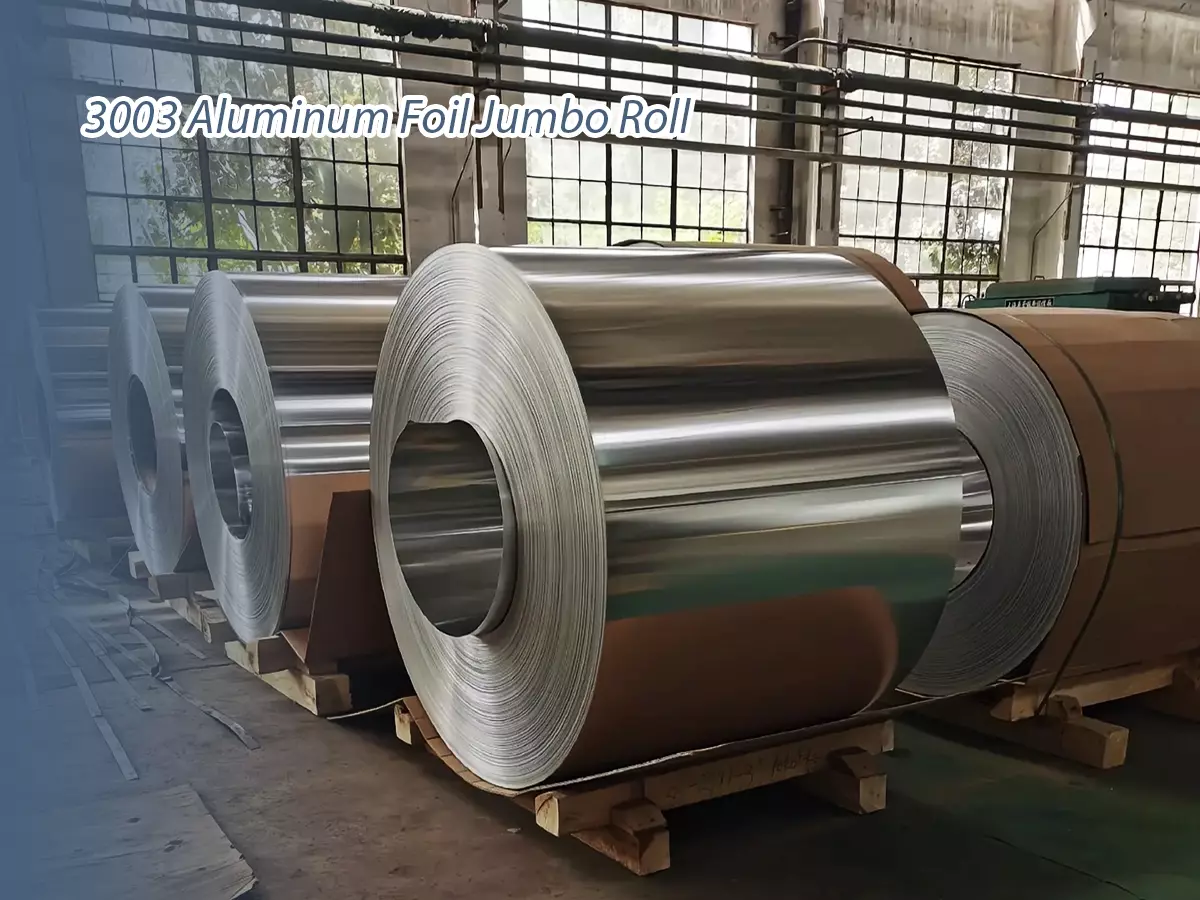
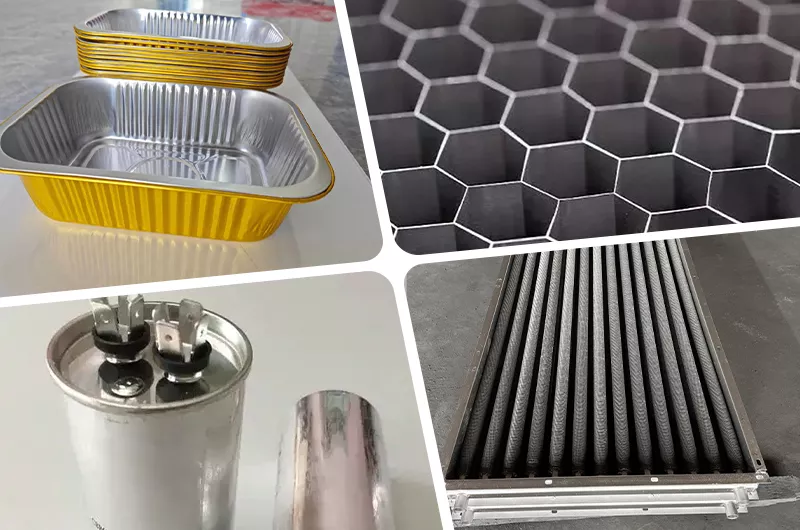
3003 aluminum foil is an Al-Mn alloy foil selected for applications that require a practical balance of strength, formability, corrosion resistance and processing stability. It is commonly supplied for food containers, honeycomb core, heat exchanger fins, thermal insulation, industrial packaging and related formed foil products.
What Is 3003 Aluminum Foil?
3003 aluminum foil is an aluminum-manganese alloy foil from the 3xxx series. It is non-heat-treatable and is primarily strengthened through cold working and temper control. The manganese content improves strength compared with 1050, 1060 and 1100 pure aluminum foil, while preserving good ductility and general corrosion resistance.
Depending on foil thickness and temper, alloy 3003 can be selected for rigid food containers, deep-drawn trays, insulation facing, honeycomb core, HVAC components, industrial wrapping and laminated materials. It is often considered when a project needs more strength and deformation resistance than pure aluminum foil but does not require the higher strength level of 5xxx-series alloys.
Final alloy selection should be based on forming depth, thickness, temper, die design, coating system, adhesive compatibility, operating environment, food-contact requirements and applicable local regulations.
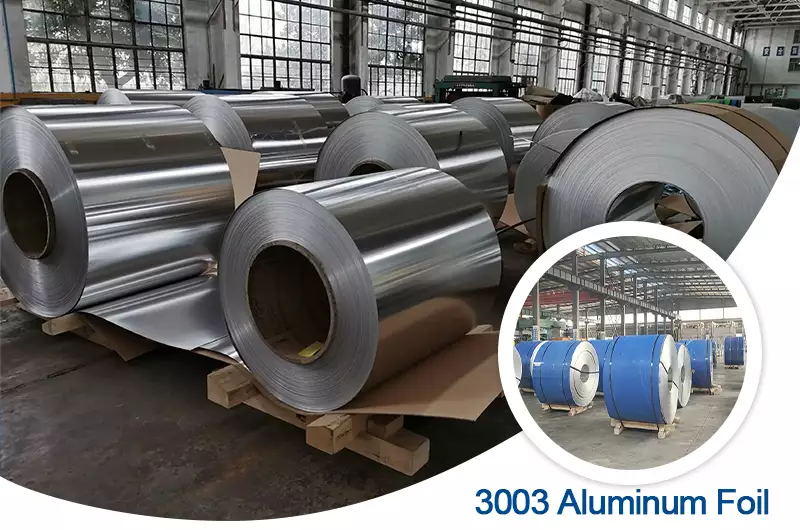
3003 Aluminum Foil Specifications
| Item | Specification |
| Product | 3003 Aluminum Foil |
| Alloy | AA 3003 / Aluminum-Manganese Alloy / Al-Mn Alloy |
| Available Tempers | O, H14, H16, H18, H22, H24 |
| Thickness | 0.006 mm–0.20 mm, subject to application and order requirements |
| Width | 100 mm–1, 600 mm, customized slit width available upon confirmation |
| Coil ID | 76 mm / 152 mm / 300 mm / 405 mm / 508 mm |
| Coil Form | Jumbo coil, slit coil, narrow coil, sheet or customized form |
| Surface | Mill finish, bright side, matte side, degreased surface or customer-specified condition |
| Edge Condition | Mill edge, slit edge, deburred edge or customized edge condition upon request |
| Applicable Standards | EN 546, relevant ASTM specifications, GB/T standards or customer-specific technical requirements |
| Documentation | Mill Test Certificate (MTC), Certificate of Analysis (COA), packing list and third-party inspection documents upon request |
| Packaging | Moisture-proof protective wrapping, wooden pallet, fumigation-free wooden case or seaworthy export packaging |
| MOQ | Confirmed according to thickness, width, temper, coil weight and production schedule |
| Delivery Time | Based on order quantity, specification, raw material availability and production schedule |
Properties of 3003 Aluminum Foil
Aluminum-Manganese Alloy
3003 is a non-heat-treatable Al-Mn alloy. It gains strength primarily through cold working and temper control rather than heat treatment.
Higher Strength Than 1xxx Foil
Compared with 1050, 1060 and 1100 aluminum foil in comparable conditions, 3003 generally provides improved strength and resistance to deformation.
Good Formability
In O, H22 and H24 tempers, 3003 foil can be considered for stamping, drawing, bending and formed foil applications.
General Corrosion Resistance
3003 aluminum foil provides good atmospheric corrosion resistance and can be used in humid environments, insulation systems and general industrial applications.
Thermal Conductivity
Aluminum offers good thermal conductivity, making 3003 foil suitable for selected heat-transfer, cooling, warming and HVAC-related components.
Compatible With Further Processing
Depending on the surface condition and end-use requirements, 3003 foil can be slit, laminated, coated, printed, embossed, stamped or bonded with other materials.
3003 H14 Aluminum Foil Chemical Composition & Mechanical Properties
Chemical Composition of 3003 Aluminum Foil
3003 aluminum foil belongs to the aluminum-manganese alloy series. The typical chemical composition is as follows:
| Element | Content |
| Si | ≤ 0.60% |
| Fe | ≤ 0.70% |
| Cu | 0.05% - 0.20% |
| Mn | 1.00% - 1.50% |
| Zn | ≤ 0.10% |
| Others | ≤ 0.15% total |
| Al | Balance |
The addition of manganese improves the strength and corrosion resistance of 3003 aluminum foil, making it suitable for forming, stamping, rolling and other processing methods.
3003 Aluminum Foil Mechanical Properties
The mechanical properties of 3003 aluminum foil vary depending on temper, thickness and processing conditions.
| Temper | Tensile Strength | Elongation | Features |
| O | Soft | High | Excellent formability |
| H14 | Medium hard | Medium | Good balance of strength and forming |
| H16 | Harder than H14 | Medium-low | Suitable for stable processing |
| H18 | Full hard | Low | Higher strength and rigidity |
| H24 | Half hard, stabilized | Medium | Good dimensional stability |
For exact mechanical property data, Haomei can provide test reports according to your order specification.
Looking for a Reliable 3003 Aluminum Foil Supplier?
Contact Haomei for detailed specifications, pricing information, technical support and free samples for your aluminum foil projects.
Fast production, global export experience, and competitive pricing for bulk orders.
Contact HaomeiHow to Choose the Right 3003 Aluminum Foil Temper
Temper selection should follow the forming process rather than being chosen only from the alloy designation. The softer O temper is generally favored for demanding forming, while harder tempers are selected when greater rigidity or dimensional stability is needed.
3003-O Aluminum Foil
O temper is the soft condition and is commonly selected where the foil must undergo drawing, stamping, bending or other forming operations with significant deformation.
Typical applications include formed food containers, trays and other products where ductility is more important than maximum hardness.
3003-H14 Aluminum Foil
H14 provides a practical balance between strength and formability. It may be suitable for general industrial processing and formed products where a soft O condition is not necessary.
3003-H16 Aluminum Foil
H16 is harder than H14 and can be considered when the application requires additional rigidity while still retaining useful processing characteristics.
3003-H18 Aluminum Foil
H18 is a hard temper selected where stiffness, hardness and dimensional stability are more important than maximum formability.
3003-H22 Aluminum Foil
H22 is a partially annealed temper that may be considered for applications requiring an intermediate combination of strength and ductility.
3003-H24 Aluminum Foil
H24 provides a partially annealed condition suitable for selected formed parts and packaging products where dimensional stability and workable ductility are both required.
Need help selecting the temper? Send the final product drawing, forming method, foil thickness and dimensional requirement to Haomei. The requested condition can then be evaluated against your actual processing route.
3003 Aluminum Foil Applications
Due to its excellent corrosion resistance, good formability, and medium strength, 3003 aluminum foil is widely used in multiple fields, including food packaging, industrial manufacturing, construction, and electronics.
- Food Containers
- Honeycomb Core
- Heat Exchanger Fins
- Thermal Insulation
- Industrial Packaging
3003 Aluminum Foil for Food Containers
3003 is commonly used for formed food trays, takeout containers, airline meal containers and other stamped foil products because the material can combine good formability with useful strength.
O temper is commonly considered for deeper forming, while other tempers may be selected for less demanding or partially formed products.
3003 Aluminum Foil for Honeycomb Core
Honeycomb core manufacturers use thin aluminum foil to create lightweight cellular structures for panels, partitions, transportation interiors and other engineered products.
For this application, buyers may need to control thickness, flatness, surface cleanliness, temper and bonding compatibility.
3003 Aluminum Foil for Heat Exchanger Fins
3003 foil can be processed into heat exchanger fins and related air-conditioning or radiator components where thermal conductivity, formability and corrosion resistance are useful.
Depending on the system design, additional requirements such as fin-forming characteristics, surface treatment or coating may also need to be considered.
3003 Aluminum Foil for Thermal Insulation
Aluminum foil can serve as a facing, vapor barrier or laminated layer in insulation products. 3003 can be considered when the project requires an alloy with more strength than a soft pure aluminum foil.
3003 Aluminum Foil for Industrial Packaging
The foil can be laminated with paper, polymer films or other substrates for selected packaging and wrapping applications. Surface condition and bonding compatibility should be specified before production.
3003 Aluminum Foil for HVAC Components
In HVAC and related equipment, aluminum materials may be used in fins, ducting components, thermal barriers and fabricated parts. The final alloy and temper should follow the equipment design and forming process.
Why Choose 3003 Aluminum Foil?
Compared with ordinary pure aluminum foil, 3003 aluminum foil offers approximately 20% higher strength. While maintaining its lightweight characteristics, it is more durable, less prone to tearing or deformation, and can meet the strength requirements of various industrial and everyday applications.
In addition, 3003 aluminum foil has excellent corrosion resistance, capable of withstanding prolonged exposure to air, moisture, and various chemical media. This makes it particularly reliable in food packaging, pharmaceutical packaging, chemical packaging, and construction protection applications.
In terms of processing performance, 3003 aluminum foil has excellent ductility and can easily be processed through rolling, coiling, bending, stretching, or printing into different thicknesses and specifications to meet diverse production needs. Combined with its reasonable cost, 3003 aluminum foil becomes an economical choice that balances high strength, corrosion resistance, and ease of processing. Whether for industrial applications or food packaging, 3003 aluminum foil provides stable quality and reliable performance.
3003 Aluminum Foil Quality Control
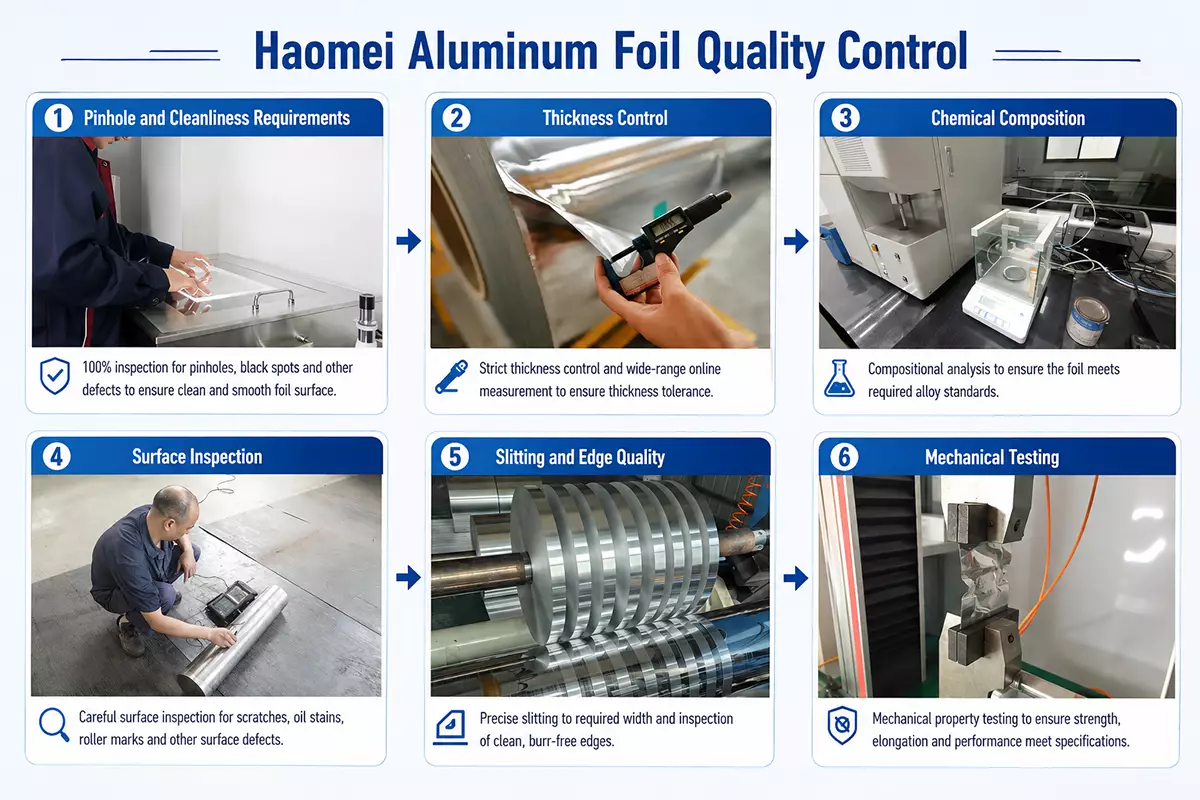
Haomei Aluminum controls 3003 aluminum foil through production and inspection stages covering material composition, dimensions, surface condition and finished coil quality.
Pinhole and Cleanliness Requirements
Where required, pinhole limits, cleanliness, wettability and surface requirements should be defined before production.
Thickness Control
Thickness is checked according to the confirmed order specification. Actual tolerance should be stated in the technical agreement.
Chemical Composition
Alloy composition can be verified through Mill Test Certificate documentation and applicable quality-control procedures.
Surface Inspection
Surface condition can be evaluated for oil, scratches, stains, wrinkles, oxidation marks and processing defects.
Slitting and Edge Quality
Slit width, edge burr, coil winding and edge condition can be controlled according to the intended converting process.
Mechanical Testing
Tensile strength and elongation testing can be arranged according to order requirements and applicable standards.
Coil Traceability
Coil labels may include alloy, temper, thickness, width, net weight, batch number and production information.
Third-Party Inspection
SGS or other third-party inspection can be arranged when specified in the purchase order or contract.
3003 Aluminum Foil Packaging and Delivery
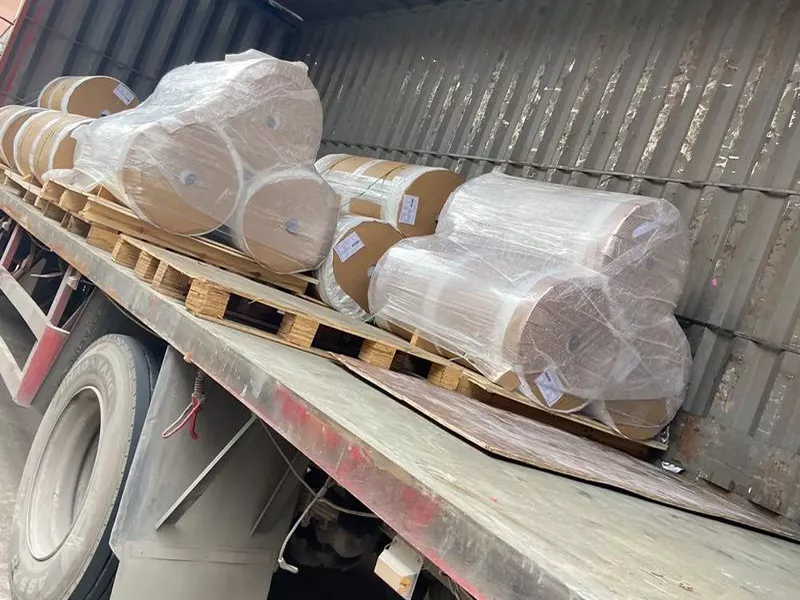
Haomei uses export-standard packaging solutions to protect 3003 aluminum foil during storage, loading and international transportation.
- Wrapped with moisture-proof paper or protective plastic film
- Packed on wooden pallets or in fumigation-free wooden cases
- Edge protection available to reduce transportation damage
- Coil labels include alloy, temper, thickness, width and batch number
- Container loading arranged according to export requirements
Delivery time is usually based on order quantity, specifications and production schedule. For standard sizes and common tempers, faster delivery can be arranged.
3003 Aluminum Foil Manufacturing Process
Alloy Preparation
Aluminum and alloying additions are prepared according to the required 3003 chemistry and production specification.
Melting & Casting
Molten metal is cast into suitable rolling stock for subsequent homogenization and rolling.
Homogenization
Controlled thermal treatment helps prepare the cast structure for stable downstream rolling performance.
Hot Rolling
The rolling stock is reduced to the required intermediate gauge before cold rolling and foil production.
Cold Rolling
Progressive cold reduction controls thickness, dimensional consistency and the work-hardening condition.
Annealing
Annealing is used as required to achieve the requested temper and processing condition.
Foil Rolling
Final foil rolling establishes the ordered thickness and surface characteristics for converting applications.
Slitting & Rewinding
Jumbo rolls can be slit or rewound to customer-defined widths, coil IDs and handling requirements.
Final Inspection
Finished coils are checked against the order specification before labeling, packaging and dispatch.
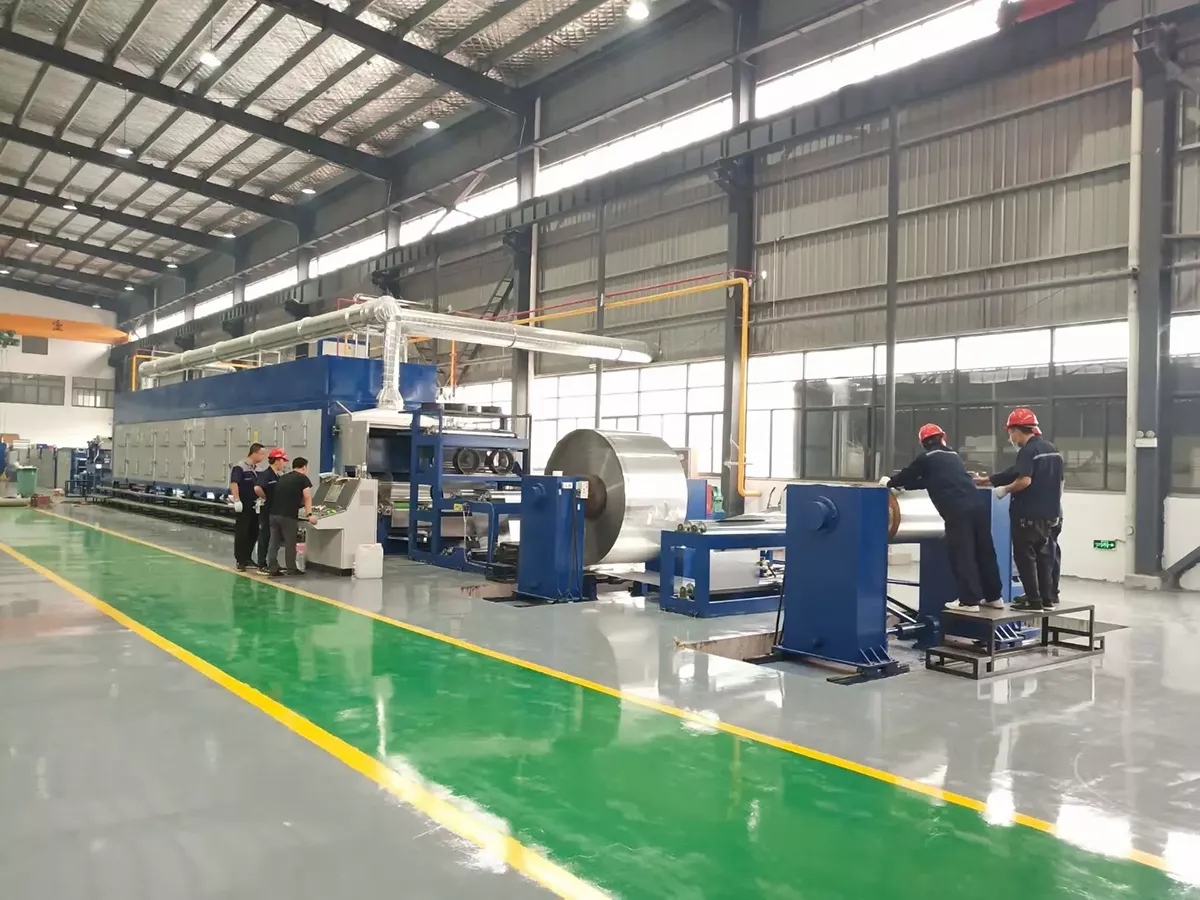
Haomei aluminum foil production, finishing and inspection at Haomei Aluminum.
Why Choose Haomei as Your 3003 Aluminum Foil Supplier?
Reliable factory supply of 3003 aluminum foil with customized specifications, stable quality and export-ready service.
- Professional Production Experience Extensive aluminum foil manufacturing and processing experience for industrial applications.
- Customized Specifications Custom thickness, width, temper and coil weight according to project requirements.
- Strict Quality Control Full inspection from raw materials to finished coils ensures stable performance.
- Surface & Thickness Control Precise tolerance control and surface inspection guarantee consistent quality.
- Export Packaging Moisture-proof and reinforced packaging suitable for long-distance shipping.
- Inspection & Certificates Mill test certificates and third-party inspection available upon request.
- Competitive Factory Price Direct manufacturer pricing for bulk orders and long-term cooperation.
- Fast Response Service Quick quotation, technical support and sample service for global customers.
3003 Aluminum Foil vs 8011, 8006 and 1060 Aluminum Foil
| Alloy | Main Alloy System | Relative Strength | Typical Applications | When to Consider It |
| 3003 Aluminum Foil | Al-Mn | Medium | Food trays, insulation, honeycomb core, industrial foil, HVAC-related components | When improved rigidity and strength over 1xxx foil are required while retaining good workability. |
| 8011 Aluminum Foil | Al-Fe-Si | Low to Medium | Household foil, pharmaceutical packaging, foil, flexible packaging and laminates | When packaging performance, market availability, folding behavior and common foil applications are priorities. |
| 8006 Aluminum Foil | Al-Fe-Mn | Medium to High | Rigid food containers, airline trays, heavy-duty foil containers and formed products | When stronger formed-performance or deeper drawing capability is required. |
| 1060 Aluminum Foil | High-Purity Aluminum | Low | Flexible foil, reflective products, conductive applications and general lamination | When softness, conductivity, reflectivity or cost efficiency is more important than strength. |
| 1050 Aluminum Foil | High-Purity Aluminum | Low | General packaging, lamination, conductive and reflective applications | When high aluminum purity and easy processing are preferred. |
| 1100 Aluminum Foil | Commercially Pure Aluminum | Low | General industrial foil, thermal and chemical-related applications | When good corrosion resistance and workability are required with lower strength demand. |
Related Aluminum Foil Grades
Haomei also supplies other aluminum foil alloys for flexible packaging, pharmaceutical applications, food containers, insulation, battery-related materials and general industrial processing.
8011 Aluminum Foil
Commonly evaluated for household foil, flexible packaging, pharmaceutical-related packaging, foil and laminated materials.
8006 Aluminum Foil
Often considered for rigid food containers, airline trays and applications requiring stronger formed-performance.
8021 Aluminum Foil
Used in selected high-barrier packaging, pharmaceutical packaging and industrial foil applications.
8079 Aluminum Foil
Suitable for flexible packaging, laminated packaging structures and applications requiring controlled foil performance.
1235 Aluminum Foil
A commonly used foil grade for flexible packaging, cable wrapping, lamination and general foil conversion.
1050 Aluminum Foil
High-purity aluminum foil for applications where conductivity, reflectivity, softness and corrosion resistance are important.
1060 Aluminum Foil
Suitable for flexible foil, insulation, lamination, conductive applications and projects requiring relatively soft aluminum foil.
1100 Aluminum Foil
Commercially pure aluminum foil used for general industrial processing, thermal applications and corrosion-resistant foil products.
FAQs about 3003 Aluminum Foil
What is 3003 aluminum foil?
3003 aluminum foil is an aluminum-manganese alloy foil with good corrosion resistance, formability and moderate strength. It is commonly used in food containers, honeycomb core, heat exchangers, insulation and industrial packaging.
What is the difference between 3003 and 8011 aluminum foil?
3003 aluminum foil has higher strength and better formability due to its manganese content. 8011 aluminum foil is more commonly used for flexible packaging, household foil and pharmaceutical packaging. The best choice depends on the application requirements.
Can 3003 aluminum foil be used for food containers?
Yes. 3003 aluminum foil is widely used for food containers, trays and formed packaging products because of its excellent forming performance and corrosion resistance.
What tempers are available for 3003 aluminum foil?
Common tempers include O, H14, H16, H18, H22 and H24. Each temper offers different combinations of strength, hardness and formability to meet various application needs.
Can you customize the thickness and width?
Yes. HM can supply customized 3003 aluminum foil including thickness, width, coil inner diameter, coil weight and surface finish according to customer requirements.
How can I get a quotation for 3003 aluminum foil?
Please send your required alloy, temper, thickness, width, quantity, application and destination port. Haomei will provide a quotation based on your specifications.
Further reading
- 3003 Aluminum Coil
- 3003 Aluminum Plate and Sheet
- 3003 h14 aluminum sheet
- 3003 h22 aluminum sheet
- 3003 o aluminum sheet
- 3003 Aluminum Disc Circle
- 3003 H14 Aluminum Coil
- 3003 Aluminum Strip
Users viewing this material also viewed the following
- Aluminum Tread Plate 3003
- 3003 Embossed Aluminum Sheet
- 3003 Aluminum Diamond Plate
- 3003 Hot-rolled Aluminum Plate
- 3003 Honeycomb Aluminum
- 3003 Aluminum Plate for New Energy Automobile Lithium Battery Power Battery Shell
- 3003+4343 Power Battery Cooling Plate
- 3003 Aluminum Plate for Brazing Water Cooling Plate
- Aluminum Brazing Composite Material 3003+4045 Aluminum Plate
- 3003 Aluminum Disc for Non-stick Pan
- 3003 Aluminum Plate for Mobile Phone Battery Shell
- 3003 Corrugated Aluminum Sheet
- 3003 Aluminum Plate for Automobile Fender
- 3003 Checker Aluminum Plate for Stair Anti-slip
- 3003 Tread Aluminum Plate for Cold Storage Floor Anti-slip
- 3003 Ultra-wide Curtain Wall Aluminum Plate
- 3003 Aluminum Plate for Building Decoration
- 3003 Roof Aluminum Plate for Decoration
- 3003 Aluminum Sheet Coil for Thermal Insulation Material
- 3003 Pre-painted Aluminum Coil
Recommended Content
- What Is the Difference Between 1100 and 3003 Aluminum?
- Aluminium 3003 H14 Data Sheet
- What is 3003 aluminum used for?
- 3003 Aluminum Tubing
- 3003 Aluminum vs. 3005 Aluminum
- 3003-H18 Aluminum vs. 3005-H18 Aluminum
- What is the difference between 3003 H14 and 3105 H14?
- 3003 Aluminum vs. 3104 Aluminum
- 3003-H18 Aluminum vs. 3004-H18 Aluminum
- 3003-O Aluminum vs. 3004-O Aluminum
- What is the difference between 3003 and 3004 aluminum?
- 3003-H22 Aluminum vs. 3003-H24 Aluminum
- What is the difference between 3003 O and 3003 H14?
- What is the difference between 3003 H14 and H24?