
1100 Aluminum Foil
1100 aluminum foil is commercially pure aluminum foil with a minimum aluminum content of 99.0%. It is valued for excellent formability, corrosion resistance, thermal conductivity and electrical conductivity. Available in O, H12, H14, H16 and H18 tempers, 1100 foil is widely used for capacitor components, heat-transfer products, laminated packaging structures, insulation, decoration and general industrial fabrication.
Haomei Aluminum supplies customized 1100 aluminum foil coils based on required thickness, width, temper, coil weight, core size, surface quality and export packaging requirements.
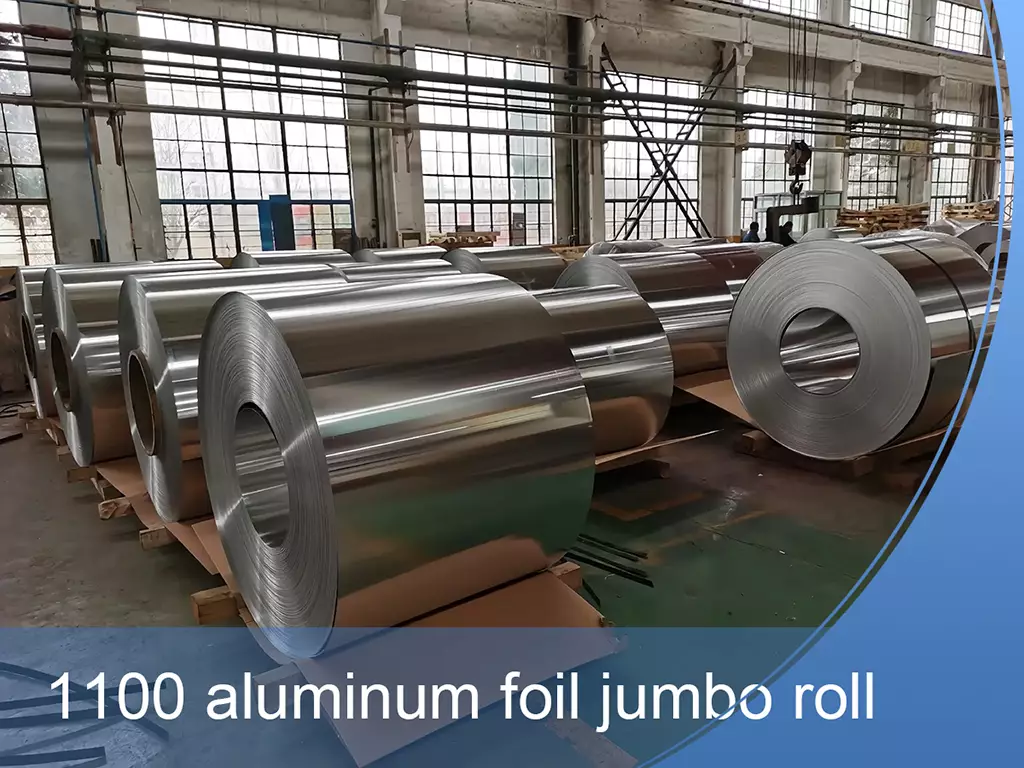
1100 aluminum foil jumbo roll produced and prepared for industrial processing at Haomei Aluminum.
What Is 1100 Aluminum Foil?
1100 aluminum foil is produced from AA 1100, a commercially pure aluminum alloy belonging to the 1xxx series. The alloy is non-heat-treatable, so its mechanical properties are adjusted mainly through cold working and annealing rather than precipitation heat treatment. W hen the foil will be stamped, embossed, folded, laminated, deep drawn or converted into finished products.
Its main advantages are high ductility, good corrosion resistance, good thermal conductivity, useful electrical conductivity and straightforward processing. These characteristics make 1100 a practical choice when a foil needs to be formed, folded, stamped, slit or handled repeatedly without requiring high structural strength.
The correct 1100 foil specification depends on the final application. Soft O temper is generally selected for demanding forming operations, while H12, H14, H16 and H18 are considered when higher hardness or stiffness is preferred.
Material selection should be based on application requirements, not simply alloy designation. For deeper forming, a softer temper may be preferable. Where better handling strength or dimensional stability is required, a harder temper may provide a better fit.
1100 Aluminum Foil Specifications
Haomei Aluminum can supply 1100 aluminum foil in jumbo rolls, slit coils, small rolls or cut sheets. The final supply range depends on production requirements, end-use application, order quantity and quality standards.
| Item | Available Range / Option |
| Alloy | AA 1100 / Aluminum Alloy 1100 |
| Aluminum Content | Minimum 99.0% |
| Temper | O, H12, H14, H16, H18 |
| Thickness | Typically 0.006 mm–0.20 mm |
| Width | Custom slit width available |
| Supply Form | Jumbo roll, slit coil, small roll or sheet |
| Surface | Mill finish / bright / matte / application-specific finish |
| Coil Core | Paper core or aluminum core |
| Processing | Slitting / rewinding / customized processing |
| Documentation | MTC, packing list, commercial invoice, certificate support |
Final thickness tolerance, width tolerance, pinhole requirement, oil residue, mechanical properties, coil weight and applicable standards should be confirmed before production. This is particularly important for capacitor foil, precision converting, food-contact packaging structures and heat-transfer applications.
Chemical Composition of 1100 Aluminium Foil
| Alloy | Si+Fe | Cu | Mn | Mg | Cr | Zn | Ti | Others | Al | |
| Individual | Total | |||||||||
| 1100 | 0.95 | 0.05-0.2 | 0.05 | - | - | 0.1 | - | 0.05 | 0.15 | 99 |
Mechanical Properties of 1100 Aluminium Foil
| Alloy | Temper | Thickness(mm) | Tensile Strength(Mpa) | Yield Strength(Mpa) | Elongation(%) | Cupping test value I.E/mm |
| 1100 | O | 0.08-0.10 | 80-110 | ≥50 | ≥18 | ≥6.0 |
| 0.10-0.20 | 80-110 | ≥50 | ≥20 | ≥6.5 | ||
| H22 | 0.08-0.10 | 100-130 | ≥60 | ≥18 | ≥5.5 | |
| 0.10-0.20 | 100-130 | ≥60 | ≥20 | ≥6.0 | ||
| H24 | 0.08-0.10 | 115-145 | ≥70 | ≥15 | ≥5.0 | |
| 0.10-0.20 | 115-145 | ≥70 | ≥18 | ≥5.5 | ||
| H26 | 0.08-0.10 | 130-160 | ≥90 | ≥8 | ≥4.0 | |
| 0.10-0.20 | 130-160 | ≥90 | ≥10 | ≥4.5 | ||
| H18 | 0.08-0.20 | ≥160 | - | ≥1 | - |
How to Choose the Right 1100 Aluminum Foil Temper
O Temper 1100 Aluminum Foil
O temper is fully annealed and offers the highest ductility among the common 1100 foil tempers. It is usually selected for embossing, folding, deep drawing, shaping, decorative processing and applications where the material must conform to complex shapes without cracking.
H12 and H14 Temper 1100 Aluminum Foil
H12 and H14 tempers provide a balance between workability and strength. They are suitable for general industrial converting, insulation, laminated structures, decorative components and applications that require more stiffness than O temper.
H16 and H18 Temper 1100 Aluminum Foil
H16 and H18 are harder tempers produced through cold working. They provide improved stiffness and shape retention, but with reduced elongation. H18 foil may be selected for products requiring a harder foil condition, such as certain stamping, rigid converting and capacitor-related applications.
| End Use Requirement | Suggested Temper | Reason for Selection |
| Deep drawing and complex forming | O | Maximum ductility and better resistance to cracking during forming. |
| Embossing and decorative shaping | O or H12 | Good forming behavior with adequate handling performance. |
| General industrial conversion | H12 or H14 | Balanced workability and stiffness. |
| Insulation and shape-retaining products | H14 or H16 | Improved rigidity compared with soft foil. |
| Higher stiffness or rigid stamping requirement | H18 | Higher cold-worked strength with lower elongation. |
1100 Aluminum Foil Material Properties
The main advantages of 1100 aluminum foil are its ductility, corrosion resistance, conductivity and ease of fabrication. It can be processed by bending, embossing, spinning, folding, laminating, stamping and selected deep-drawing operations, especially when supplied in annealed O temper.
Excellent Formability
O temper 1100 aluminum foil is easy to bend, fold, emboss and shape. It is suitable for applications requiring smooth forming performance.
Good Corrosion Resistance
The naturally formed aluminum oxide layer provides good corrosion resistance under normal atmospheric and many industrial conditions.
Thermal Conductivity
1100 foil is useful in selected heat-transfer, insulation and thermal-management applications where lightweight and formability are required.
Electrical Conductivity
The alloy offers good electrical conductivity and can be considered for selected electrical, capacitor and shielding applications.
Decorative Surface
Its clean metallic appearance makes 1100 foil suitable for decorative products, reflectors, labels, tags and embossed materials.
Recyclable Material
Aluminum is widely recyclable and can support material-efficiency objectives in packaging, converting and industrial manufacturing.
Typical Applications of 1100 Aluminum Foil
- Capacitor and Electrical Applications For selected capacitor, electrical and shielding applications.
- Heat Exchangers and Thermal Management For fins, heat-transfer components and thermal-management parts.
- Packaging and Laminated Materials For packaging, barrier layers, lidding and laminated materials.
- Chemical and Industrial Processing For industrial parts, containers and selected processing components.
- Insulation and Composite Materials For insulation, protective wraps and composite materials.
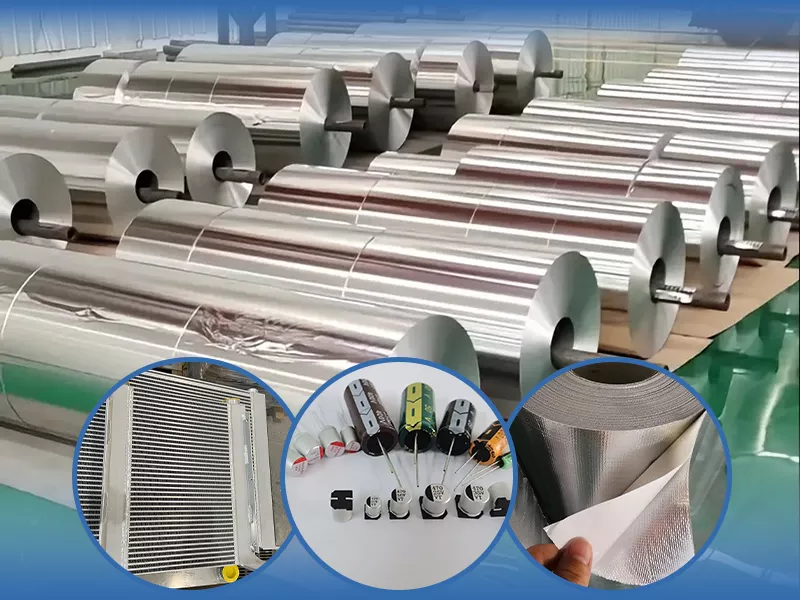
Capacitor Components
1100 aluminum can be used in selected electrolytic capacitor component applications. The actual foil grade, surface condition, thickness and temper should be matched to the capacitor design and production process.
For electrical applications where conductivity is a major priority, 1060 Aluminum Foil may also be evaluated.
Heat Exchanger Fins
1100 aluminum foil can be used for heat-transfer components where good thermal conductivity, corrosion resistance and forming capability are required.
For designs requiring higher strength or greater resistance to handling deformation, 3003 Aluminum Foil may be considered as an alternative.
Insulation, Decorative and Industrial Products
The low density, corrosion resistance and ease of forming of 1100 make it suitable for selected insulation laminates, decorative products, reflectors, labels, trims and industrial components.
Packaging and Lidding
Aluminum foil provides an effective barrier against moisture, light and gases when used in an appropriate packaging structure.
The final food-contact or pharmaceutical packaging system must comply with the applicable regulations, coatings, adhesives and processing requirements.
For packaging applications where alloy selection is driven by sealing, forming or strength requirements, customers may also compare 8011 Aluminum Foil, 8021 Aluminum Foil and 8079 Aluminum Foil.
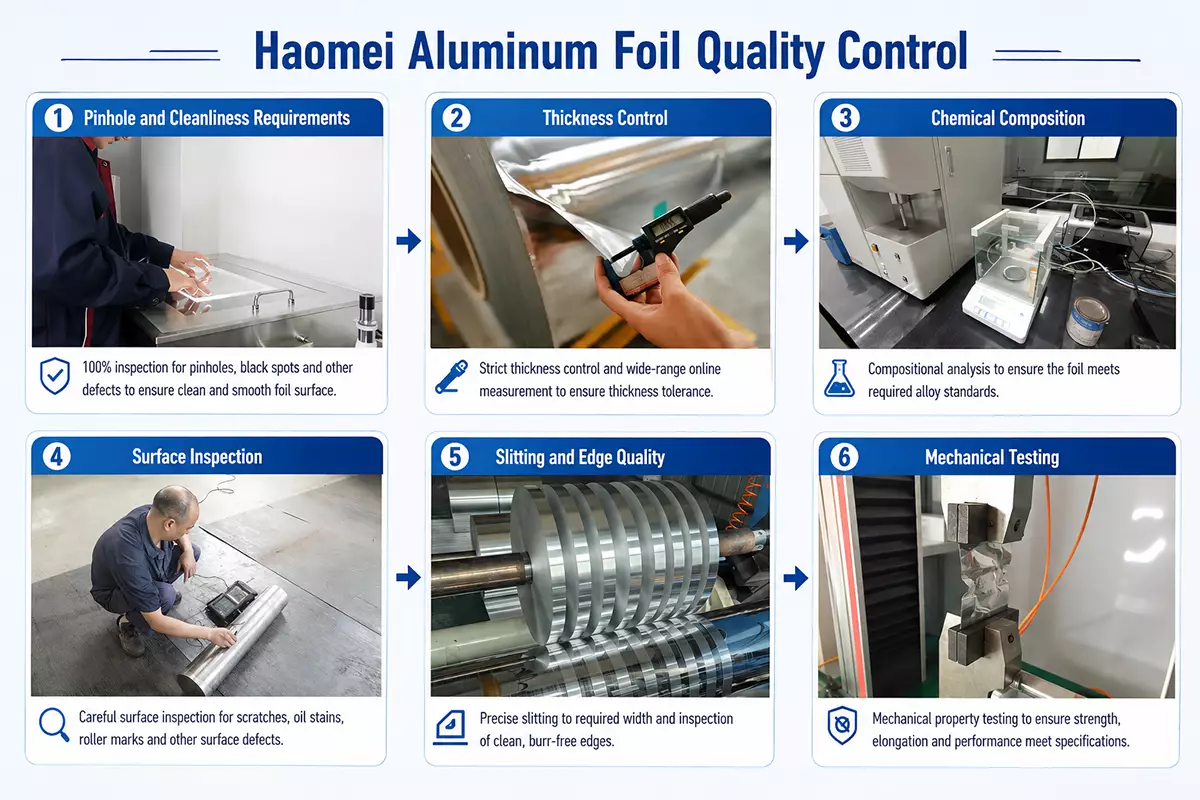
1100 Aluminum Foil Quality Control
- Chemical Verification Verify alloy chemistry against the applicable specification and material documentation.
- Thickness Inspection Check foil thickness and consistency across the required measuring locations.
- Surface Inspection Inspect for visible surface defects, contamination, scratches and other agreed quality requirements.
- Physical Testing Where required, test tensile strength, elongation and other specified properties according to the governing standard.
- Coil & Packing Check Confirm coil weight, core dimensions, winding condition, labels and export packaging before shipment.
1100 Aluminum Foil Packaging and Delivery
1100 aluminum foil is packaged according to the product dimensions, coil requirements and shipping conditions. Haomei uses protective materials to help reduce moisture exposure, surface damage and handling risks during storage, loading and international transport.
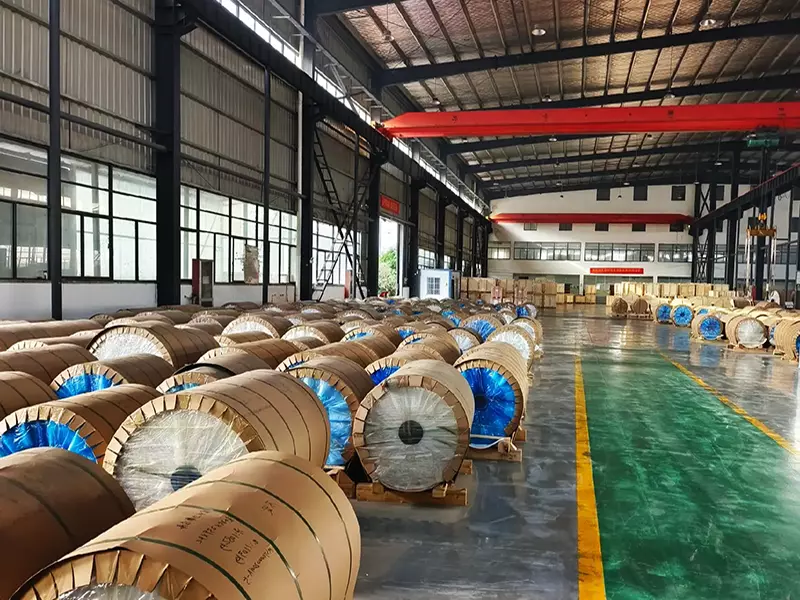
- Moisture Protection: Moisture-resistant paper, film or other protective materials are used according to the shipping environment and customer requirements.
- Coil Protection: Aluminum foil coils are secured with suitable inner and outer protection to help minimize scratches, deformation and handling damage.
- Wooden Pallet Support: Wooden pallets or other agreed support systems can be provided according to coil size, weight and transportation requirements.
- Export Identification: Package labels can include alloy, temper, dimensions, coil number, weight and other information required by the customer.
- Loading and Unloading Protection: Packaging and securing methods are selected to support safer forklift, crane and handling during shipment.
Packaging details can be adjusted for loading, long-distance ocean freight and customer-specific handling or labeling requirements.
1100 Aluminum Foil Price
The price of 1100 aluminum foil depends on several factors rather than a single fixed market number. The main cost variables are aluminum market conditions, foil thickness, width, temper, order quantity, processing requirements, packaging and delivery destination.
To request a quotation for 1100 aluminum foil for sale, provide the alloy, temper, thickness, width, quantity, application and destination.
Get 1100 Aluminum Foil Price1100 vs 1050 vs 1060 vs 1235 Aluminum Foil
No aluminum foil grade is universally "better". The correct choice depends on purity, conductivity, strength, formability, application and cost.
| Alloy | Main Strength | Common Selection Reason |
| 1100 | Formability, corrosion resistance and balanced properties | General industrial foil and applications where easy forming is more important than high strength |
| 1050 | High aluminum purity and conductivity | Applications prioritizing purity and electrical or thermal conductivity |
| 1060 | High purity and conductivity | Electrical and thermal applications where conductivity is a key factor |
| 1235 | High purity and established foil processing characteristics | Packaging and selected electrical or industrial foil uses |
For lithium-ion battery current collector applications, application-specific battery foil grades such as 1050, 1060, 1070 or 1235 may be more appropriate depending on the electrode design and required properties. Select the alloy based on the actual technical specification rather than application name alone.
1100 Aluminum Foil Manufacturer and Supplier
Haomei Aluminum supplies 1100 aluminum foil in jumbo rolls and slit rolls for industrial, packaging, electrical, thermal and general fabrication applications. Material can be produced to the required thickness, width, temper, winding direction and packaging specification, with inspection and quality documents provided according to the order.
1100 Aluminum Foil Supply Options
- Jumbo rolls for converting and further processing
- Slit rolls in specified widths
- O, H12, H14, H16, H18, H22 and H24 tempers
- Custom thickness and width within production capability
- Coil winding and inner diameter requirements
- Export packaging for containerized and international shipments
- Mill test certificates and inspection documents when required
1100 Aluminum Foil RFQ
- Temper: O, H12, H14, H16, H18, H22 or H24
- Thickness: required foil thickness and tolerance
- Width: finished width or slit width
- Quantity: required order volume or estimated annual demand
- Delivery: destination port, country or delivery location
FAQ – 1100 Aluminum Foil
What is 1100 aluminum foil?
1100 aluminum foil is made from AA 1100, a commercially pure aluminum alloy containing at least 99.00% aluminum under the applicable alloy specification. It offers good formability, corrosion resistance, and useful thermal and electrical conductivity for a range of industrial applications.
What thicknesses are available for 1100 aluminum foil?
A typical planning range is approximately 0.006–0.20 mm, although the actual available thickness depends on temper, width, tolerance, production capability, and order quantity. The exact thickness and tolerance should be confirmed before ordering.
What is the difference between O and H18 1100 aluminum foil?
O temper is annealed and provides high ductility for forming and bending. H18 is a full-hard temper with higher hardness and strength but lower elongation. The appropriate temper depends on the forming process and the performance required in the finished product.
Is 1100 aluminum foil suitable for food packaging?
1100 aluminum foil can be used in suitable food-contact packaging structures when the supplied material, surface condition, coatings, adhesives, processing aids, and finished product meet the applicable requirements of the destination market. Specific compliance requirements should be confirmed before production.
Is 1100 aluminum foil suitable for heat exchangers?
1100 aluminum foil can be considered for heat-transfer components where thermal conductivity, corrosion resistance, and formability are important. For applications that require a higher strength level, 3003 aluminum may provide a more suitable balance of strength and formability.
Is 1100 aluminum foil better than 1060 aluminum foil?
Neither alloy is universally better. 1060 has higher aluminum purity and is often selected when electrical or thermal conductivity is a primary consideration, while 1100 offers a practical combination of purity, formability, corrosion resistance, and general-purpose performance.
Can 1100 aluminum foil be slit to custom widths?
Custom slitting can be available depending on the foil thickness, finished width, tolerance, coil specification, and processing equipment. When requesting a quotation, provide the required slit width and tolerance so the production configuration can be confirmed.
How is 1100 aluminum foil priced?
The price of 1100 aluminum foil depends on aluminum market conditions, thickness, width, temper, order quantity, processing requirements, packaging, and destination. A quotation based on the complete specification is more reliable than a generic price per kilogram or ton.
What information is needed for a 1100 aluminum foil quotation?
Please provide the alloy, temper, thickness, width, quantity, end application, delivery destination, and any required standards or inspection documents. For slit rolls, also include the core ID, coil dimensions, winding requirements, and finished slit width where applicable.
Which 1100 aluminum foil temper is best for deep drawing and embossing?
O temper is generally preferred for deep drawing, bending, embossing, folding, and other operations that require high ductility. Where additional stiffness is needed, H12 or H14 may be considered depending on the forming process and finished-product requirements.
Does Haomei Aluminum provide 1100 aluminum foil samples?
Sample availability depends on the required alloy, temper, thickness, width, and stock condition. Customers can provide their target specification to confirm available sample sizes, preparation requirements, and delivery arrangements.
Related Aluminum Foil Products
Different aluminum foil alloys are selected according to the required combination of strength, formability, conductivity, barrier performance and end-use requirements.
Further reading
- 1100 Aluminum Plate Sheet
- 1100 0 aluminum sheet
- 1100 h14 aluminum sheet
- 1100 h18 aluminum sheet
- 1100 h12 aluminum sheet plate
- 1100 H16 Aluminum
- 1100 H22 Aluminum
- 1100 H24 Aluminum
- 1100 H26 Aluminum
- 1100 H28 Aluminum
- 1100 Aluminum Coil
- 1100 Aluminum Disc Circle
Users viewing this material also viewed the following
- 1100 Embossed Aluminum Sheet
- Hemispherical embossed aluminum sheet coil 1050 1060 1100 for automotive heat shield
- 1100 Aluminum Sheet for PCB (Printed Circuit Board)
- 1100 Aluminum Plate for Heat Sink Applications
- 1100 Aluminum Plate for Printing Plates
- 1100 Aluminum Plate for Building Exterior Cladding
- 1100 Aluminum Veneer Panel
- 1100 Aluminum Plate for Stair Handrails
- 1100 Aluminum Plate for Pressure Tanks
- 1100 H16 Aluminum Sheet Roll for Refrigerator Linings
- 1100 O/H14 Aerospace Aluminum Sheet and Plate
- 1100 Aluminum Plate for New Energy Charging Stations
- 1100 Embossed Aluminum Sheet for Automotive Heat Shield
- 1100 Aluminum Plate for Aluminum Composite Panels
- 1100 Corrugated Aluminum Sheet
- 1100 Color Coated Aluminum Sheet
Recommended Content
- What Is the Difference Between 1100 and 3003 Aluminum?
- 1100 vs. 1050 Aluminium Which Alloy is Right for Your Project?
- 1100-H14 Aluminum vs. 1100-H24 Aluminum
- 1100-H14 Aluminum vs. 1100-H16 Aluminum
- 1100-H14 Aluminum vs. 1100-H18 Aluminum
- 1100-H12 Aluminum vs. 1100-H14 Aluminum
- 1100-H14 Aluminum vs. 1100-O Aluminum
- 1060-O Aluminum vs. 1100-H14 Aluminum: A Comparative Analysis
- 1060 Aluminum vs. 1100-H14 Aluminum: Key Differences
- Comparison of 1060-H28 Aluminum vs. 1100-H28 Aluminum