
3003+4343 Power Battery Cooling Plate is an important material solution for liquid cooling plates used in new energy vehicle power batteries and energy storage battery systems. Haomei Aluminum uses a composite structure of 3003 aluminum alloy core material + 4343 aluminum alloy brazing cladding, providing battery cooling plate manufacturers with aluminum sheets that combine high strength, excellent thermal conductivity, good formability, and reliable brazing sealing performance.
In EV battery packs and ESS energy storage systems, cell operating temperature directly affects charging and discharging efficiency, cycle life, and overall safety performance. Liquid cooling plates manufactured from 3003+4343 brazed aluminum composite sheets can quickly remove heat generated by battery cells through internal cooling channels, helping maintain a more stable operating temperature range.
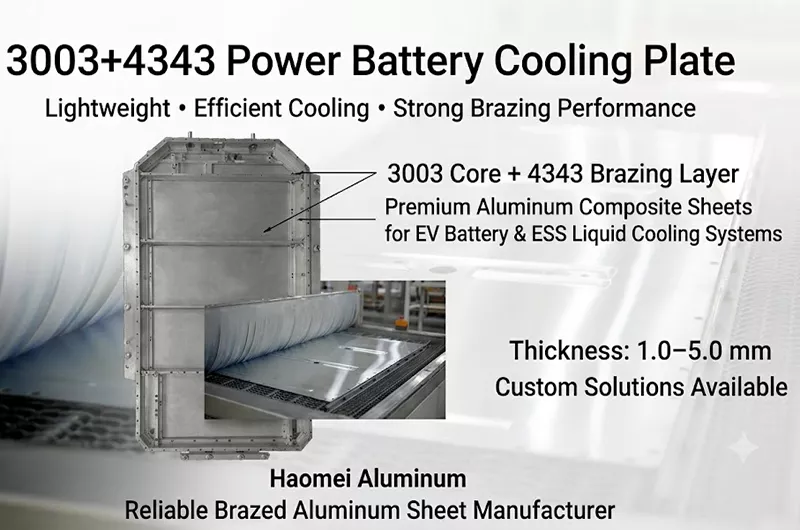
Haomei Aluminum supplies 3003+4343 brazed aluminum composite sheets for liquid cooling plates used in electric vehicle power batteries and energy storage systems. The 3003 aluminum alloy core provides structural strength, excellent formability, and corrosion resistance, while the 4343 aluminum alloy cladding melts during the high-temperature brazing process to achieve reliable sealing and connection of internal cooling channels.
Common Thickness Options for 3003+4343 Brazing Aluminum Sheet
Haomei Aluminum supplies 3003+4343 clad aluminum sheets in a wide range of thicknesses to meet the structural and thermal requirements of automotive battery cooling plates and energy storage cooling systems. The overall thickness can be customized based on cooling channel design, forming method, and brazing process requirements.
| Total Thickness | Typical Applications |
| 1.0–1.5 mm | Lightweight EV battery module cooling plates, compact liquid cooling channels, and applications requiring reduced weight |
| 1.5–2.5 mm | Standard power battery liquid cooling plates, battery module cooling structures, and mass-production automotive applications |
| 2.5–4.0 mm | Large-size cooling plates, high-strength structures, and components requiring deeper stamping performance |
| 4.0–5.0 mm | Energy storage systems, large battery packs, and heavy-duty cooling components with higher mechanical requirements |
In addition to thickness, selecting the right 3003+4343 brazing aluminum sheet requires consideration of several key factors, including:
- Cladding structure, including single-side or double-side 4343 aluminum cladding;
- 4343 brazing layer thickness ratio and bonding performance;
- Sheet or coil supply format, width, length, and production requirements;
- Aluminum temper selection, such as O temper or customized conditions for forming processes;
- Cooling channel design, stamping depth, corner radius, and forming capability;
- Brazing furnace type, temperature range, and production process requirements;
- Coolant type, operating pressure, corrosion resistance, and long-term service conditions.
For battery cooling plate manufacturers developing new liquid cooling structures, Haomei Aluminum provides customized material recommendations based on alloy combination, cladding ratio, thickness tolerance, and brazing requirements. You can also refer to our 3003 Aluminum Sheet solutions and 4343 brazing aluminum applications for more information about suitable aluminum materials.
What Is 3003+4343 Power Battery Cooling Plate?
3003+4343 Power Battery Cooling Plate is a brazing aluminum composite material specially developed for electric vehicle battery thermal management systems and energy storage cooling applications. It consists of a 3003 aluminum alloy core layer combined with a single-side or double-side 4343 aluminum brazing alloy cladding layer. Through advanced roll bonding technology, the two aluminum alloys are integrated to provide a reliable material solution for manufacturing liquid cooling plates.
During the production of battery cooling plates, the 3003 aluminum core provides structural strength, corrosion resistance, and excellent forming performance required for stamping and channel forming processes. The 4343 brazing layer acts as a filler metal during high-temperature brazing, melting and bonding the cooling plate components together to create sealed and durable internal cooling channels.
With a combination of lightweight design, good thermal conductivity, corrosion resistance, and stable brazing performance, 3003+4343 brazing aluminum sheet is widely used for advanced battery cooling solutions, including:
- Liquid cooling plates for new energy vehicle (NEV) power battery packs;
- Battery thermal management systems for commercial vehicles and heavy-duty trucks;
- Liquid cooling modules for energy storage cabinets and containerized ESS systems;
- Battery cooling components for forklifts, construction machinery, and specialty vehicles;
- Cooling structures for prismatic cells, pouch cells, and battery modules.
As a key material for battery thermal management systems, 3003+4343 composite aluminum sheet helps manufacturers achieve lightweight battery structures while maintaining reliable heat dissipation and long-term sealing performance. It is widely selected by battery cooling plate manufacturers for electric vehicles and energy storage applications.
Material Structure of 3003+4343 Brazing Aluminum Composite Plate
The 3003+4343 brazing aluminum composite plate is designed for high-performance thermal management applications, especially in power battery cooling plates and energy storage cooling systems. It combines a strong 3003 aluminum alloy core with a 4343 aluminum brazing layer, creating a lightweight structure that offers reliable forming performance, efficient heat transfer, and secure brazed joints.
3003 Aluminum Core
Provides the main structural support with good corrosion resistance, formability, and mechanical stability for complex cooling channel designs.
4343 Brazing Layer
Acts as a low-melting filler alloy that melts during brazing and creates strong metallurgical bonding between aluminum components.
Cooling Plate Assembly
After stamping, forming, and vacuum brazing, the composite plate becomes a sealed cooling structure for battery thermal management systems.
3003 Aluminum Alloy Core: Strength and Formability for Cooling Plate Manufacturing
3003 aluminum alloy is an Al-Mn series alloy widely used in heat exchangers, automotive components, and liquid cooling applications. It provides a balanced combination of strength, corrosion resistance, thermal conductivity, and manufacturing flexibility.
In a 3003+4343 battery cooling plate, the 3003 core layer is mainly responsible for maintaining the overall structure and supporting the formation of internal coolant channels.
- Provides stable mechanical strength for battery cooling plate structures;
- Offers excellent stamping, deep drawing, and bending performance for complex flow channel designs;
- Helps transfer heat efficiently from battery cells to the cooling medium;
- Reduces overall system weight due to aluminum's lightweight characteristics;
- Maintains reliable corrosion resistance under suitable cooling environments.
With its excellent balance between formability and durability, 3003 aluminum is suitable for large-size cooling plates and designs requiring precise channel forming.
4343 Aluminum Brazing Layer: Ensuring Leak-Free Connections
4343 aluminum alloy is an Al-Si brazing alloy with a lower melting temperature than the 3003 core material. During vacuum brazing or controlled atmosphere brazing, the 4343 layer melts first and flows into the bonding area, forming a strong and continuous connection between aluminum plates.
The 4343 cladding layer plays an important role in the manufacturing process:
- Creates reliable metallurgical bonding during high-temperature brazing;
- Improves sealing performance around cooling channels and connection areas;
- Helps achieve uniform and durable coolant passages;
- Enhances resistance against thermal cycling and pressure fluctuations;
- Reduces the need for additional brazing materials during production.
The thickness ratio of the 4343 brazing layer is typically around 10% of the total composite plate thickness. Customized cladding ratios can be supplied according to cooling plate design, brazing temperature requirements, and customer production standards.
Chemical Composition of Battery Cooling Plate
| Alloy | 3003 | 4343 | 4045 |
| Si | 0.6 | 6.8-8.2 | 9.0-11.0 |
| Fe | 0.7 | 0.8 | 0.8 |
| Cu | 0.05-0.20 | 0.25 | 0.3 |
| Mn | 1.0-1.5 | 0.1 | 0.05 |
| Mg | - | - | 0.05 |
| Cr | - | - | - |
| Ni | - | - | - |
| Zn | 0.1 | 0.2 | 0.1 |
| Ti | - | - | 0.2 |
| Al | Remainder | ||
Mechanical Properties of Battery Cooling Plate
| Material | Condition | Tensile Strength (ksi min) | Yield Strength (ksi min) | Elongation % in 2" 0.064 Sheet |
| Alloy 3003-0 Sheet 0.064" thick | 3003-0 | 14-19 | 5 | 25 |
| Alloy 3003-H12 Sheet 0.064" thick | 3003-H12 | 17-23 | 12 | 6 |
| Alloy 3003-H14 Sheet 0.064" thick | 3003-H14 | 20-26 | 17 | 5 |
| 3003-H16 Sheet 0.064" thick | 3003-H16 | 24-30 | 21 | 4 |
| 3003-Sheet 0.064" thick | 3003-H18 | 27 min | 24 | 4 |
Advantages of 3003+4343 Power Battery Cooling Plates
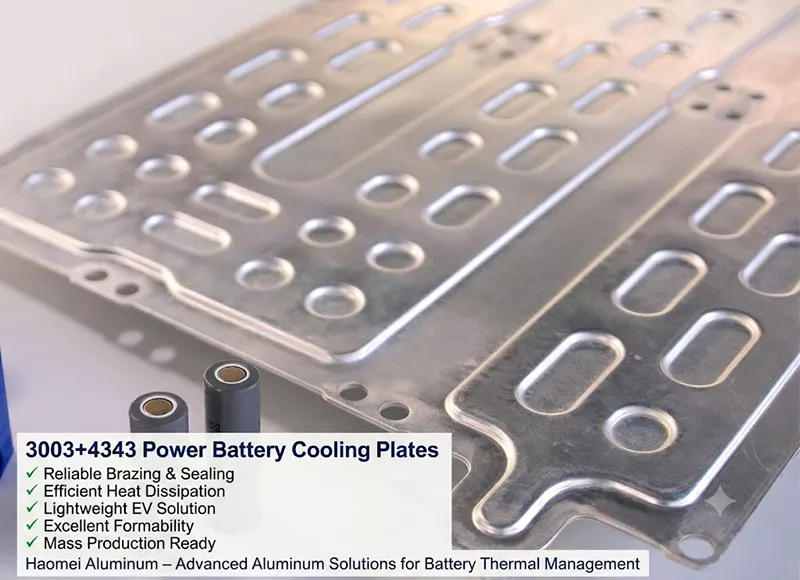
- Highly Reliable Sealing for Liquid Cooling Channels
- Fast Heat Transfer for Improved Battery Thermal Management
- Lightweight Design for New Energy Vehicle Applications
- Excellent Stamping and Processing Adaptability
- Suitable for Mass Brazing Production
Highly Reliable Sealing for Liquid Cooling Channels
Battery liquid cooling plates place extremely high demands on sealing performance. Any coolant leakage may lead to battery pack insulation risks, system failure, or even safety hazards.
After vacuum brazing or controlled-atmosphere brazing, 3003+4343 clad aluminum sheets can form continuous brazed joints, creating a strong seal between stamped flow channel plates. Proper design of channel edges, brazing gaps, and cladding ratios helps improve pressure resistance and leak-proof performance.
Fast Heat Transfer for Improved Battery Thermal Management
Battery cells generate significant thermal loads during fast charging, high-rate discharge, high-temperature operation, and low-temperature preheating. The 3003 aluminum alloy core rapidly transfers heat from the cells to the internal channels of the cooling plate, where it is then carried away by the coolant.
For both prismatic and pouch cell systems, uniform temperature control helps to:
- Reduce temperature differences among cells;
- Improve heat dissipation during fast-charging conditions;
- Lower the likelihood of localized hot spots;
- Enhance battery cycle consistency;
- Extend the service life of power battery systems.
Lightweight Design for New Energy Vehicle Applications
Compared with steel cooling components, aluminum alloy liquid cooling plates offer significant weight reduction advantages. The 3003+4343 Power Battery Cooling Plate can meet structural and thermal management requirements while reducing battery pack weight, thereby supporting lower vehicle energy consumption and extended driving range.
For energy storage systems, lightweight materials also help reduce transportation and installation costs, as well as structural loads on the system.
Excellent Stamping and Processing Adaptability
Complex serpentine channels, parallel channels, zoned channels, and multi-port liquid cooling plates place high demands on material formability. The 3003 core alloy has good ductility and is suitable for stamping, deep drawing, bending, and subsequent assembly processes.
Haomei Aluminum can recommend suitable material tempers and thickness configurations based on customers’ stamping depths, mold designs, and brazing processes, helping reduce issues such as cracking, springback, and localized thinning.
Suitable for Mass Brazing Production
The 4343 cladding layer is integrated onto the surface of the sheet, reducing the need for additional filler metal in conventional manufacturing processes. For large-scale production of power battery liquid cooling plates, clad brazing aluminum sheets are more conducive to improving process consistency and automated manufacturing efficiency.
Manufacturing Process of Power Battery Cooling Plates
- Material Selection Based on the dimensions of the liquid cooling plate, channel depth, operating pressure, brazing method, and coolant requirements, select the appropriate thickness, temper, and cladding structure of the 3003+4343 clad aluminum sheet.
- Stamping and Forming The aluminum sheet is stamped into the designed cooling channels, manifolds, port locations, and sealing edges.
- Cleaning and Assembly Surface oil, contaminants, and impurities are removed to ensure clean brazing areas. The upper and lower plates, connectors, and other components are then accurately positioned and assembled.
- Vacuum Brazing or Controlled-Atmosphere Brazing At the specified process temperature, the 4343 brazing layer melts and fills the joint gaps, forming a stable metallurgical bond.
- Leak-Tightness and Pressure Testing The brazed liquid cooling plate undergoes leak testing, pressure resistance testing, and flow testing to verify the sealing performance and unobstructed flow of the cooling channels.
- Post-Processing and Final Assembly Surface treatment, connector installation, flatness correction, and final assembly are carried out according to application requirements.
Material is the foundation of liquid cooling plate reliability. Selecting stable 3003+4343 clad aluminum sheet helps control quality variations during the stamping and brazing stages.
How to Select the Right 3003+4343 Aluminum Cooling Plate Material?
Choosing the right 3003+4343 composite aluminum sheet for Power Battery Cooling Plates requires more than simply selecting a thickness. Material performance depends on battery design, brazing process, cooling channel structure, operating environment, and long-term reliability requirements. A suitable material solution should provide a balance of thermal conductivity, formability, pressure resistance, and corrosion performance.
Selecting Material Based on Battery Cell Type
Different battery cell structures place different demands on cooling plate materials. The 3003+4343 brazing aluminum sheet can be optimized according to the cooling plate design and heat management requirements.
- Prismatic Cell Cooling Plates: Require excellent temperature uniformity, stable plate flatness, and sufficient mechanical strength to withstand internal coolant pressure across large cooling areas.
- Pouch Cell Cooling Plates: Usually require good surface consistency, lightweight construction, and reliable forming performance to achieve efficient heat transfer with a compact design.
- Cylindrical Cell Cooling Systems: May involve cooling channels, heat transfer plates, or integrated structures, requiring materials with suitable forming characteristics and structural compatibility.
Matching Material with the Brazing Process
The brazing method directly affects the selection of composite aluminum materials. Vacuum brazing, CAB (Controlled Atmosphere Brazing), and other brazing processes require proper matching of the 4343 cladding alloy, cladding thickness ratio, surface condition, and alloy performance.
Before mass production, material verification should be carried out together with the cooling plate manufacturing process to ensure stable brazing quality, strong bonding, and consistent production performance.
Considering Cooling Channel Design Requirements
The design of internal cooling channels plays an important role in material selection. Deep channels, narrow passages, complex bends, and high-pressure structures require aluminum sheets with reliable elongation, forming stability, and mechanical strength.
A thinner sheet can help reduce weight but may affect pressure resistance, while excessive thickness can increase material consumption and make forming more difficult. The optimal 3003+4343 thickness should be selected according to channel geometry and application conditions.
Evaluating Corrosion Resistance and Operating Conditions
Since battery cooling plates operate in continuous contact with coolant, material selection should consider coolant composition, ion concentration, pH value, temperature cycling, and compatibility with other metals in the battery cooling system.
For applications requiring enhanced corrosion resistance and long service life, Haomei Aluminum can provide customized recommendations for composite structure design, alloy selection, and surface treatment solutions based on specific project requirements.
Why Choose Haomei Aluminum?
Haomei Aluminum specializes in the supply of industrial aluminum sheets, aluminum coils, and aluminum alloy composite materials. We provide 3003+4343 brazing composite aluminum sheet solutions for customers in power battery thermal management, automotive heat exchangers, and energy storage liquid cooling systems.
Material Support for Liquid Cooling Plate Applications
We not only supply 3003+4343 clad aluminum sheets, but also focus on customers' actual manufacturing requirements, including stamping, brazing, sealing, and pressure resistance. Based on different cooling plate designs, we can assist in selecting suitable alloy combinations, thickness, cladding ratio, and material temper.
Customizable Specification Options
According to project requirements, Haomei Aluminum can provide customized options including:
- Sheet or coil supply formats;
- Customized thickness and width;
- Single-side or double-side 4343 cladding;
- Customized cladding thickness ratios;
- Material tempers suitable for stamping processes;
- Cut-to-length packaging and export transportation solutions.
Consistent Batch Quality Control
For power battery cooling plate materials, thickness tolerance, cladding bonding quality, flatness, and surface condition can directly affect downstream processing performance. Haomei Aluminum focuses on material consistency to help customers reduce variations during stamping and brazing production.
Serving Global New Energy Vehicle and Energy Storage Markets
From sample evaluation to mass production supply, Haomei Aluminum works closely with customers on material parameter confirmation, packaging solutions, and export delivery arrangements. Whether you are a liquid cooling plate manufacturer, battery pack integrator, thermal management system supplier, or energy storage equipment company, Haomei Aluminum can provide reliable aluminum material support for your projects.
For more information about industrial aluminum alloy applications, please visit Haomei Aluminum Product Center or contact our technical sales team for professional material selection advice.
Request a Quote for 3003+4343 Battery Cooling Plate Material
Haomei Aluminum supplies 3003+4343 brazing aluminum sheet for EV battery cooling plates, energy storage cooling systems, and other thermal management applications. To recommend the right material solution, please share your project requirements with our technical team.
- Required sheet thickness, width, and length;
- Single-side or double-side 4343 cladding structure;
- 4343 brazing layer thickness or cladding ratio;
- Required alloy temper and material specifications;
- Application type, such as EV, PHEV, commercial vehicle, or ESS cooling system;
- Forming process, stamping requirements, and brazing conditions;
- Estimated order quantity and annual demand;
- Packaging, delivery destination, and market requirements.
Ready to Optimize Your Battery Cooling Systems?
Reach out to us today to request a technical data sheet or a sample of our 3003/4343 clad aluminum. Let Haomei Aluminum be your reliable partner in EV innovation.
Request a QuoteBased on your battery thermal management design and manufacturing process, Haomei Aluminum can provide a suitable 3003+4343 aluminum brazing sheet solution with the required strength, formability, corrosion resistance, and brazing performance.
FAQ – 3003+4343 Power Battery Cooling Plate
What do “3003” and “4343” represent in 3003+4343 aluminum composite material?
3003 is the core alloy of the cooling plate, providing structural strength, good formability, and corrosion resistance. 4343 is the brazing cladding alloy on the surface, which melts during high-temperature brazing to bond and seal the cooling plate channels.
Is the 4343 cladding layer always 10% of the total thickness?
Around 10% is a commonly used design reference, but it is not a fixed standard. The actual cladding ratio depends on the brazing process, total material thickness, channel structure, brazing gap, and sealing requirements.
Is 3003+4343 aluminum composite sheet suitable for vacuum brazing?
Yes. 4343 is commonly used as a brazing cladding alloy for vacuum brazing or controlled atmosphere brazing processes. The specific brazing parameters should be verified by the cooling plate manufacturer based on furnace type, heating curve, assembly clearance, and product design.
How is the thickness of a liquid cooling plate material determined?
Common thickness ranges are from 1.0 mm to 5.0 mm. The suitable thickness depends on battery pack space limitations, channel depth, working pressure, plate size, forming process, weight requirements, and pressure resistance performance.
Can Haomei Aluminum provide samples of 3003+4343 composite aluminum sheet?
Yes. Haomei Aluminum can discuss material solutions based on alloy structure, thickness, width, cladding ratio, and expected order quantity. Customers are encouraged to provide cooling plate drawings or key material requirements when making an inquiry so that we can recommend the most suitable solution.