
3003 Aluminum Honeycomb is a lightweight hexagonal honeycomb core material manufactured from 3003 aluminum alloy foil through special stretching and expansion processes. With excellent strength-to-weight ratio, corrosion resistance, thermal conductivity, and processing adaptability, 3003 aluminum honeycomb is widely used in architectural decoration, rail transit, marine interiors, industrial equipment, and composite sandwich panel structures.
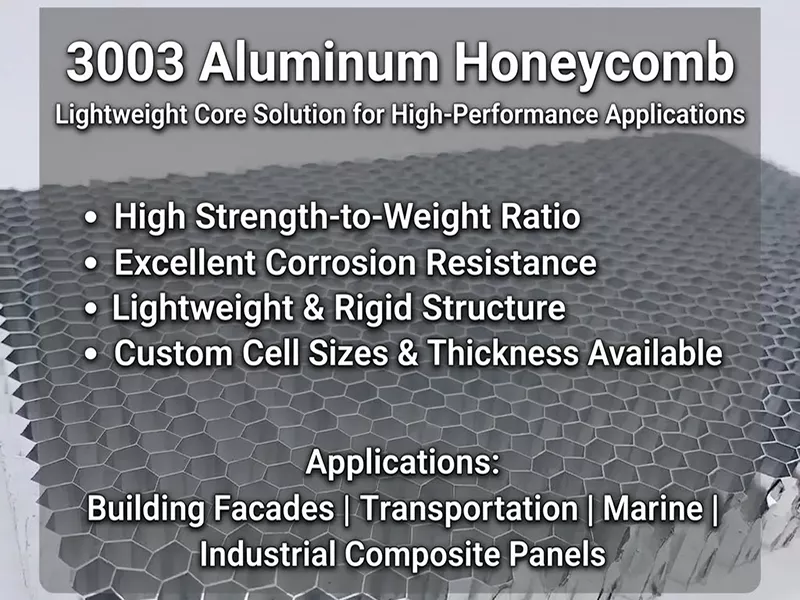
As an aluminum processing and honeycomb material manufacturer, Haomei Aluminum can provide 3003 Aluminum Honeycomb Core with various cell sizes, thicknesses, densities, expanded states, and perforation options. It can also be further processed into 3003 Aluminum Honeycomb Panel solutions suitable for curtain walls, ceilings, partitions, and transportation interior applications.
For more aluminum honeycomb material solutions, please visit our Honeycomb Aluminum Foil and Aluminum Alloy Products catalogs.
What is 3003 Aluminum Honeycomb?
3003 Aluminum Honeycomb is commonly known as 3003 aluminum honeycomb core or 3003 aluminum honeycomb material. Its basic structure is made by bonding, stacking, cutting, and expanding multiple layers of 3003 aluminum foil. After expansion, it forms a regular hexagonal honeycomb cell structure.
3003 aluminum alloy is an Al-Mn series anti-rust aluminum alloy, with aluminum as the main component and approximately 1% manganese content. Compared with pure aluminum honeycomb, 3003 Aluminum Honeycomb offers a more balanced combination of strength, corrosion resistance, and forming stability, making it suitable for a wide range of commercial, architectural, and industrial composite panel applications.
The honeycomb core itself is generally not used as a decorative surface material. Instead, it serves as the supporting core layer in sandwich structures. When combined with aluminum sheets, stainless steel sheets, fiberglass panels, HPL panels, thin stone panels, or other facing materials, it forms a lightweight honeycomb sandwich panel with high stiffness and excellent structural performance.
3003 Honeycomb Aluminum Specifications
| Specification Item | Common Specifications |
| Cell Size | 1/8" (3.175 mm) |
| 3/16" (4.7625 mm) | |
| 1/4" (6.35 mm) | |
| 3/8" (9.525 mm) | |
| 1/2" (12.7 mm) | |
| Foil Thickness | 0.003" (0.076 mm) |
| 0.005" (0.127 mm) | |
| 0.007" (0.178 mm) | |
| 0.010" (0.254 mm) | |
| Panel Size | 4' x 8' (1219 mm x 2438 mm) |
| Customizable Sizes | |
| Panel Thickness | 0.25" (6.35 mm) |
| 0.5" (12.7 mm) | |
| 1" (25.4 mm) | |
| 2" (50.8 mm) | |
| Coating Types | Anodized Coating |
| Polyester Powder Coating | |
| Polyurethane Coating | |
| Perforation Type | Hexagonal Perforation |
| Circular Perforation | |
| Slotted Perforation | |
| Custom Perforation |
3003 Aluminum Honeycomb Core Product Specifications
| Item | Common Specifications |
| Alloy Grade | 3003 Aluminum Alloy |
| Material Temper | H18, H19, etc., specific temper can be confirmed according to project requirements |
| Main Composition | Approximately 98% aluminum and about 1% manganese |
| Honeycomb Shape | Hexagonal cell structure |
| Common Cell Sizes | 1/4", 3/8", 1/2", 3/4", 1" |
| Corresponding Sizes in Millimeters | Approximately 6.35 mm, 9.52 mm, 12.7 mm, 19.05 mm, 25.4 mm |
| Honeycomb Core Thickness | Can be cut and processed according to customer requirements |
| Supply Forms | Unexpanded blocks, expanded sheets, perforated honeycomb core, non-perforated honeycomb core |
| Surface Treatment | Natural finish, corrosion-resistant treatment, or customized according to composite processing requirements |
| Application Methods | Standalone honeycomb core, composite sandwich panels, customized honeycomb structural components |
Cell size, aluminum foil thickness, and honeycomb core height directly affect the material weight, compression performance, shear strength, and overall rigidity of composite panels. For curtain wall or large-size ceiling projects, it is recommended to select the appropriate honeycomb core specifications after confirming the facing panel thickness, panel dimensions, installation method, and design load requirements.
If matching facing panel materials are required, you can also consult our 3003 Aluminum Coil
Features and Advantages of 3003 Aluminum Honeycomb Core
Lightweight Design and High Specific Strength Performance
3003 Aluminum Honeycomb Core adopts a regular hexagonal honeycomb structure, achieving a balance between lightweight design and structural strength through optimized material distribution. Compared with traditional solid aluminum plates, it can effectively reduce structural weight while maintaining good load-bearing capacity and improving overall stiffness.
With high specific strength and excellent bending resistance, 3003 Aluminum Honeycomb Core is widely used in sandwich structures such as architectural decorative panels, rail transit interiors, marine structures, industrial equipment panels, and other applications where weight control is highly required.
Excellent Corrosion Resistance for Long-Term Service Environments
3003 Aluminum Honeycomb Core is manufactured from 3003 aluminum alloy foil. The manganese element in the alloy improves the material's corrosion resistance, enabling it to maintain stable structural performance in general industrial environments, indoor applications, and properly protected outdoor conditions.
For high-humidity environments, coastal salt spray conditions, or special industrial applications, Haomei Aluminum can provide customized recommendations for different aluminum foil conditions, surface treatment methods, edge sealing solutions, and composite processes according to project requirements, meeting long-term service demands under various application conditions.
Excellent Processing Performance and Flexible Customization Options
3003 Aluminum Honeycomb Core offers excellent processing adaptability and can meet production requirements such as stretching and expansion, cutting, splicing, sizing processing, and composite forming. According to customers' structural design requirements, customized solutions are available for different thicknesses, cell sizes, core heights, and overall dimensions.
For irregular structural components, large-size honeycomb core blocks, local reinforcement areas, and special installation positions, 3003 Aluminum Honeycomb Core can also provide flexible processing options.
Good Thermal Conductivity for Thermal Management Applications
Aluminum alloy materials have good thermal conductivity. 3003 Aluminum Honeycomb Core offers application advantages in structural designs that require both weight control and heat transfer performance.
This material can be used in some industrial equipment platforms, auxiliary heat dissipation structures, precision equipment support components, and composite panel systems requiring temperature balance. In practical applications, thermal performance is affected by factors such as honeycomb cell size, facing materials, and overall structural design.
Perforated and Non-Perforated Structures Available for Different Composite Processes
According to the production methods of honeycomb sandwich panels and final application requirements, 3003 Aluminum Honeycomb Core is available in both perforated and non-perforated structures.
- Perforated 3003 Aluminum Honeycomb Core: Suitable for composite processes requiring air release, pressure balance, or improved adhesive flow performance, commonly used in vacuum lamination and some special sandwich panel manufacturing processes.
- Non-Perforated 3003 Aluminum Honeycomb Core: Suitable for applications requiring high sealing performance, surface flatness, and structural stability.
Haomei Aluminum can recommend suitable honeycomb core solutions based on customers' facing materials, adhesive systems, production equipment, and final application environments.
What is 3003 Aluminum Honeycomb Panel?
3003 Aluminum Honeycomb Panel is a sandwich composite panel made with a 3003 aluminum honeycomb core as the middle layer, combined with aluminum sheets or other decorative facing materials on both sides. Its typical structure is:
Facing Sheet + Adhesive Layer + 3003 Aluminum Honeycomb Core + Adhesive Layer + Back Sheet
The facing sheet can be made of aluminum alloys such as 3003, 3105, 5005, and 5052. It can also be customized according to project requirements with PVDF coated aluminum panels, powder coated aluminum panels, anodized aluminum panels, stainless steel sheets, thin stone panels, or HPL decorative surfaces.
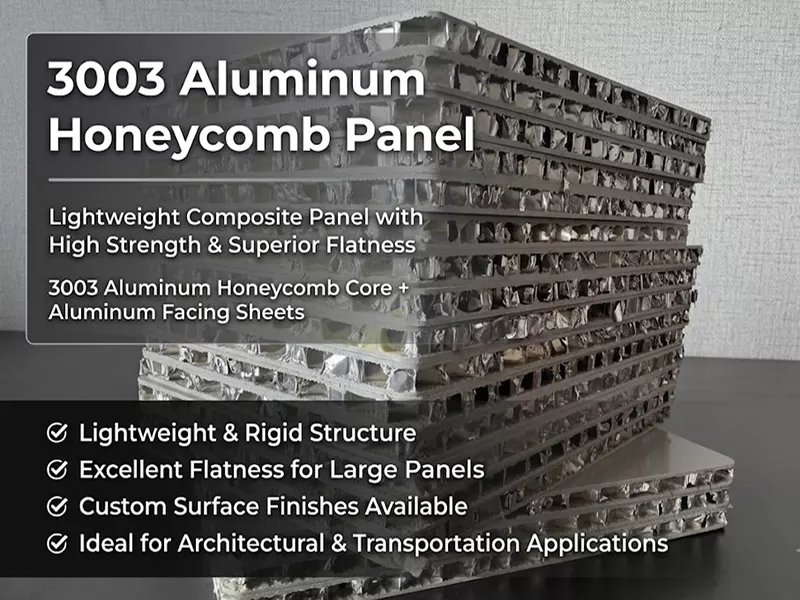
Compared with conventional single-layer aluminum sheets, 3003 Aluminum Honeycomb Panel provides higher flatness and bending stiffness. Compared with solid panels, it offers better weight control. Therefore, it is particularly suitable for large-size decorative panels, public building ceilings, interior and exterior wall cladding, and transportation interior panels.
Advantages of 3003 Aluminum Honeycomb Panel
Higher Panel Flatness
The honeycomb core provides uniform support for the facing sheets, reducing the risk of deformation of large-size panels during transportation, installation, and service. For projects with high requirements for visual flatness, such as airports, subway stations, exhibition halls, and commercial complexes, aluminum honeycomb panels are a proven and widely used solution.
Lighter Overall Structure
While maintaining high stiffness, 3003 aluminum honeycomb panels can significantly reduce the weight per unit area. This helps reduce the load on supporting structures, frames, and connection components, while also making on-site handling and installation easier.
Better Impact Resistance and Compression Performance
The multi-cell structure of the honeycomb core helps distribute local loads. When used for equipment panels, vehicle interior panels, ship partitions, or industrial work surfaces, properly designed honeycomb panels can achieve a balance between lightweight performance and structural stability.
Various Surface Finishing Options
Haomei Aluminum can provide different surface solutions according to architectural and interior design requirements, including:
- PVDF fluorocarbon coating;
- PE polyester coating;
- Powder coating;
- Wood grain, stone grain, and metallic brushed finishes;
- Anodized surfaces;
- Mirror finish, embossed surfaces, or customized colors.
3003 Honeycomb Aluminum Chemical Composition
| Element | 3003 |
| Al | 96.8%-99% |
| Cu | 0.05%-0.20% |
| Fe | 0.7% max |
| Mg | 1.0%-1.5% |
| Si | 0.60% |
| Zn | 0.4% max |
| Residuals | 0.15% max |
Applications of Aluminum Alloy 3003 Honeycomb
Architectural Facades and Interior Decoration
3003 Aluminum Honeycomb Panel is commonly used in architectural projects that require lightweight performance, high flatness, and long-term durability, including:
- Building exterior walls and curtain wall decorative panels;
- Interior wall systems;
- Column cladding in commercial spaces;
- Ceilings in airports, stations, hospitals, and schools;
- Cleanroom partitions and clean workshop wall panels;
- Elevator cabins and decorative panels for public areas.
In cleanrooms, medical spaces, and laboratories, aluminum honeycomb panels feature easy-to-clean surfaces, excellent flatness, and compatibility with sealed installation systems, making them one of the commonly used enclosure materials.
Industrial Equipment and Functional Structures
3003 Aluminum Honeycomb Core is also widely used in industrial applications, such as:
- Machine beds and worktables for laser cutting equipment;
- Jigs, fixtures, and lightweight tool bases;
- Energy absorption structures;
- Equipment partitions, machine housings, and protective components;
- Composite structures requiring high flatness and lightweight performance.
For laser processing equipment or special industrial applications, the honeycomb cell size, perforation design, core thickness, and composite structure should be specially designed according to actual operating conditions.
Rail Transit and Marine Interior Applications
In the interior structures of trains, subways, passenger vehicles, and ships, weight reduction usually means lower energy consumption, higher payload capacity, and easier installation and maintenance. 3003 Aluminum Honeycomb can be used for:
- Floor panels and floor substrates;
- Interior wall panels for carriages;
- Ceiling panels;
- Seat back panels and partitions;
- Ship cabin interiors and lightweight furniture panels.
For projects involving rail transit, ships, and other applications with requirements for flame retardancy, smoke toxicity, salt spray resistance, or specific certifications, technical standards and testing requirements should be confirmed before purchasing.
What Makes the 3003 Alloy Ideal for Honeycomb?
At its most basic level, 3003 aluminum honeycomb is a lightweight core material crafted from precisely corrugated aluminum foil, which is then bonded to form a continuous grid of hexagonal cells.
The secret to its performance lies in the metallurgy. Our 3003 alloy is composed of roughly 98% aluminum and 1% manganese (Al 98/Mn 1). This specific chemical makeup provides exceptional formability. Unlike stiffer, more brittle alloys, the 3003 easily withstands the complex node-bonding and expansion processes required in our factory to create pristine, uniform hexagonal cells.
Beyond formability, this composition ensures a remarkably high strength-to-weight ratio, excellent natural corrosion resistance, and high thermal conductivity.
3003 Alloy Material Source Learn more about the alloy used in our honeycomb manufacturing: 3003 aluminum coil and foil product page.
3003 Aluminum Honeycomb Core vs. 3003 Aluminum Honeycomb Panel
3003 Honeycomb Core
The raw internal cellular structure made from bonded and expanded aluminum foil. It is supplied for customers who will laminate, fabricate, or integrate the core into their own composite assemblies.
3003 Honeycomb Panel
A finished sandwich structure in which the honeycomb core is bonded between two outer metal skins, usually compatible aluminum sheets, to create a rigid, flat, lightweight panel.
3003 Aluminum Honeycomb Core
The 3003 aluminum honeycomb core is the raw, internal structure. This is the "cellular" heart of the product. To accommodate different shipping and manufacturing needs, we supply the core in several configurations:
Unexpanded Blocks
For clients who want to save on freight costs and have their own expansion equipment, shipping solid unexpanded blocks is highly economical.
Expanded Sheets
We can pull and expand the material at our facility, shipping you ready-to-use core sheets trimmed to your exact dimensions.
Perforated Core
If you plan on laminating the core to create a solid panel, we highly recommend our perforated core. Tiny pinholes in the foil allow structural gases to vent properly during the adhesive curing process, preventing panel blistering.
Unperforated Core
Unperforated honeycomb is available for open-cell applications where gas venting during panel lamination is not required.
At Haomei Aluminum, our standard cell sizes are highly customizable, most commonly ranging from 1/4" to 1.0" (approximately 6.35 mm to 25.4 mm), allowing you to balance density and strength exactly to your project's specifications.
3003 Aluminum Honeycomb Panel
When the core is sandwiched between two outer metal skins (usually made of compatible aluminum sheets), it becomes a 3003 aluminum honeycomb panel.
This sandwich construction yields a panel that is incredibly rigid and perfectly flat, yet weighs a fraction of what a solid aluminum plate of the same thickness would weigh. As a manufacturer, we ensure that the adhesive bond between our 3003 core and the outer skins can withstand intense shearing forces, making the finished panels ready for immediate installation or further machining.
How to Choose the Right 3003 Aluminum Honeycomb Core?
When purchasing 3003 Aluminum Honeycomb Core, it is not recommended to compare only the unit price. The final performance of honeycomb materials is closely related to cell size, aluminum foil, core height, bonding quality, expanded condition, and composite processing technology.
- Cell Size Smaller cell sizes generally provide denser support and higher strength, but the material cost and weight may increase accordingly; larger cell sizes are lighter and are suitable for applications with relatively lower load-bearing requirements.
- Aluminum Foil Thickness and Core Density Thicker aluminum foil and higher honeycomb density usually indicate better compression and shear performance. The actual selection should balance structural requirements and cost control.
- Honeycomb Core Height Core height has a significant impact on the bending stiffness of sandwich panels. Large-span panels or areas with higher loads usually require a more reasonable core height design.
- Perforated or Non-Perforated Requirements If vacuum lamination, hot pressing, or processes requiring air and adhesive release are used, it should be confirmed whether perforation is required. If the product has sealing, isolation, or other special functional requirements, a comprehensive evaluation is necessary.
- Supply Form Unexpanded honeycomb blocks are convenient for transportation and subsequent processing; expanded honeycomb sheets are suitable for direct lamination. Haomei Aluminum can provide the appropriate form according to customers' equipment and processing procedures.
- Final Application Environment Indoor, outdoor, coastal, high-humidity, industrial corrosive environments, and transportation applications have different requirements for panels, adhesives, edge sealing, and surface treatments.
Haomei Aluminum's 3003 Aluminum Honeycomb Supply Capability
Haomei Aluminum provides 3003 Aluminum Honeycomb Core and 3003 Aluminum Honeycomb Panel solutions for customers in architectural decoration, industrial manufacturing, transportation, and composite material industries. We focus not only on the honeycomb core itself, but also on the compatibility between materials, panels, adhesives, processing methods, and the final application environment.
We can provide:
- Custom-sized 3003 aluminum honeycomb core processing;
- Various honeycomb cell sizes and core height options;
- Unexpanded, expanded, perforated, and non-perforated supply;
- Aluminum honeycomb panel composite processing;
- Coated aluminum facing panels for architectural decoration;
- Sample testing and specification confirmation support;
- Export packaging and bulk delivery services.
For customers using honeycomb materials for the first time, we recommend providing panel dimensions, facing material type, application location, load requirements, installation method, and target quantity. This information helps determine the appropriate cell size, thickness, and composite structure of the 3003 Aluminum Honeycomb more accurately, avoiding potential processing issues and performance problems caused by unsuitable specifications.
Contact Haomei Aluminum for 3003 Aluminum Honeycomb Quote
If you are sourcing 3003 Aluminum Honeycomb Core, 3003 Aluminum Honeycomb Panel, or customized aluminum honeycomb sandwich structures, please provide Haomei Aluminum with the following information:
- Required product: honeycomb core or honeycomb panel;
- Alloy grade and facing panel requirements;
- Cell size and honeycomb core thickness;
- Whether perforation is required;
- Panel dimensions, quantity, and application scenario;
- Surface treatment, color, and performance standards;
- Destination port or delivery location.
We will provide a suitable 3003 Aluminum Honeycomb material solution, technical specifications, and quotation support based on your project requirements. Request a Quote
FAQ – 3003 Aluminum Honeycomb
What is the difference between 3003 Aluminum Honeycomb and 5052 Aluminum Honeycomb?
3003 Aluminum Honeycomb is known for its good formability, corrosion resistance, and cost-effectiveness, making it suitable for most architectural decoration and general industrial sandwich panel applications. 5052 Aluminum Honeycomb typically offers higher strength and improved corrosion resistance, especially for applications requiring better mechanical performance or enhanced resistance to marine environments. The right choice depends on the specific load requirements, service environment, and project budget.
Can 3003 Aluminum Honeycomb Core be used for outdoor curtain walls?
Yes. 3003 Aluminum Honeycomb Core can be used in outdoor curtain walls and architectural applications. However, the overall performance of a curtain wall system depends not only on the honeycomb core material, but also on the facing sheet coating, edge sealing process, adhesive durability, installation details, and drainage design. For outdoor projects, weather-resistant aluminum panels and proper structural design based on local climate conditions are generally recommended.
Can 3003 Aluminum Honeycomb Core be customized with different cell sizes and thicknesses?
Yes. Haomei Aluminum can provide customized 3003 Aluminum Honeycomb Core solutions according to project requirements, including different cell sizes, core thicknesses, expanded dimensions, perforation options, and supply formats. For customized orders, drawings, samples, and technical specifications should be confirmed in advance to ensure the product meets the final composite manufacturing requirements.
Is 3003 Aluminum Honeycomb supplied in expanded or unexpanded form?
Both options are available. Unexpanded honeycomb blocks help reduce transportation space and are suitable for customers with their own expanding and composite processing capabilities. Expanded honeycomb cores are more convenient for direct use in sandwich panel production. The suitable supply form can be selected according to the customer's equipment, transportation costs, and production requirements.