
3004 Aluminum Foil
3004 aluminum foil is a non-heat-treatable Al-Mn-Mg alloy developed for applications that need a useful combination of strength, formability, corrosion resistance and low weight. Compared with 1xxx series foil, it provides higher alloy strength, while its manganese and magnesium content gives it a useful balance between rigidity and forming performance.
Haomei Aluminum supplies 3004 aluminum foil for food containers, takeaway trays, honeycomb core, heat-transfer components and other industrial applications. The foil can be supplied in different tempers, thicknesses and widths according to the customer's forming process, equipment and end use.
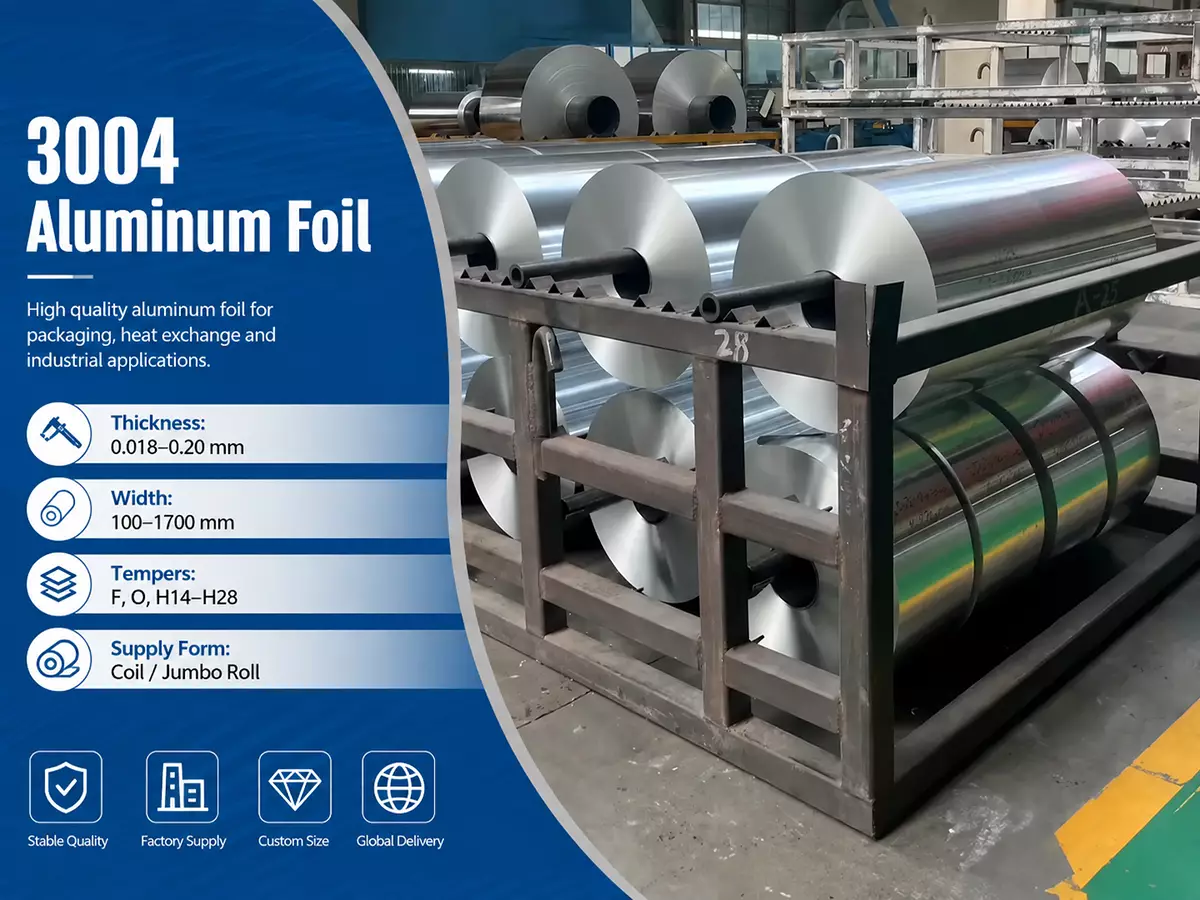
3004 Aluminum Foil Specifications
| Item | Typical Supply Range |
| Aluminum Alloy | 3004 |
| Alloy Series | 3xxx Series |
| Temper | F, O, H14, H16, H18, H19, H22, H24, H26, H28* |
| Thickness | 0.018–0.20 mm |
| Width | 100–1700 mm |
| Supply Form | Coil / Jumbo Roll |
| Surface | Mill finish; clean surface, without defects affecting forming or lamination |
| Typical Applications | Food containers, trays, takeaway packaging, honeycomb core, heat-transfer components and industrial applications |
| Standards | ASTM B209; EN 485 / EN 573 where applicable |
| Customization | Thickness, width, temper, coil ID and packaging can be discussed according to order requirements |
For food-production, the required thickness should normally be determined together with the dimensions, wall geometry, forming depth and press process rather than selected from thickness alone.
Why Choose 3004 Alloy Foil?
3004 is a non-heat-treatable aluminum alloy primarily strengthened by manganese and magnesium. Its typical composition includes approximately 1.0%–1.5% manganese and 0.8%–1.3% magnesium. Compared with 3003 aluminum foil, 3004 generally provides higher strength while retaining the ductility needed for stamping, drawing and shaping.
- Higher strength for formed containers: Suitable for trays and containers that need to retain their shape during filling, stacking, transport and heating.
- Good deep-drawing performance: Available in soft and work-hardened tempers to match different stamping depths and wall-height requirements.
- Excellent barrier performance: Aluminum foil naturally blocks light, moisture, grease and gases, helping protect packaged food products.
- Good corrosion resistance: Appropriate for many food packaging and industrial packaging conditions when the correct alloy, coating and conversion process are selected.
- Lightweight Construction: Aluminum foil provides a high barrier against light and moisture while offering low material weight.
- Process compatibility: Can be used for stamping, embossing, laminating, coating and other downstream converting operations.
3004 Aluminum Foil Applications
Food Containers and Takeaway Trays
3004 foil is used for aluminum food containers, lunch boxes, trays and other semi-rigid packaging applications where the material must retain shape after forming.
Haomei also supplies 3003 Aluminum Foil , which can be considered where a different strength-formability balance is required.
Honeycomb Core
3004 foil is also used to manufacture aluminum honeycomb core. In this application, flatness, thickness consistency, surface quality and strength are important because the foil is processed into a cellular structure.
Heat-Transfer Components
3004 aluminum can be used for selected heat-transfer and air-conditioning components where corrosion resistance, formability and moderate strength are required.
Customers looking specifically for higher-conductivity pure aluminum foil can also review 1100 Aluminum Foil and 1060 Aluminum Foil .
Industrial Packaging
The combination of lightweight construction, formability and barrier performance makes aluminum foil suitable for selected protective and industrial packaging structures.
The correct alloy and temper should be selected according to forming requirements, mechanical loading and the required final product configuration.
Chemical Composition of 3004 Aluminum Foil
| Alloy | Si | Fe | Mg | Mn | Cu | Cr | Zn | Other | Al |
| 3004 | 0.3 | 0.7 | 0.8-1.3 | 1.0-1.5 | 0.25 | - | 0.25 | 0.05 | Remains |
Mechanical Properties of 3004 Aluminium Foil
| Alloy | Tensile strength (Mpa) | Elogation (%) |
| 3004 | 160-190 | >9 |
3004 Aluminum Foil Available Temper Options
3004 aluminum foil can be supplied in different tempers to match the required balance of formability, strength and dimensional stability. Haomei can produce the temper according to the foil thickness, end use and converting process.
O Temper
Fully annealed 3004 foil with the highest formability among the listed tempers. O temper is a practical choice for deep drawing, forming and other processes where the foil needs to accommodate significant deformation without excessive cracking.
H14 / H16
Strain-hardened tempers that offer more strength and stiffness than O temper while maintaining useful forming performance. They are commonly considered when the finished component needs a balance between handling strength and moderate forming requirements.
H18 / H19
Higher-strength tempers designed for applications where rigidity, handling strength and dimensional stability are more important than maximum formability.
H18 and H19 may be specified for honeycomb core, structural foil and other demanding applications, with the final temper selected according to the required thickness, strength and manufacturing process.
H22 / H24 / H26 / H28
These tempers cover intermediate strength levels between softer annealed material and higher-strength hard tempers. The choice depends on the required combination of forming behavior, strength and dimensional stability for the finished product.
Quality Control for 3004 Aluminum Foil
Haomei checks 3004 aluminum foil throughout the production and finishing process to keep thickness, surface condition and coil quality within the agreed requirements. Inspection can be adjusted according to the customer's thickness, width, temper, application and packaging requirements.
- Surface cleanliness: The foil surface is checked for dirt, foreign matter, stains and other conditions that could affect further processing.
- Oil residue: Residual rolling oil is controlled according to the required surface condition and end-use requirements.
- Scratches and roll marks: The surface is inspected for visible scratches, pressure marks, roll marks and other defects generated during rolling or handling.
- Edge condition: Coil edges are checked for burrs, cracks, dents and other damage that may interfere with slitting, forming or subsequent processing.
- Black spots and contamination: The foil is inspected for black spots, embedded particles and other visible contamination.
- Pinholes: Pinholes are monitored because they can affect the barrier performance and reliability of foil used in demanding applications.
- Thickness variation: Foil thickness is measured during production and final inspection to verify consistency across the agreed specification.
Inspection records and material documentation can be provided for applicable orders. Specific inspection criteria can be confirmed before production based on the customer's drawings, technical specification or purchasing requirements.
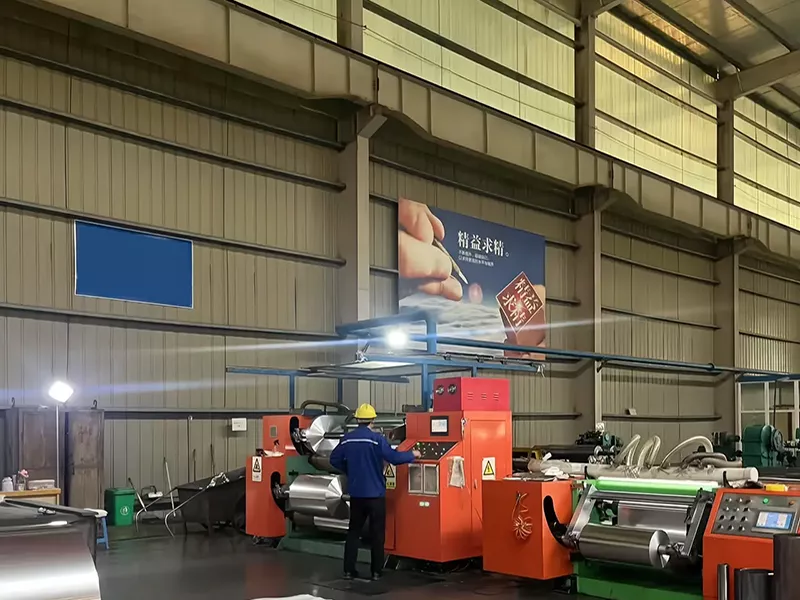
3004 aluminum foil coil inspection and quality control at Haomei Aluminum.
How to Choose the Right 3004 Aluminum Foil
- Final application Food container, honeycomb core, heat-transfer component or another use.
- Thickness The required final thickness after forming and processing.
- Width Required coil width or slit width.
- Temper O, H14, H18 or another specified condition.
- Coil requirements ID, OD, coil weight and maximum coil weight if applicable.
- Quantity Trial quantity, monthly consumption or annual demand.
- Quality requirements Surface, pinhole, flatness, mechanical properties and dimensional tolerances.
- Documentation MTC, inspection report, certificate of origin or other project documents.
Request a 3004 Aluminum Foil Quote
Tell us your required thickness × width, temper, quantity and application.
Get a 3004 Aluminum Foil Quote3004 Aluminum Foil Coil Packaging and Delivery
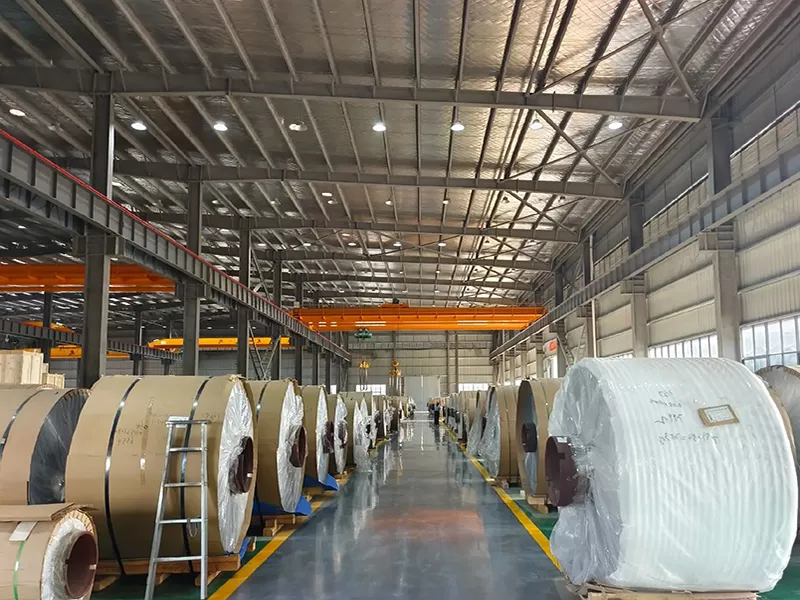
3004 aluminum foil coil packaging can be adjusted according to coil weight, transportation method, destination and storage conditions.
- Moisture-resistant protective materials
- Protective paper or film
- Wooden or reinforced support systems
- Coil edge protection
- Export seaworthy outer packaging
- Customer-specific marking and identification
3004 Aluminum Foil vs 3003 Aluminum Foil
Both 3003 and 3004 belong to the 3xxx aluminum alloy family and are commonly used in packaging and forming applications. The main difference is that 3004 contains magnesium in addition to manganese, which generally gives it higher strength.
| Factor | 3003 | 3004 |
| Main alloying elements | Manganese | Manganese + Magnesium |
| Strength | Moderate | Generally higher |
| Formability | Very good | Very good, with a higher-strength balance |
| Typical use | Trays and general containers | Containers requiring increased rigidity |
| Honeycomb core | Suitable for selected products | Widely used for selected higher-strength core applications |
| Best selection approach | Prioritize forming / workability | Prioritize a balance of strength and forming |
For applications where formability is the primary concern and rigidity is less demanding, 3003 aluminum foil may be a cost-effective option. For higher-strength containers or structural foil uses, 3004 is often the more suitable choice.
Related Aluminum Foil Products
Haomei Aluminum supplies multiple aluminum foil alloys for different combinations of strength, formability, corrosion resistance, conductivity and packaging performance.
- 3003 Aluminum Foil A balance of strength, corrosion resistance and formability for general-purpose applications.
- 8006 Aluminum Foil For applications where higher rigidity and strength are important.
- 8011 Aluminum Foil For food packaging and applications requiring a widely used 8xxx-series foil grade.
- 8021 Aluminum Foil For pharmaceutical packaging and other barrier-oriented packaging structures.
- 8079 Aluminum Foil For selected flexible packaging applications where formability and barrier performance are important.
- 1235 Aluminum Foil For packaging and industrial applications where high aluminum purity and foil processing characteristics are required.
- 1100 Aluminum Foil For commercially pure aluminum applications requiring excellent formability and useful thermal and electrical conductivity.
- 1050 Aluminum Foil For applications where high aluminum content and good conductivity or formability are priorities.
- 1060 Aluminum Foil For applications requiring high-purity aluminum and good electrical or thermal conductivity.
Frequently Asked Questions About 3004 Aluminum Foil
What is 3004 aluminum foil?
3004 aluminum foil is a non-heat-treatable 3xxx-series aluminum alloy foil containing manganese and magnesium. It is used where a combination of strength, formability and corrosion resistance is required.
Is 3004 aluminum foil stronger than 3003?
Generally, 3004 provides higher strength than 3003 because of its alloy composition, but the actual mechanical properties depend on temper, thickness and applicable specification.
For purchasing decisions, the required tensile strength and forming performance should be specified rather than relying on a fixed percentage difference.
What thickness is commonly used for 3004 food foil?
Food-foil is commonly produced in the approximate 0.03–0.20 mm range, although the required thickness depends on size, wall geometry, forming depth and production equipment.
Can 3004 aluminum foil be used for lunch boxes and food containers?
Yes. 3004 is used commercially for aluminum food containers, lunch boxes and takeaway trays, particularly where good forming performance and higher rigidity are required.
Which temper is suitable for food containers?
O temper is commonly used where high forming ability is required. Other tempers may be selected depending on the forming process and finished- rigidity.
The appropriate temper should be confirmed against the customer's press and mold conditions.
Can 3004 aluminum foil be used for honeycomb core?
Yes. 3004 foil is used for aluminum honeycomb core because it offers a useful balance of strength, flatness, low weight and formability.
H18 and H19 conditions are often considered for higher-strength honeycomb-core applications.
What is the difference between 3004 and 8006 aluminum foil?
3004 belongs to the 3xxx series and uses manganese and magnesium to provide its strength balance.
8006 is an 8xxx-series alloy commonly selected for foil where high rigidity and forming performance are required.
The better option depends on the design and forming process.
What information is needed for a quotation?
Send the alloy, temper, thickness, width, quantity, application and any special requirements such as coil ID, maximum coil weight, pinhole limits or inspection documents.
Can Haomei Aluminum provide slit 3004 foil coils?
Yes. Slit width, coil weight, inner diameter and packaging method can be discussed based on your stamping, laminating or converting equipment.
Which thickness is suitable for a takeaway aluminum container?
Thickness depends on tray size, shape, drawing depth, lid design, required load capacity and temper. Rather than selecting only by a common market thickness, it is better to validate the material on the actual mold and production line.
Further reading
Users viewing this material also viewed the following
- 3004 Aluminum Honeycomb Board Core Material
- 3004 Corrugated Aluminum Plate
- 3004 Aluminum Strip for Blinds
- 3004 Aluminum Plate for Automobile Fuel Tank
- 3004 Aluminum Plate for Aluminum-plastic Board Substrate
- 3004 Deep-drawn Aluminum Plate
- 3004 Aluminum Plate for Traffic Signs
- 3004 Aluminum Plate for Aluminum Curtain Wall
- 3004 Roof Aluminum Sheet
Recommended Content