
In marine engineering, transportation, pressure vessels, storage tanks, and sheet metal fabrication, 5086 aluminum and 5052 aluminum are both commonly used aluminum-magnesium alloys. Both belong to the 5xxx series and offer good corrosion resistance, weldability, and formability, but they differ significantly in strength, service environments, and fabrication methods.
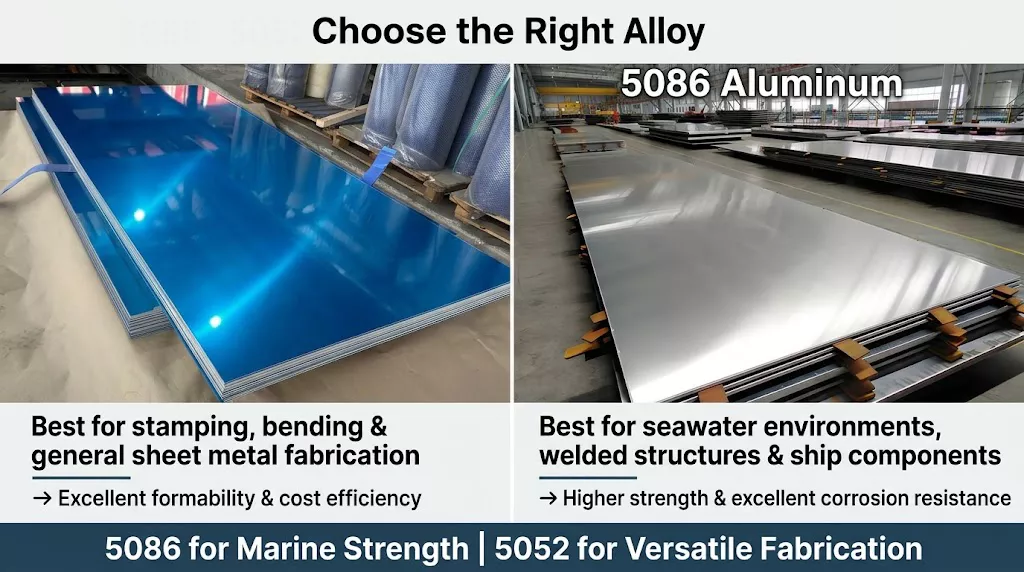
If the project focuses on seawater corrosion environments, high-strength welded structures, or ship components, 5086 is often the more suitable choice. if the priority is stamping, bending, conventional sheet metal fabrication, and cost control, 5052 is usually the more practical option.
5086 Aluminum vs 5052: Quick Comparison
Neither 5086 nor 5052 can be significantly strengthened by heat treatment. Instead, their strength and hardness are mainly adjusted through strain hardened tempers such as H32, H34 and H116.
The main difference between the two alloys is their magnesium content.
- 5086 aluminum: Typically contains about 3.5 to 4.5% magnesium, providing higher strength and making it well suited for load bearing welded structures.
- 5052 aluminum: Typically contains about 2.2 to 2.8% magnesium. It offers moderate strength with better ductility, bendability and general fabrication performance.
5086 aluminum is generally preferred for higher strength and marine corrosion resistance, while 5052 aluminum is a more practical choice for forming, bending and general sheet metal fabrication.
| Property | 5086 Aluminum | 5052 Aluminum |
| Aluminum series | 5000 series | 5000 series |
| Main alloying element | Magnesium | Magnesium |
| Typical Mg content | About 3.5 to 4.5% | About 2.2 to 2.8% |
| Corrosion resistance | Excellent, particularly in marine environments | Very good for general and industrial applications |
| Strength | Generally higher | Moderate to good |
| Formability | Good | Excellent |
| Weldability | Good | Good |
| Marine applications | Excellent choice for demanding marine service | Suitable for general and lighter-duty marine applications |
| Common tempers | O, H32, H111, H116 | O, H32, H34 |
| Typical applications | Ship structures, marine equipment, tanks and structural panels | Enclosures, transportation panels, HVAC equipment and general fabrication |
5086 vs 5052: How to Choose the Right Aluminum Alloy?
When to Choose 5086 Aluminum
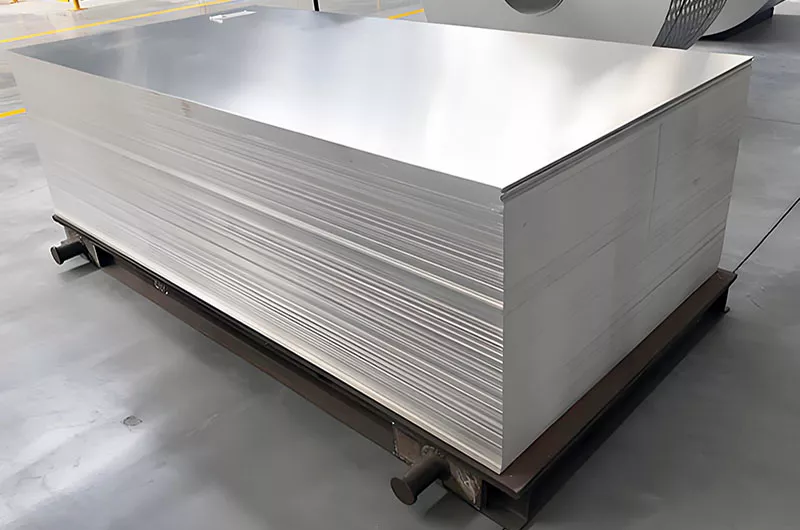
- Choose 5086 when the application involves long-term exposure to seawater, salt spray, or other demanding marine environments.
- Choose 5086 when higher yield strength and structural load-bearing capacity are important.
- It is well suited for hulls, marine engineering components, ship structures, and large welded assemblies.
- 5086 is a strong option when good mechanical performance is required after welding.
- For relatively thick aluminum plate used in heavy-duty industrial or structural applications, 5086 is often more suitable than 5052.
When to Choose 5052 Aluminum
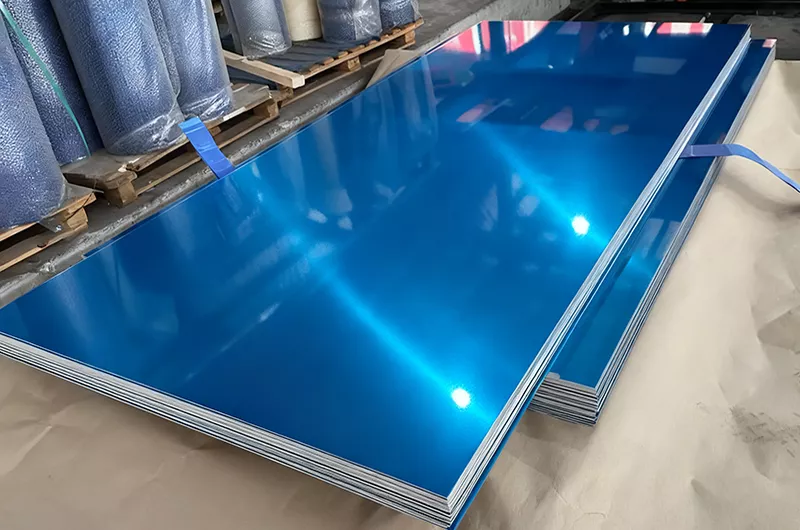
- Choose 5052 when frequent bending, stamping, roll forming, stretching, or other sheet metal fabrication is required.
- 5052 is suitable for conventional outdoor, humid, and moderately corrosive environments.
- It is commonly used for housings, fuel tanks, signs, decorative panels, containers, and general-purpose fabricated parts.
- Choose 5052 when moderate strength is sufficient and forming performance, surface quality, and processing consistency are higher priorities.
- 5052 is available in a wide range of product forms, including aluminum sheet, coil, discs, embossed sheet, and five-bar tread plate.
5086 aluminum vs 5052: Chemical Composition Comparison
| Element | 5086 Aluminum | 5052 Aluminum |
| Aluminum Al | Balance | Balance |
| Magnesium Mg | Approximately 3.5%–4.5% | Approximately 2.2%–2.8% |
| Manganese Mn | Approximately 0.2%–0.7% | Typically low |
| Chromium Cr | Small amount | Approximately 0.15%–0.35% |
| Main Characteristics | High strength, excellent seawater corrosion resistance | Good formability, corrosion resistance, easy fabrication |
The higher magnesium content gives 5086 an advantage in strength and corrosion resistance in marine environments, but it also means that it is generally less flexible than annealed 5052 when performing complex deep drawing or bending to very small radii.
Mechanical Properties: 5086 Is Stronger, While 5052 Is Easier to Form
| Property | 5086-H116 / H32 (Typical) | 5052-H32 (Typical) |
| Tensile Strength | Approximately 290–350 MPa | Approximately 210–260 MPa |
| Yield Strength | Approximately 200–250 MPa | Approximately 160–195 MPa |
| Elongation | Good | Good to excellent |
| Bending / Stamping Performance | Good | Excellent |
| Weldability | Excellent | Excellent |
| Seawater Corrosion Resistance | Excellent | Very good |
5086 generally offers significantly higher load-bearing capacity than 5052. Therefore, 5086 is a common choice for applications such as ship decks, hull plates, offshore platform structures, heavy-duty vehicle side panels, and welded storage tanks.
Although 5052 has slightly lower strength, it offers excellent processing adaptability. For products that require stamping, rolling, bending, stretching, or surface finishing, 5052 is often easier to process and can provide more consistent finished-product quality.
Corrosion Resistance: Both Perform Well, but 5086 Is Preferred for Marine Projects
5xxx series aluminum alloys are known for their corrosion resistance and are particularly suitable for humid, salt-spray, and industrial atmospheric environments.
5086: Suitable for Long-Term Marine and Salt-Spray Environments
5086 is a typical marine grade aluminum alloy. It offers excellent resistance to seawater, salt spray, and humid environments, making it commonly used for:
- Ship hulls, decks, and bulkheads
- Fishing boats, yachts, and workboats
- Offshore platforms and coastal facilities
- Seawater treatment equipment
- Welded pressure vessels and storage tanks
For shipbuilding plates, dock facilities, or structures that are exposed to seawater for extended periods, 5086 H116 aluminum plate sheet is recommended as a priority option. The H116 temper is commonly used for marine-service plate and provides a balance of strength and resistance to exfoliation corrosion.
5052: Suitable for General Humid, Chemical, and Outdoor Environments
5052 also offers good resistance to atmospheric corrosion and has good resistance to a variety of chemical media. It is commonly used for:
- Fuel tanks, oil tanks, and liquid storage tanks
- Appliance panels and equipment housings
- Chemical containers
- Architectural decorative panels
- Interior and exterior components for transportation equipment
- Road signs, advertising signs, and sheet metal parts
For general outdoor, industrial, or mildly salt-spray environments, 5052 aluminum plate sheet is usually sufficient and provides a good balance between cost and ease of fabrication.
Weldability: Both 5086 and 5052 Are Suitable for Welding
If the project requires TIG, MIG, or other common aluminum alloy welding processes, both 5086 and 5052 are reliable material choices.
However, the two alloys are used differently in welded structures:
- 5086: Suitable for structural components where higher post-weld strength is required. It can retain good overall strength in the welded condition and is commonly used for ship hulls and large load-bearing components.
- 5052: Suitable for conventional welded sheet metal, boxes, containers, and pipe accessories. It offers stable weldability and relatively easy fabrication.
For large welded structures, the design should not consider only the base-metal strength. Factors such as the heat-affected zone, filler metal selection, plate thickness, weld design, and service medium should also be considered. For marine environments, the applicable temper and relevant classification society or project standards should also be confirmed.
Forming and Bending Performance: 5052 Is Better Suited for Complex Sheet Metal Fabrication
For applications that require stamping, stretching, roll forming, and repeated bending, 5052 is generally easier to fabricate than 5086.
Forming Advantages of 5052
5052 is particularly suitable for the following manufacturing processes:
- Sheet metal bending
- Deep drawing and shallow drawing
- Roll forming
- Punching
- Embossing
- Spinning
- Fabrication of housings, covers, and enclosures
If the part requires higher ductility, 5052 O aluminum sheet can be selected. The O temper indicates the annealed condition, in which the material is softer and suitable for products requiring high formability. For sheet metal parts that need to balance a certain level of strength with conventional bending requirements, 5052 H32 aluminum sheet is a more common choice.
In addition, 5052 can be supplied in various forms and surface options, such as:
Processing Characteristics of 5086
5086 can also be bent and formed, but because of its higher strength, more appropriate die design, bending radius, and process control are required for complex fabrication. For thick plate components where structural strength is the primary objective, these limitations are generally acceptable.
Commonly supplied tempers include:
- 5086 H32 aluminum plate sheet: suitable for structural plates requiring a certain degree of cold-work strengthening.
- 5086 H111 aluminum plate sheet: suitable for applications requiring a lightly strain-hardened temper.
- 5086 O aluminum plate sheet: suitable for applications with higher subsequent forming requirements.
- 5086 aluminum coil: suitable for continuous processing, leveling, or specific coil applications.
If you need thicker plates for marine or structural applications, you can check the dimensions and temper options available for 5086 aluminum plate sheet.
Application Comparison: Where Is 5086 Used? Where Is 5052 Used?
Typical Applications of 5086 Aluminum
5086 is better suited for high-strength, welded, and marine corrosion environments, and is commonly used for:
- Hull plates, decks, and bulkheads
- Yachts, fishing boats, and high-speed workboats
- Offshore engineering structures
- Desalination and marine equipment
- Welded storage tanks
- Heavy-duty vehicles and military vehicle components
- Pressure vessels and low-temperature vessels
- Industrial structural plates requiring higher strength
Typical Applications of 5052 Aluminum
5052 is better suited for general industrial sheet metal fabrication and formed components, including:
- Oil tanks and fuel tanks
- Appliance housings
- Building curtain walls and decorative panels
- Road signs
- Chemical equipment housings
- Side panels for transport vehicles
- Cookware, lighting fixtures, and aluminum discs
- Anti-slip flooring and step plates
- Insulation aluminum jacketing and embossed sheets
5086 vs 5052 for Cost
Price should be evaluated together with alloy, temper, thickness, width, quantity, processing and certification requirements.
5052 can be a cost-effective choice for general fabrication because it is widely used and easy to process. 5086 may justify a higher material cost when its additional corrosion resistance or strength reduces design, maintenance or replacement concerns.
For large projects, the lowest purchase price is not necessarily the lowest total cost. The better question is whether the material matches the environment and fabrication process closely enough to avoid unnecessary machining, forming problems or premature replacement.
Choosing the Right Aluminum for Your Project
The choice between 5086 and 5052 should ultimately be based on the actual service conditions rather than alloy name alone. If your project involves seawater, welded structures or higher strength requirements, 5086 deserves close consideration. If the material needs to be repeatedly bent, stamped or formed into sheet-metal components, 5052 may offer the better balance.
Haomei Aluminum can supply both alloy families in different tempers, forms and processing options. Contact the technical sales team with your required alloy, temper, thickness, width, length, application and applicable standard to identify a suitable material specification.
Need Help Choosing Between 5086 and 5052?
Tell us your required alloy, temper, thickness, width, length, application and applicable standard. Haomei Aluminum can help you compare 5086 and 5052 and select a suitable plate, sheet or coil specification for your project.
Request a QuoteFrequently Asked Questions – 5086 vs 5052 Aluminum
Is 5086 aluminum stronger than 5052?
Generally, yes. In commonly compared tempers, 5086 offers higher strength than 5052. For example, typical 5086-H116 data is around 290 MPa tensile strength and 207 MPa yield strength, compared with approximately 228 MPa and 193 MPa for 5052-H32.
Is 5086 better than 5052 for saltwater?
For demanding saltwater and marine structural applications, 5086 is generally the preferred alloy because it combines strong corrosion resistance with higher mechanical strength.
Is 5052 easier to bend than 5086?
Generally, yes. 5052 is known for its good forming characteristics, particularly in the O temper. The final bendability still depends on thickness, bend radius, and temper.
Can 5086 and 5052 be welded?
Yes. Both alloys are suitable for common aluminum welding processes such as MIG and TIG. However, the welded joint and heat-affected zone should be considered when designing a structural assembly.
Which is better: 5086 H116 or 5052 H32?
For marine structures and higher-strength applications, 5086-H116 is generally the better fit. For general sheet-metal fabrication and applications requiring easier forming, 5052-H32 may be more practical.
Is 5086 more corrosion resistant than 5052?
5086 is particularly well suited to marine environments and is commonly selected for seawater-exposed structures. 5052 also has very good corrosion resistance and remains a strong choice for many outdoor and industrial applications.
Products you may be interested in
- 5052 Aluminum Coil
- 5052 Aluminum Sheet & Plate
- 5086 Aluminum Plate Sheet
- 5086 h116 aluminum plate sheet
- 5086 h32 aluminum plate sheet
- 5086 h111 aluminum plate sheet
- 5086 O aluminum plate sheet
- 5052 h32 aluminum sheet
- 5052 0 aluminum sheet
- 5052 H34 Aluminum Sheet, Coil and Strip
- 5052 Aluminum Disc Circle
Users viewing this material also viewed the following
- Aluminium circle 5052 H32 for Tank Cover
- 5052 Diamond Tread Aluminum Plate
- 5052 Stucco Embossed Aluminum Sheet
- 5052 Color Coated Aluminum Sheet
- 5052 Marine Grade Aluminum Plate
- 5086 Marine Aluminum Plate
- Aluminum Foil and Strip for Lids and Can Ends
- Aluminum Sheet Strip for Easy Open Ends
Recommended Content