
The main difference between 5052-H32, H34 and O is the balance between strength and formability: H32 offers a practical middle ground, H34 provides higher strength, and O provides the greatest forming flexibility.
At Haomei Aluminum, we recommend selecting the temper around the finished part and its fabrication route, rather than treating H32, H34 and O as interchangeable versions of the same material.
When comparing 5052-H32 vs H34 vs O, the main difference is not the aluminum alloy itself, but its temper. All three use the 5052 aluminum- magnesium alloy, yet they behave differently during bending, drawing, stamping and fabrication. Selecting the right condition can affect forming quality, dimensional consistency and the performance of the finished component.
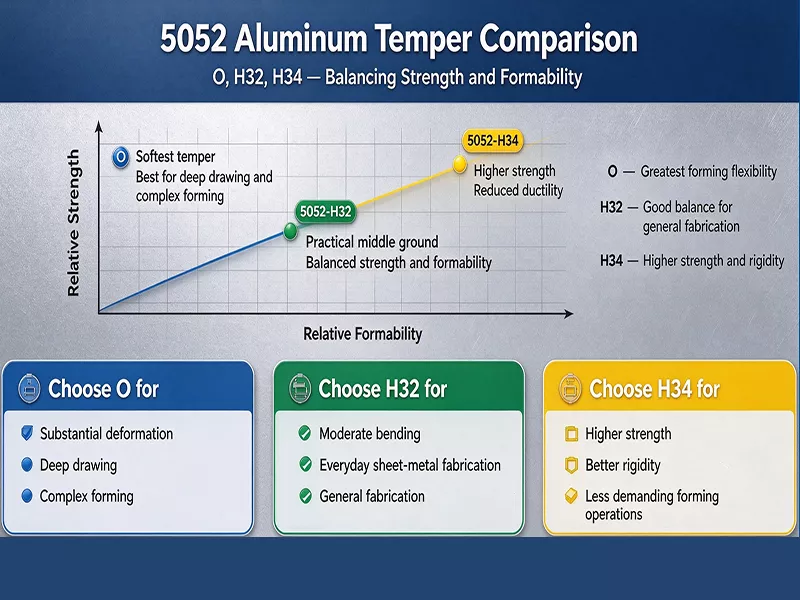
- 5052-O is the softest condition and is generally the first option to consider for deep drawing and complex forming. 5052-H32 offers a practical balance of strength and formability for general fabrication. 5052-H34 provides a higher strength level than H32, but usually gives up some ductility.
- If your component needs substantial deformation, start by evaluating O temper. For moderate bending and everyday sheet-metal fabrication, H32 is often a sensible starting point. When higher strength or rigidity matters more than demanding forming operations, H34 may be the better candidate.
5052-H32 vs H34 vs O Quick Comparison Table
| Comparison | 5052-O | 5052-H32 | 5052-H34 |
| Material condition | Annealed | Strain-hardened and stabilized | Strain-hardened and stabilized |
| Relative strength | Lowest of the three | Higher than O | Generally higher than H32 |
| Ductility | Highest of the three | Good, with less ductility than O | Generally lower than H32 |
| Forming capability | Best suited to demanding forming | Good for moderate forming and bending | Better suited to less demanding forming |
| Deep drawing | Preferred starting point | Depends on draw depth and geometry | Requires careful process evaluation |
| Bending | Generally best for tight or complex bends | Good for many routine bends | May require a larger bend radius |
| Typical selection priority | Formability | Balance of strength and formability | Higher strength with less demanding forming |
All three tempers retain the basic advantages of 5052: good corrosion resistance, good weldability and useful fabrication characteristics.
However, a harder temper does not make aluminum substantially stiffer. Elastic stiffness remains nearly the same. H34 can resist permanent deformation better than O, but the same panel geometry will not become dramatically less flexible simply because the temper changes.
What Do H32, H34 and O Mean?
5052 is an aluminum-magnesium alloy. It is not strengthened by precipitation heat treatment in the way that alloys such as 6061 are. Its strength is adjusted primarily through cold working and annealing.
5052-O: Annealed for Greater Formability
The O designation refers to the annealed condition. In 5052-O aluminum, annealing reduces the effects of previous strain hardening and produces a softer material with high ductility. This makes it a useful choice when a part must undergo substantial deformation without cracking.
Typical applications include drawn components, formed enclosures, tank-related parts, curved panels and other products with complex geometries.
For detailed product options, see Haomei's 5052-O aluminum sheet.
5052-H32: A Balance Between Strength and Formability
H32 belongs to the strain-hardened and stabilized family of tempers. The final two digits identify the specified temper condition; H32 corresponds to a quarter-hard condition within the H3x temper series. Its strength is higher than that of O temper while useful forming capability is retained.
It can be suitable for equipment covers, cabinets, vehicle and trailer panels, fabricated tanks, marine equipment panels and many other parts that require both mechanical performance and corrosion resistance.
Review the available sizes and specifications on Haomei's 5052-H32 aluminum sheet page.
5052-H34: Higher Strength with Reduced Forming Flexibility
H34 is also strain-hardened and stabilized, but represents a higher degree of hardness than H32. It typically offers greater strength than H32, while reduced ductility can make demanding bending or forming operations more difficult.
H34 is worth evaluating for panels, covers, fabricated components and other parts where additional strength or rigidity is useful and the manufacturing process does not require severe deformation.
For sheet, coil and strip supply options, visit 5052-H34 aluminum sheet, coil and strip.
Strength Comparison: How Different Are They?
| Mechanical property | 5052-O | 5052-H32 | 5052-H34 |
| Typical tensile strength | About 195 MPa | About 230 MPa | About 260 MPa |
| Typical yield strength | About 90 MPa | About 195 MPa | About 215 MPa |
| Relative ductility | Highest | Intermediate | Lowest |
| Elastic modulus | About 70 GPa | About 70 GPa | About 70 GPa |
Actual requirements depend on the product form, thickness, governing standard and specified test conditions.
Which Temper Is Best for Bending?
For demanding bends, O is usually the safest starting point. For routine sheet-metal bending, H32 often provides the better overall balance. H34 requires more care.
There is no single minimum bend radius that applies to every 5052 sheet.
Bending performance depends on:
- Sheet thickness
- Inside bend radius
- Bend angle
- Bend-line orientation relative to the rolling direction
- Tooling and forming method
- Edge quality and surface condition
- Actual material properties
- Start with H32 if the bend radii are moderate and the finished enclosure needs reasonable strength.
- Consider O if the bends are tight or the part requires substantial additional forming.
- Consider H34 if the geometry is less demanding and higher yield strength is important.
Which 5052 Temper Is Best for Stamping, Drawing and Spinning?
5052-O for Deep Drawing and Spinning
5052-O is the softest of these three tempers and generally offers the best formability for demanding operations. It is a practical starting point for deep-drawn parts, spun components and shapes that require substantial material flow.
For round blanks, Haomei supplies 5052 aluminum disc circles with customized dimensions to suit specific forming requirements.
5052-H32 for Bending and Moderate Stamping
5052-H32 offers a useful balance of strength and formability for parts that need to retain their shape while undergoing moderate deformation. Typical applications include brackets, equipment covers, enclosures and shallow-stamped components.
When selecting H32, consider bend radius, material thickness and forming direction. These factors help determine whether the temper is suitable for the intended part.
5052-H34 for Strength-Focused Components
5052-H34 has higher tensile strength than H32 but generally provides less forming flexibility. It is worth considering for components with limited stamping, relatively generous bends or a greater need for strength in the finished part.
For repeat production using 5052 aluminum coil, specify the temper, thickness tolerance, slit width and edge requirements.
5052-O vs H32 vs H34: Corrosion Resistance Compared
Does 5052-H34 resist corrosion better than 5052-H32 or 5052-O? Not necessarily. All three tempers belong to the 5052 aluminum alloy family, which is known for its good corrosion resistance, particularly in humid environments and many marine-related applications. The main difference between these tempers is their mechanical properties, not a fundamental change in alloy composition.
For applications exposed to seawater or coastal conditions, review the required material specification, design loads, joining methods and maintenance requirements before choosing a temper. You can also explore our 5052 marine aluminum plate to learn more about available material options for marine-related fabrication.
For structural or class-approved marine applications, confirm that the specified alloy and temper meet the applicable design code, certification and project requirements. Although 5052 offers good corrosion resistance, it is not an automatic replacement for marine structural alloys such as 5083 or 5086 where those grades are specifically required.
Request a Quote for 5052-O, H32 or H34 Aluminum
At Haomei Aluminum, temper selection is considered together with product dimensions, fabrication requirements and the intended application.
For a quotation or technical review, prepare the following details:
- Alloy and temper: 5052-O, H32 or H34.
- Product form: sheet, plate, coil, strip, disc or tube.
- Thickness, width, length or outside diameter and wall thickness.
- Required mechanical properties and applicable material standard.
- Fabrication process: bending, deep drawing, stamping, welding or rolling.
- Surface finish, coating and protective-film requirements.
- Quantity, packaging, destination and inspection-document requirements.
Need 5052 Aluminum in O, H32 or H34?
Haomei Aluminum supplies 5052 aluminum sheet, plate, coil, strip and related product forms. Our team can review your required temper, dimensions, surface condition and material specification to identify a suitable supply option.
Contact Haomei AluminumFAQ – 5052-H32 vs H34 vs O Aluminum
Is 5052-H34 stronger than 5052-H32?
Generally, yes. H34 represents a higher degree of strain hardening than H32 and normally provides higher strength. Exact tensile strength, yield strength and elongation depend on material thickness, product form and the applicable specification.
Is 5052-O stronger than H32 or H34?
No. O is the annealed condition and generally has the lowest strength and highest ductility of these three tempers. It is often preferred when forming requirements are more demanding than strength requirements.
Which 5052 temper is best for bending?
5052-O is generally better for tight bends and demanding forming. H32 provides a useful balance for many ordinary bending applications, while H34 requires closer attention to bend radius, thickness, bend direction and tooling.
Can 5052-H34 aluminum be bent without cracking?
Yes, provided the bend radius and forming conditions are suitable. The result depends on thickness, bend direction, tooling and material properties. A radius suitable for 5052-O or H32 should not automatically be assumed suitable for H34.
Does 5052 aluminum respond to heat treatment?
5052 is non-heat-treatable for strengthening in the same way as precipitation-hardened aluminum alloys. Its H tempers obtain increased strength mainly through strain hardening and stabilization. Annealing changes the material condition and must be controlled when specific mechanical properties are required.
Is 5052-0 the same as 5052-O?
In the temper designation, O is the letter O, not the numeral zero. Some product searches and informal listings use 5052-0 to represent the annealed condition, but purchase documents should clearly identify the intended temper as 5052-O.
Can Haomei supply 5052 aluminum in sheet, plate, coil and strip?
Haomei Aluminum supplies 5052 aluminum sheet, plate, coil and strip in selected dimensions and tempers, subject to the applicable specification and production requirements. Disc circles, tread plate, embossed and color-coated products can also be discussed. Tube requirements should be confirmed separately against the required dimensions and standard.
Can 5052-H34 replace 5052-H32?
Sometimes, but not automatically. H34 offers higher strength and generally lower ductility than H32. Check bending, drawing and other forming requirements before approving the substitution, and verify that the replacement meets the applicable mechanical property and product specification requirements.
Products you may be interested in
- 5052 Aluminum Coil
- 5052 Aluminum Sheet & Plate
- 5052 h32 aluminum sheet
- 5052 0 aluminum sheet
- 5052 H34 Aluminum Sheet, Coil and Strip
- 5052 Aluminum Disc Circle
Users viewing this material also viewed the following
- Aluminium circle 5052 H32 for Tank Cover
- 5052 Diamond Tread Aluminum Plate
- 5052 Stucco Embossed Aluminum Sheet
- 5052 Color Coated Aluminum Sheet
- 5052 Marine Grade Aluminum Plate
- Aluminum Foil and Strip for Lids and Can Ends
- Aluminum Sheet Strip for Easy Open Ends
Recommended Content