
Aluminum foil is widely used as the high-barrier layer in flexible packaging where protection against light, moisture, oxygen and aroma loss is critical.
At Haomei Aluminum, we supply packaging-grade aluminum foil for laminated pouches, sachets, lidding materials and other multilayer structures.
Our flexible packaging foil can be supplied in different alloys, tempers, thicknesses and widths to match converting, printing, laminating and sealing requirements.
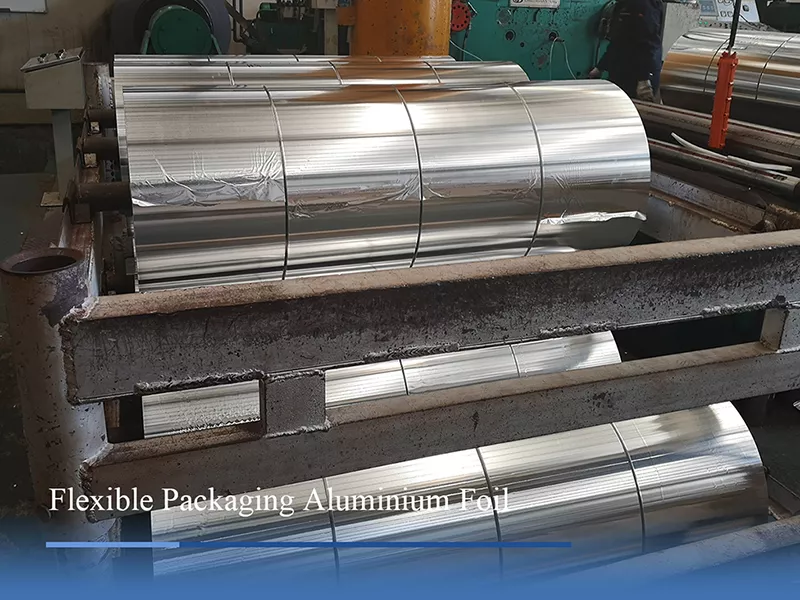
Flexible Packaging Aluminum Foil Specifications
| Alloy | 1235, 8011, 8079 and other grades depending on requirements |
| Temper | O, H18 and other conditions according to application |
| Typical Thickness | Approx. 6–20 μm for many flexible packaging structures |
| Width | Customized to converting requirements |
| Form | Jumbo roll / slit coil |
| Surface | Mill finish, suitable for laminating, printing or coating |
| Processing | Slitting and customized roll dimensions available |
| Packaging | Export-grade moisture and damage protection |
| Customization | Alloy, thickness, width, coil size and packing |
| Application | Flexible food, pharmaceutical, cosmetic & industrial packaging |
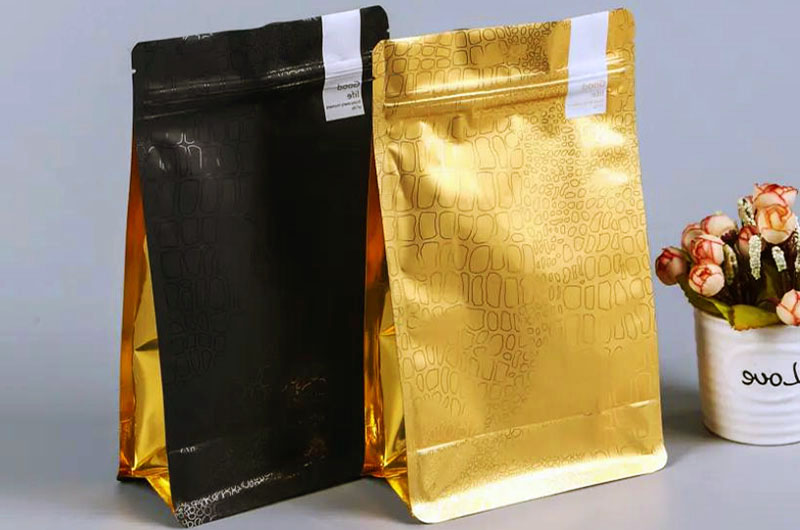
What Is Aluminum Foil for Flexible Packaging?
Aluminum foil for flexible packaging is a thin aluminum layer incorporated into a multilayer packaging structure to provide high-level barrier protection. Unlike a standalone plastic film, aluminum foil can provide an effective barrier against light, moisture, gases and aroma migration, which is why it remains important in applications where product protection and shelf life are critical.
In most flexible packs, the foil is laminated with other materials rather than used alone. A typical structure may combine aluminum foil with PET, PE, PP or paper, with each layer performing a different function. The foil provides barrier protection, while polymer layers can contribute sealability, toughness, printability and heat resistance.
Features of Flexible Packaging Aluminium Foil
High Barrier Protection
Aluminum foil provides an exceptionally strong barrier against light, moisture and gases. This is one of the main reasons it is used in flexible laminates for sensitive food, pharmaceutical and other products.
Dead-Fold Characteristics
Foil can retain folds and creases instead of returning to its original shape. This dead-fold behavior is useful for wraps, sachets and packaging structures that need to conform closely to the product.
Lamination Compatibility
Aluminum foil can be combined with polymer films and paper to create multilayer structures. The foil provides the barrier layer, while materials such as PET, PE and PP can provide mechanical strength, printability or heat-sealing functions.
Aroma and Product Protection
For products where flavor, fragrance or volatile components are important, the foil layer can help reduce unwanted transmission through the package.
Laminated Structure of Flexible Packaging Aluminium Foil
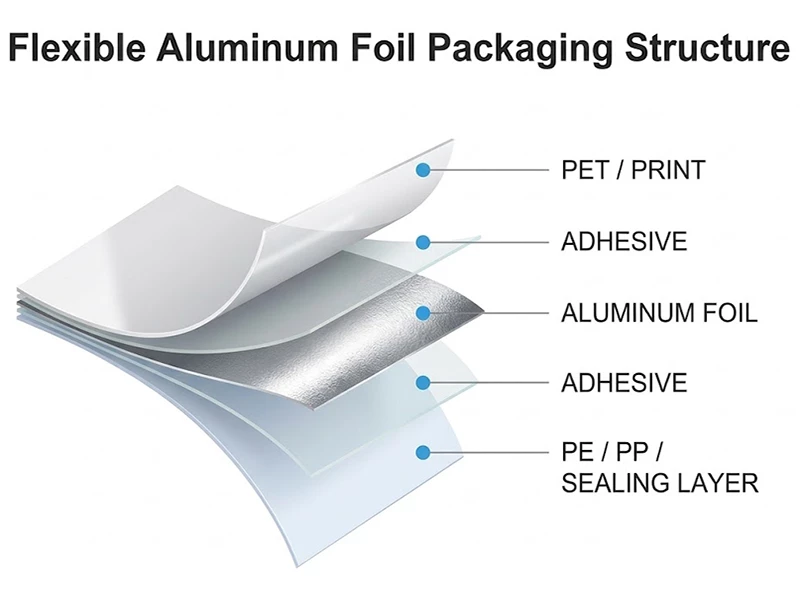
In a multilayer package, aluminum foil normally functions as the barrier layer rather than the complete package. The outer film may provide printing and mechanical protection, while the inner polymer layer is designed for heat sealing and contact with the packaged product.
The foil grade and thickness should therefore be considered together with the rest of the laminate. A thicker foil is not automatically the better choice if the converting process or final package does not require it.
Typical concept: PET / Adhesive / Aluminum Foil / Adhesive / PE or PP
| Laminate structure | Common use and design consideration |
| PET / AL / PE | Pouches and sachets; PET supports print protection, while PE provides the sealing layer |
| PET / AL / PA / CPP | Some retort pouch designs; films, adhesives and seals must be validated for the intended thermal process |
| Paper / AL / PE | Selected wraps and sachets combining a paper outer layer, foil barrier and heat-sealable inner layer |
Here, AL refers to aluminum foil, actual constructions also require compatible bonding systems. Bare foil is not normally the heat-sealing layer. Seal performance comes from the selected polymer film or coating and the sealing conditions.
Which Aluminum Alloy Is Used for Flexible Packaging?
There is no single alloy suitable for every flexible packaging project. Alloy selection depends on foil processing, ductility, strength, final structure and downstream converting requirements.
1235 Aluminum Foil
Suitable where high purity, excellent ductility and good foil processing characteristics are required.
View 1235 Aluminum Foil8011 Aluminum Foil
A widely used packaging alloy offering a practical balance of strength, formability and foil processing performance.
View 8011 Aluminum Foil8079 Aluminum Foil
Used for certain high-performance packaging applications where particular strength and foil-processing requirements need to be considered.
View 8079 Aluminum Foil
Flexible Packaging Aluminium Foil Chemical Composition
| Elements | Composition /% | ||
| 1235 | 8011 | 8079 | |
| Si | 0-0.65 | 0.50-0.90 | 0.05-0.30 |
| Fe | 0-0.65 | 0.60-1 | 0.70-1.30 |
| Cu | 0-0.05 | 0-0.10 | 0-0.05 |
| Mn | 0-0.05 | 0-0.20 | - |
| Mg | 0-0.05 | 0-0.05 | - |
| Cr | - | 0.05 | - |
| Zn | 0-0.1 | 0-0.10 | 0-0.10 |
| Ti | 0-0.06 | 0-0.08 | - |
| V | 0-0.05 | - | - |
| Al | Rem | Rem | Rem |
Mechanical Properties of Flexible Packaging Aluminium Foil
| Alloy | Temper | Thickness /mm | Tensile strength /MPa | elongation after break /%, (not less than) | |
| A50mm | A100mm | ||||
| 1235 | O | 0.0060 - 0.0090 | 45-95 | 0.5 | |
| 8011 8079 | 50-105 | 1.0 | |||
Flexible Packaging Aluminium Foil Common Applications
Food & Beverage Packaging
Provides an effective barrier against light, oxygen and moisture, helping flexible packaging maintain product quality during storage and distribution.
Pharmaceutical Packaging
Used in high-barrier laminate structures where protection from moisture, light and air is important for product stability and shelf life.
Cosmetic & Personal Care
Supports compact flexible packaging with light and moisture protection, while the laminate structure provides reliable sealing and product compatibility.
Medical Packaging
Suitable for selected healthcare packaging structures requiring controlled barrier performance, clean surfaces and dependable package integrity.
Household Packaging
Can be incorporated into flexible structures where moisture resistance, chemical compatibility and seal performance are important during handling and storage.
Industrial Packaging
Offers barrier protection for sensitive materials and technical products, with foil grade and laminate construction selected according to application requirements.
Powder & Granule Packaging
Helps limit moisture and oxygen exposure, making foil-containing laminates suitable for packaging applications where environmental protection is required.
Single-Use Packaging
Combines barrier performance with lightweight construction for compact flexible formats, with sealing and opening characteristics adapted to the package design.
High-Barrier Flexible Packaging
Aluminium foil serves as the barrier layer within multilayer structures, working with polymer films and sealant layers to achieve the required overall package performance.
How to Choose Aluminum Foil for Flexible Packaging
Define the Packaging Format
Identify whether the project uses a pouch, sachet, lidding material, stick pack or another converted structure.
Determine the Barrier Requirement
Consider whether the product is particularly sensitive to moisture, oxygen, light, aroma or contamination.
Select the Alloy
Choose the alloy according to ductility, foil rolling performance, strength and downstream converting requirements.
Select the Foil Thickness
Match the gauge to the barrier requirement and laminate design instead of simply choosing the thickest available foil.
Confirm the Laminating Process
Consider adhesive lamination, printing, coating and heat-sealing conditions.
Confirm Roll Specifications
Width, core diameter, coil weight, outer diameter and slit width can all affect converting efficiency.
Why Source Flexible Packaging Foil from Haomei Aluminum?
Haomei Aluminum pays close attention to foil thickness, surface finish, roll dimensions and overall material consistency to help customers maintain stable production.
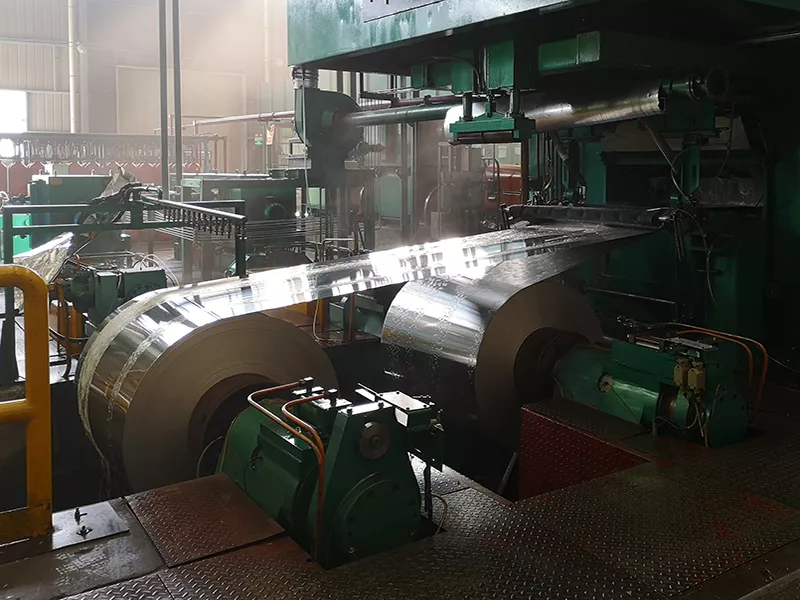
We supply aluminum foil in jumbo rolls as well as slit widths for flexible packaging converters, packaging manufacturers, distributors and other industrial buyers. Specifications can be arranged based on the required alloy, temper, thickness, width, core size, coil weight and packing method.
- Customized Specifications Alloy, temper, thickness and width can be arranged to suit the project.
- Jumbo Roll Supply Large-format rolls are available for slitting and further converting.
- Slit Coil Processing Narrower widths can be supplied according to converter requirements.
- Export Packaging Protective packing is used to reduce the risk of moisture and handling damage during shipment.
Need Aluminum Foil for Your Flexible Packaging Project?
Tell us your required alloy, thickness, width, roll dimensions and packaging application. Haomei Aluminum can review the specification and recommend a suitable foil configuration for your converting process.
Request a QuoteQuality Control for Flexible Packaging Foil
Depending on order requirements, inspection can include thickness, width, surface condition, mechanical properties, coil dimensions and packaging integrity.
- Incoming Material Inspection Raw material is checked before entering production.
- Rolling & Thickness Control Foil thickness and rolling conditions are monitored during production.
- Annealing Annealing is carried out according to the required foil temper and processing condition.
- Surface Inspection The foil surface is checked for appearance and conditions that may affect further converting.
- Slitting / Rewinding Roll width, winding condition and coil dimensions are checked during finishing.
- Final Packaging Inspection Finished coils are inspected for packing condition before shipment.
Flexible Packaging Aluminium Foil Packaging and Delivery
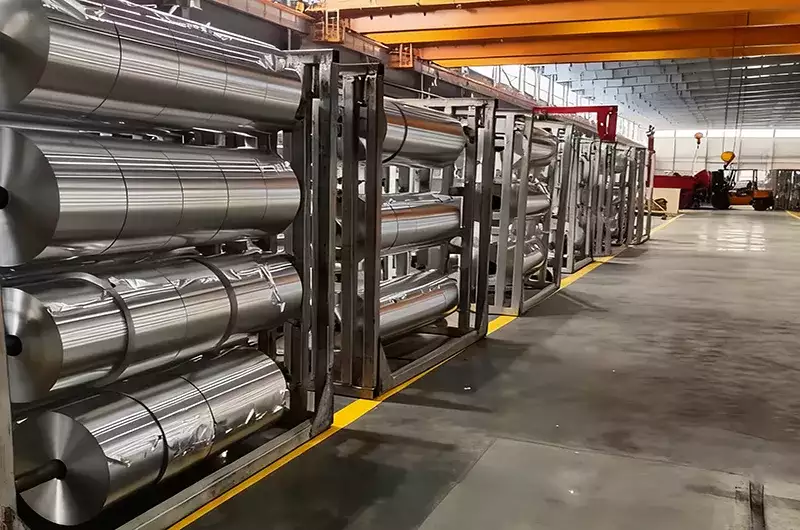
Aluminum foil coils are protected against moisture, contamination and mechanical damage during transportation. Export packaging can be configured according to coil dimensions, loading requirements and the customer's unloading or storage conditions.
Standard Export Protection
- Moisture-resistant wrapping
- Protective paper or film
- Steel or reinforced strapping
- Wooden pallets or suitable export supports
- Coil edge protection
Customized Packing
Final packing can be adjusted according to container loading, coil size and customer unloading or warehouse requirements.
For larger projects, packing specifications should be confirmed together with coil dimensions and delivery requirements before production.
FAQ – Aluminum Foil for Flexible Packaging
What thickness of aluminum foil is commonly used for flexible packaging?
Many flexible packaging laminates use foil in the approximate 12–20 μm range, but the final gauge depends on the laminate design, required barrier performance, converting process and cost target.
Which aluminum alloy is best for flexible packaging?
There is no single alloy suitable for every package. 1235, 8011 and 8079 are among the alloys used for packaging foil, with selection depending on ductility, strength and processing requirements.
Can aluminum foil be laminated with PET and PE?
Yes. Aluminum foil is commonly incorporated into multilayer structures with PET, PE, PP and other materials. The outer layer and inner sealing layer perform functions that the foil itself does not need to provide.
Is aluminum foil suitable for coffee packaging?
Yes. Foil-based laminates are widely used for coffee packaging because they provide strong protection against light, moisture, gases and aroma transmission.
Can Haomei supply slit aluminum foil?
Yes. Foil can be supplied in jumbo rolls or slit widths according to the customer's converting requirements, subject to the specific order specification.
Can foil thickness and width be customized?
Yes. Thickness, width, coil dimensions, alloy, temper and packing requirements can be discussed according to the application and downstream processing conditions.
Is thicker aluminum foil always better?
No. The optimum gauge depends on the final packaging structure and performance requirement. Increasing thickness without a corresponding technical need may increase material consumption without providing a proportional benefit.