
Haomei Aluminum supplies packaging aluminium foil in roll form for food, pharmaceutical, household and flexible packaging applications. Material options can be adjusted according to the required barrier performance, forming characteristics, converting process and finished package structure.
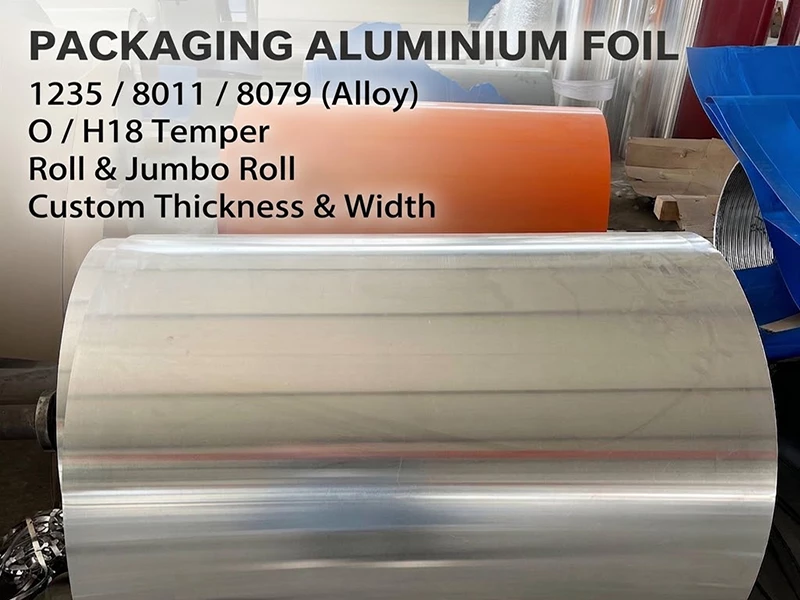
Packaging Aluminium Foil Specifications
- Alloy
- 1235 / 8011 / 8079 and other options
- Temper
- O / H18 and other tempers
- Form
- Roll / Jumbo Roll
- Thickness
- Custom as required
- Width
- According to customer specifications
- Finish
- Mill finish or application-specific requirements
- Standards
- ASTM / EN / customer specifications
- Supply
- Industrial and export orders
What Is Packaging Aluminium Foil?
Packaging aluminium foil is a thin aluminium material supplied in roll form and converted into structures such as pouches, sachets, lids, wraps and laminated packaging. Its value comes from the combination of low weight, formability and resistance to light, moisture and gases. The required foil specification depends on the package design rather than thickness alone, so alloy, temper, gauge, width and surface condition should be considered together.
Packaging Aluminium Foil for Different Applications
Food Packaging
Aluminium foil can be incorporated into packaging structures where protection from light, moisture and gases is important.
- Sachets
- Pouches
- Coffee packaging
- Confectionery
- Dairy products
- Processed foods
See our food packaging aluminium foil range for application-specific options.
Pharmaceutical Packaging
Foil can be used as part of pharmaceutical packaging structures where protection from environmental conditions is required.
- Blister packaging
- Sachets
- Strip packs
- Powder packaging
Specification should be determined from the finished package and applicable production requirements.
Household Packaging
Aluminium foil is also supplied for household and food-contact applications where lightweight material and practical handling are important.
- Household foil
- Wraps
- Prepared food
- Baking applications
Flexible Packaging
Foil can be laminated with other materials to create flexible packaging structures requiring a higher level of barrier protection.
- Laminate structures
- High-barrier pouches
- Retort-related structures
- Specialty packaging
Explore flexible packaging aluminium foil for related applications.
Why Aluminium Foil Is Used in Packaging
Aluminium foil is selected for packaging because several material characteristics can work together within the final package structure.
Barrier Performance
Aluminium foil can provide an effective barrier against light and can contribute to protection from oxygen and moisture. The overall barrier performance depends on the complete packaging structure.
Lightweight Material
Foil combines low material weight with useful packaging performance, making it suitable for structures where package weight and material efficiency need to be considered.
Formability
Depending on alloy and temper, aluminium foil can provide the ductility and forming characteristics required for folding, shaping and converting.
Converting Compatibility
Packaging foil can be combined with PE, PET, paper and other substrates to create different laminated packaging structures.
Packaging Aluminium Foil Alloy and Temper Options
| Alloy | Typical Characteristics | Common Considerations |
| 1235 | High ductility and good foil-forming characteristics. | General packaging foil and applications requiring good forming behaviour. |
| 8011 | Balanced strength and formability. | Food, household and flexible packaging applications. |
| 8079 | Good ductility for demanding foil applications. | Flexible packaging and selected specialty applications. |
For grade-specific information, see our 8011 aluminium foil and 8079 aluminium foil pages.
Temper is equally important. Soft O-temper foil may be suitable where flexibility and folding are required, while other applications may call for a different mechanical condition.
How to Specify Packaging Aluminium Foil
Application
Identify the final package and product being protected.
Barrier Level
Define the required protection against light, moisture and gases.
Foil Thickness
Select gauge according to the complete packaging structure.
Alloy & Temper
Balance ductility, strength and converting requirements.
Width
Match the foil width to the converting and slitting process.
Roll Configuration
Confirm core, weight, diameter, winding and packaging.
Haomei Quality Control for Packaging Aluminium Foil
Inspection requirements can be adjusted according to order specifications, customer quality standards and the intended converting process.
Incoming Material Inspection
Material condition and relevant incoming specifications are reviewed before production or further processing.
Foil Thickness Control
Thickness is checked against the specified tolerance and production requirements.
Width and Roll Dimension Check
Width, roll dimensions and other order-specific dimensional requirements can be inspected.
Surface Inspection
Surface condition is checked for issues that could affect subsequent converting or final appearance.
Mechanical Property Testing
Mechanical properties can be evaluated according to the relevant material specification and customer requirements.
Packaging Inspection
Finished roll packaging is checked to help protect the material during storage, handling and export transportation.
Haomei Aluminium Foil Packaging and Delivery
Suitable moisture-resistant protection can be arranged according to shipment conditions.
Wrapping materials are selected to help protect the foil surface and roll during handling.
Protective measures can be used to reduce the risk of damage to roll edges during transportation.
Strapping is arranged according to roll size, handling requirements and export conditions.
Wooden pallets or suitable export supports can be arranged according to loading and unloading requirements.
Final packing can be adjusted according to container loading, coil dimensions, transportation conditions and the customer's unloading or warehouse requirements.
Why Choose Packaging Aluminium Foil from Haomei Aluminum?
Product Specification Support
Alloy, temper, thickness, width and roll configuration can be discussed according to the application, converting process and finished packaging requirements.
Roll Supply for Converting
Haomei supplies aluminium foil in roll and jumbo-roll forms for customers involved in slitting, lamination, pouch production and other downstream converting processes.
Export-Oriented Packaging
Packing arrangements can consider roll size, loading, transportation conditions and customer unloading requirements.
Documentation and Inspection
Material and quality documents can be arranged according to the order requirements and agreed inspection specifications.
Looking for a broader range of aluminium foil products? Visit our aluminium foil product category to compare related materials and applications.
FAQ – Packaging Aluminium Foil
What aluminium alloys are commonly used for packaging foil?
Depending on the application, packaging foil may be produced from alloys such as 1235, 8011 and 8079. Selection depends on ductility, strength, forming requirements, foil thickness and the converting process.
What thickness is used for packaging aluminium foil?
There is no single standard thickness for every application. Foil gauge is normally selected according to the laminate structure, required barrier performance, forming or converting process and cost target.
Can packaging aluminium foil be supplied in jumbo rolls?
Yes. Haomei Aluminum can supply aluminium foil in roll or jumbo-roll form according to width, core, roll weight, winding requirements and the customer's converting process.
Can packaging aluminium foil be customized?
Yes. Alloy, temper, thickness, width, roll configuration and packaging can be discussed according to the application and production requirements.
Is aluminium foil suitable for flexible packaging?
Yes. Aluminium foil is commonly incorporated into flexible packaging laminates where high barrier performance is required. The final specification depends on the laminate structure and converting process.