
1060 Aluminum Foil
1060 aluminum foil is a widely used pure aluminum foil material. With its high purity, stable performance, and outstanding cost-effectiveness, it holds a significant position in both industrial and consumer applications. From food and pharmaceutical packaging to electronic components, automotive manufacturing, and building insulation, 1060 aluminum foil meets diverse usage needs and is one of the most common basic aluminum foil materials in modern industry.
As a member of the 1000 series of pure aluminum, 1060 aluminum foil has an aluminum content of no less than 99.6%. Compared with 1050 aluminum foil, its purity is slightly higher, resulting in superior electrical conductivity, thermal conductivity, and corrosion resistance. This material cannot be strengthened through heat treatment; its mechanical properties are primarily achieved through work hardening during the cold working process.
In practical applications, 1060 aluminum foil is known for its excellent ductility, formability, and weldability, and is commonly used in packaging, electronics, food, and pharmaceutical industries. Examples include capacitors, battery materials, electronic labels, heat exchangers, and HVAC systems, where 1060 aluminum foil is frequently utilized. It is also widely used in the production of gaskets, automotive components, and various food packaging products.
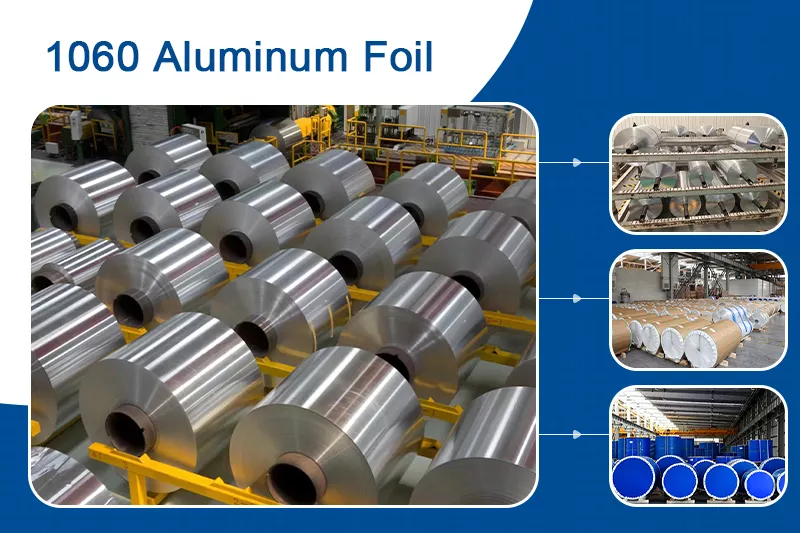
Additionally, aluminum foil made from 1060 aluminum alloy can be supplied in different thickness specifications according to requirements. Among them, 1060 hot-rolled aluminum foil with a thickness of approximately 0.1 mm is particularly mature in the field of automotive components.
As a professional aluminum foil manufacturer, Haomei Aluminum has established a strict quality control system in the production of 1060 aluminum foil. From raw material selection to finished product shipment, we monitor the microstructure, mechanical and electrical properties, sheet flatness, thickness tolerance, and surface cleanliness of the aluminum foil throughout the entire process, ensuring that every batch of 1060 aluminum foil delivers stable and reliable performance.
Among them, 0.1mm thick hot-rolled 1060 aluminum foil is one of Haomei Aluminum's flagship products, serving the automotive component manufacturing sector for a long time. With excellent formability, dimensional consistency, and processing stability, this product has built a strong market reputation in the industry and continues to receive recognition from numerous clients. Currently, the annual output and market share of this specification remain at the domestic leading level, ranking at the forefront of the industry.
1060 Aluminum Foil Specifications
| Alloy | 1060 |
| Temper | F, O, H14, H16, H18, H19, H22, H24, H26, H28 |
| Thickness (mm) | 0.015-0.2 mm |
| Width (mm) | 100-1700 |
| Length (mm) | c |
| Standard | ASTM B479, ASTM B209 |
| Typical Applications | Aluminum gaskets, electrolytic capacitors, automotive heat shields, etc. |
Common Supply Conditions of 1060 Aluminum Foil
O Condition (Soft / Annealed)
Fully annealed, 1060 aluminum foil offers extremely high ductility and flexibility, making it easy to bend and stretch. It is especially suitable for deep drawing, complex stamping, and applications requiring high formability.
H12 / H14 / H18 Condition
Different levels of strength and hardness are achieved through cold working and strain hardening. Compared to O condition, 1060 aluminum foil in these tempers maintains excellent processing performance while providing higher strength, dimensional stability, and flatness, commonly used in industrial applications requiring strength, durability, and assembly precision.
Characteristics of 1060 Aluminum Foil
High Purity and Stable Performance
The high-purity aluminum matrix ensures consistent performance for 1060 aluminum foil while providing excellent resistance to various chemical media and atmospheric environments, suitable for long-term usage conditions.
Excellent Electrical and Thermal Conductivity
1060 aluminum foil possesses very high electrical and thermal conductivity among aluminum alloys, frequently used in electrical, electronic components, battery materials, and heat exchange applications.
Outstanding Ductility and Formability
The material is soft, easy to roll, bend, and stamp, capable of deep drawing, spinning, and complex bending processes. It is widely used in stamped parts, gaskets, fins, and precision component manufacturing.
Good Corrosion Resistance and Reflectivity
The foil surface naturally forms a dense oxide protective layer, providing excellent chemical and weather corrosion resistance. At the same time, its high reflectivity makes it suitable for insulation, thermal protection, and reflective applications.
Weldability and Environmental Benefits
Although 1060 aluminum foil cannot be strengthened through heat treatment, it can be processed using various conventional welding methods. Moreover, it is lightweight and highly recyclable, meeting modern industrial requirements for environmental protection and sustainability.
If an application does not require high material strength but emphasizes processing performance, thermal conductivity, and stability, 1060 aluminum foil is undoubtedly a mature, reliable, and cost-effective choice.
Applications of 1060 Aluminum Foil
Electrical and Electronics Industry
With excellent conductivity, 1060 aluminum foil is commonly used for electrolytic capacitor foils, battery flexible connectors, battery tabs, transformer windings, and insulation materials. It is also applied in electronic component shields and cable coverings to reduce electromagnetic interference and enhance system stability.
Automotive and Transportation
In automotive manufacturing, 1060 aluminum foil is often used in automotive heat shields, various gaskets, and lightweight components. Its good reflectivity and thermal stability make it an ideal material for engine compartment insulation, exhaust system heat protection, and components in new energy vehicles.
Insulation and Thermal Protection
Leveraging its high reflectivity and effective thermal control, 1060 aluminum foil is widely used in HVAC systems, building insulation layers, and radiation shielding materials, playing a key role in energy saving and temperature regulation.
Packaging Industry
1060 aluminum foil is non-toxic, tasteless, and moisture-resistant, and can withstand high-temperature sterilization processes, making it suitable for food packaging, pharmaceutical packaging, and industrial protective packaging, effectively extending product shelf life and enhancing safety.
Other Industrial Applications
In chemical and general industrial sectors, 1060 aluminum foil is often processed into gaskets, sealing materials, protective liners, and corrosion-resistant components. It is also used in electronic labels, heat exchangers, and reflective panels for lighting, where high formability and surface performance are required.
1060 Aluminum Foil Application Examples
1060 Lithium Battery Foil
1060 aluminum foil features uniform thickness and excellent ductility, making it suitable for battery current collectors, flexible connections, coating, rolling, and other precision processing techniques. Its stable chemical properties and dimensional accuracy help improve overall battery consistency and safety, and it is therefore widely used in the manufacturing of power batteries, energy storage batteries, and consumer electronics batteries.
1060 Aluminum Foil for Injection Vial Seals
1060 aluminum foil is non-toxic, corrosion-resistant, and offers excellent sealing performance, effectively isolating moisture, oxygen, and external contaminants to ensure drug quality. The foil surface is smooth, suitable for stamping and composite processing, can closely cooperate with rubber stoppers or coating materials, and can withstand high-temperature sterilization processes.
1060 Aluminum Foil Chemical Composition
| Si | Fe | Cu | Mn | Mg | Zn | Others-Each | Others Total | Al |
| 0.30 | 0.7 | 0.25 | 1.0-1.5 | 0.8-1.3 | 0.25 | 0.05 | 0.15 | Bal. |
Mechanical Properties of 1060 Aluminum Foil
| Tensile strength σb (MPa) | Yield strengt σ0.2 (MPa) | Elongation δ16 (%) | Electrical conductivity(20℃)(IACS, %) |
| ≥75 | ≥35 | 3-5 | 62 |
Advantages and Limitations of 1060 Aluminum Foil
Advantages of 1060 Aluminum Foil
- Cost-effective: Approximately 30% lower in cost compared to alloy aluminum foil, while meeting most general performance requirements.
- Strong processing adaptability: Highly malleable, suitable for stamping, stretching, bending, welding, and other processing methods.
- Environmentally friendly and sustainable: 100% recyclable, low production energy consumption, in line with carbon neutrality trends.
- Balanced performance: Offers a good combination of electrical conductivity, thermal conductivity, corrosion resistance, and formability, with a wide range of applications.
Limitations of 1060 Aluminum Foil
- Low strength: Lower strength than alloy aluminum foils, not suitable for high-strength structural components.
- Cannot be strengthened by heat treatment: Strength can only be improved through cold working.
- Average wear resistance: Low surface hardness, prone to scratches.
1060 vs 1050 Aluminum Foil
- Purity: 1060 > 1050
- Electrical conductivity: 1060 slightly better
- Strength: Very close
- Price: 1050 is generally more cost-effective
- If the product focuses on electrical performance and stability, 1060 aluminum foil is the better choice.
- If the application requires standard performance with an emphasis on cost control and general use, 1050 aluminum foil is more advantageous.
Purity Differences
Both 1060 and 1050 aluminum foils belong to the 1000 series of pure aluminum materials, but they differ slightly in chemical composition. 1060 aluminum foil contains no less than 99.6% aluminum, whereas 1050 aluminum foil contains approximately 99.5% aluminum. Although the difference is small, the higher purity gives 1060 a slight advantage in certain properties.
Electrical and Thermal Conductivity
Due to higher purity, 1060 aluminum foil typically outperforms 1050 aluminum foil in electrical and thermal conductivity. Therefore, it is preferred in applications with high electrical performance requirements, such as electrolytic capacitors, electrical connectors, and battery materials.
Strength and Processing Performance
Neither can be strengthened by heat treatment; their strength relies primarily on cold working and strain hardening. In the same temper conditions (e.g., O, H14, H18), the mechanical properties of 1060 and 1050 aluminum foil are very similar, with comparable processing, formability, and weldability.
Cost and Cost-Performance Ratio
In practice, 1050 aluminum foil is more widely used, with larger supply and typically lower prices, offering a clear cost-performance advantage, suitable for large-volume applications sensitive to cost. 1060 aluminum foil, on the other hand, is more suitable for scenarios requiring higher electrical and thermal conductivity and material consistency.
Comparison of 1060 Aluminum Foil with Other Aluminum Foils
| Property | 1060 Aluminum Foil | 8011 Aluminum Foil | 3003 Aluminum Foil |
| Aluminum Content | ≥99.6% | 97-98% | 98-99% |
| Main Alloying Elements | None | Fe, Si | Mn |
| Strength | Low | Medium | Medium-High |
| Electrical Conductivity | Excellent | Good | Good |
| Price | Low | Medium | Medium |
| Typical Applications | Food packaging, capacitors | Composite packaging, containers | Chemical equipment, radiators |
Selection and Procurement Recommendations for 1060 Aluminum Foil
As a professional 1060 aluminum foil manufacturer, Haomei Aluminum recommends that customers clearly define their actual usage requirements before selection and procurement to ensure that the material performance closely matches the application scenario.
Clarify Specifications and Applications
Before procurement, clearly indicate the required aluminum foil thickness, width, supply condition (such as O, H14, or H18), and specific application field. Different usage scenarios have varying requirements for formability, strength, and surface quality. Defining these needs helps us provide a more suitable product solution.
Enhance Technical Communication and Customization Support
It is recommended to communicate thoroughly with the manufacturer during the inquiry stage, submitting detailed technical parameters and usage requirements. Haomei Aluminum can provide professional material selection advice, sample confirmation, and customization of thickness, width, and other specifications to ensure consistency and stability in bulk supply.
Pay Attention to Surface Quality and Quality Control
For applications such as electronic foils and capacitor foils that require high quality, it is recommended to specify surface quality standards during procurement, such as requirements for black spots, scratches, roller marks, and surface cleanliness. We strictly control the surface condition during production to meet the stringent quality requirements of high-end applications.
Further reading
- 1060 Aluminum Coil
- 1060 Aluminum Plate Sheet
- 1060 h12 aluminum sheet plate
- 1060 h24 aluminum sheet plate
- 1060 Aluminum Disc Circle
- 1060-O Aluminum
- 1060-H14 Aluminum
- 1060-H16 Aluminum
- 1060-H18 Aluminum
- 1060 H22 Aluminum
- 1060 H26 Aluminum
- 1060 H28 Aluminum
- 1060 Aluminum Strip
Users viewing this material also viewed the following
- 1060 O Aluminium Strips for Transformers Winding
- 1060 Aluminum Mirror Sheet Coil
- 1060 Embossed Aluminum Sheet
- Hemispherical embossed aluminum sheet coil 1050 1060 1100 for automotive heat shield
- 1060 Aluminum Plate for Curtain Wall Panel
- 1060 Aluminum Plate for Stamping Parts
- 1060 Aluminum Plate for Automotive Parts
- 1060 H24 Stamping Aluminum Plate for Aluminum Bottle Cap
- 5 Bar 1060 Aluminum Checker Plate
- 1060 Decorative Aluminum Plate
- 1060 Aluminum Tread Plate for Carriage Floor
- 1060 Hot-rolled Aluminum Plate for Lamps
- 1060 Aluminum Circle Disc for Kitchenware
- 1060 O Aluminum Coil Strip for Mask Nose Clip
- 1060 Aluminum Strip for Vial Seals
- 1060 Embossed Aluminum Sheet for Automotive Heat Shields
- 1060 Aluminum Plate Strips for Capacitor Shells – High Purity & Durable
- 1060 Aluminum Plate for Outdoor Billboard
- 1060 Aluminum Plate for Printed Circuit Board (PCB) Substrates
- 1060 Aluminum Sheet Coil for Pipeline Insulation
- 1060 Aluminum Plate for Aluminum-based Copper-clad Plate
Recommended Content
- Key Differences Between 1050 and 1060 Aluminum What You Need to Know
- 1060-O Aluminum vs. 1100-H14 Aluminum: A Comparative Analysis
- 1060 Aluminum vs. 1100-H14 Aluminum: Key Differences
- Performance Comparison: 1060-H16 Aluminum vs. 1060-H24 Aluminum
- Differences Between 1060-H22 Aluminum and 1070-H22 Aluminum
- Comparison of 1060-H28 Aluminum vs. 1100-H28 Aluminum