
When choosing color-coated aluminum for a building, roof, wall panel, ceiling, sign or fabricated component, the aluminum alloy is only part of the decision. The coating system can have just as much influence on appearance, weathering performance, maintenance and service life.
PE (polyester) and PVDF (polyvinylidene fluoride) are two of the most common coating systems used for color-coated aluminum. They differ significantly in cost, expected weathering performance, color retention, flexibility during fabrication and suitability for different environments.
PE coated aluminum is more economical and flexible, making it a practical choice for interior decoration and short- to medium-term outdoor projects in relatively mild environments. PVDF coated aluminum is a high-performance fluoropolymer coating system that provides stronger resistance to UV exposure and chemical attack, along with better long-term color retention. It is generally preferred for curtain walls, exterior façades, premium roofing and buildings in coastal or other demanding environments.
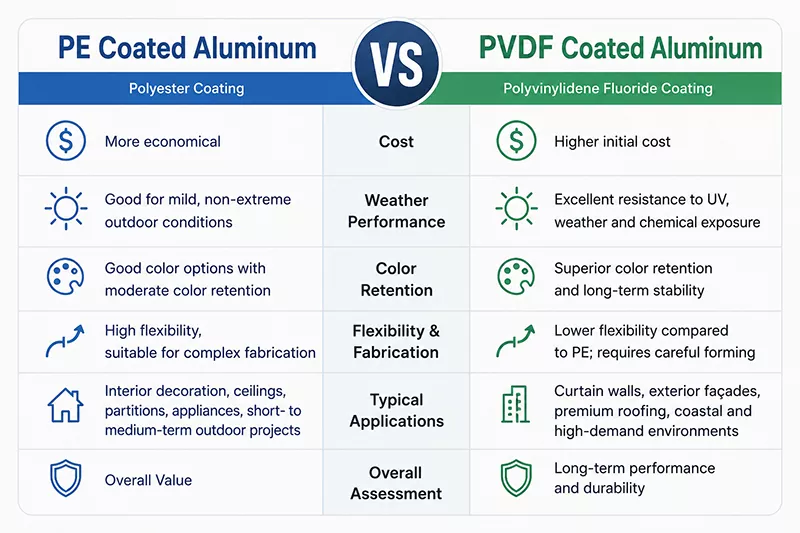
PE vs PVDF Coated Aluminum
| Property | PE Coated Aluminum | PVDF Coated Aluminum |
| Coating type | Polyester | Polyvinylidene fluoride (PVDF) / fluorocarbon resin system |
| Outdoor service life | Typically around 5–8 years, depending on the environment and coating quality | Typically around 20–30 years, with high-quality coating systems capable of providing even longer outdoor weathering performance |
| Initial cost | Generally lower | Generally higher |
| UV resistance | Good for many general applications | Excellent for demanding exterior exposure |
| Color retention | More sensitive to long-term UV exposure | Superior long-term color and gloss retention |
| Weather resistance | Suitable for moderate environments | Designed for severe and long-term outdoor exposure |
| Flexibility | Generally very good | Good, but formulation and coating system matter |
| Formability | Suitable for many bending and forming operations | Suitable for forming, but process control is important |
| Chemical resistance | Moderate | High |
| Typical use | Interior and general-purpose exterior products | Architectural and demanding exterior applications |
The actual service life of PE and PVDF coatings is not a fixed number. Factors such as sunlight intensity, temperature and humidity, air pollution, salt spray exposure, installation orientation, coating thickness, primer system, application quality and routine maintenance can all affect long-term performance.
What Are PE Coated Aluminum and PVDF Coated Aluminum?
PE Coated Aluminum: Polyester Coated Aluminum
PE coated aluminum uses a polyester-based coating to provide color, surface protection and a smooth decorative finish. It is widely used for aluminum coils and sheets because it offers good coating adhesion, a broad range of colors and good flexibility during fabrication.
One of the main advantages of PE coating is its good formability. The coating can generally withstand bending, roll forming, pressing and other fabrication processes with a lower risk of cracking when the material is properly selected and processed. This makes PE coated aluminum coil a practical option for interior decoration, light-duty panels and outdoor projects where weathering requirements are moderate and cost is an important consideration.
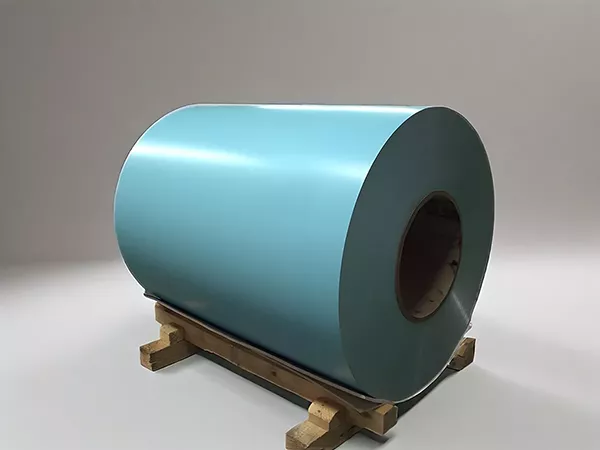
PVDF Coated Aluminum: Fluoropolymer Coated Aluminum
PVDF coated aluminum uses a fluoropolymer-based coating designed for demanding outdoor environments. Compared with standard polyester coatings, PVDF generally provides stronger resistance to ultraviolet exposure, color fading, chalking, moisture and atmospheric corrosion.
For this reason, PVDF coated aluminum coil is commonly selected for curtain walls, commercial building facades, airports, stadiums, architectural roofs and other exterior applications where long-term appearance and weather resistance are important. Although the initial material cost is usually higher than PE coated aluminum, the longer-lasting finish can be valuable for projects where repainting or replacement would be difficult.
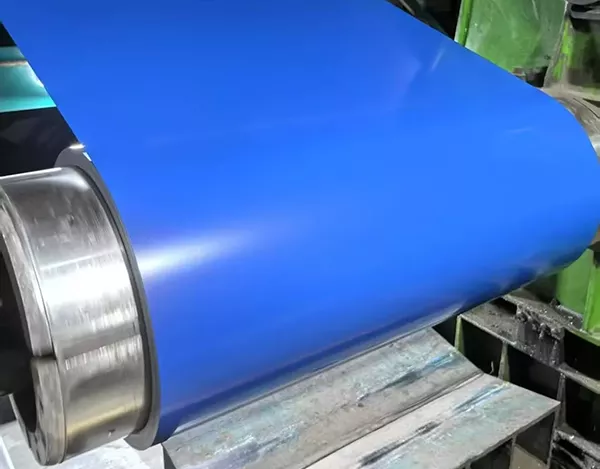
Outdoor Durability: PVDF Is Better Suited to Long-Term Building Projects
For outdoor applications, coating durability is often one of the most important factors when choosing between PE and PVDF. PE coatings can meet the requirements of many short- and medium-term outdoor applications, but prolonged exposure to strong UV radiation, high temperatures, heavy rainfall or industrial pollution may gradually lead to loss of gloss, color fading and chalking.
For this reason, PE coated aluminum is often a practical choice for temporary architectural decoration, short-term advertising facilities, general outdoor signs and applications where long-term appearance retention is not a primary concern. If a project is expected to be replaced or renovated within a few years, PE coating can help reduce the initial material cost.
PVDF coating is better suited to building projects with a longer expected service life. Its fluoropolymer coating system provides stronger resistance to prolonged exposure to sunlight, rain and temperature or humidity changes, making it a common choice for commercial complexes, office buildings, transportation facilities, high-end residential developments and large public buildings.
For metal roofing, the coating is exposed to solar radiation, rainfall and repeated thermal expansion and contraction over many years. The required weathering performance should therefore be considered carefully. You can also explore Color Coated Aluminum Coil for Roofing and select a suitable coating system based on the local climate, expected building service life and project budget.
UV Resistance and Color Retention: PVDF Has a Clearer Advantage
Ultraviolet radiation gradually affects the resins and pigments in an organic coating. PE coatings can provide good color and gloss when new, but prolonged exposure to strong sunlight may cause certain dark, highly saturated or bright colors to show greater changes in color and gloss, along with possible chalking over time.
PVDF coatings generally provide better resistance to UV exposure, making them a strong option for dark gray, black, blue, red and other architectural colors where long-term color retention is important. On building facades, stable color not only affects the overall appearance but can also help reduce visible color differences when individual panels need to be replaced later.
PVDF coating is worth considering for projects located in environments such as:
- High-altitude, desert, tropical or strongly sun-exposed regions
- Areas with high summer temperatures and intense UV radiation
- Coastal locations with high humidity or salt spray
- Industrial areas near chemical plants, steel mills, power plants or other sources of atmospheric pollution
- Commercial and public buildings where long-term facade color consistency is important
For architectural facade projects, Color Coated Aluminum for Curtain Wall should be selected with consideration for building height, panel orientation, climate, color design and the expected maintenance cycle. For high-rise curtain walls and landmark buildings, PVDF is often the more reliable long-term option.
Flexibility and Formability: PE Is Better for Complex Bending
PE coatings are generally more flexible and have good elongation during fabrication. During bending, roll forming, profiling, stamping and slitting, PE coated aluminum can adapt well to various forming operations and may reduce the risk of coating cracks when the appropriate coating and processing conditions are used.
For interior decorative panels, advertising components, appliance housings, ceiling panels, metal trim and other products that require relatively tight bending radii, PE coating can offer greater processing convenience. When further slitting, bending or component fabrication is required, Color Coated Aluminum Strip can be customized according to width, thickness, color, coating system and fabrication requirements.
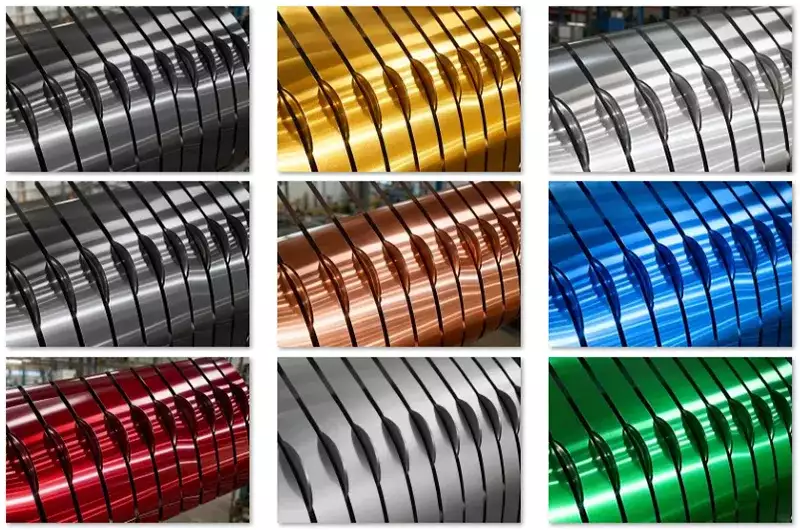
PVDF coatings are generally harder and provide stronger weathering performance, but complex forming operations require closer control of the bending radius, coating thickness and forming process. For demanding PVDF coated aluminum projects, it is advisable to conduct sample bending tests, adhesion tests and surface inspections before full-scale production.
Corrosion and Chemical Resistance: PVDF Is Preferred for Coastal and Industrial Environments
Standard PE coatings can perform well in normal humidity and mildly polluted environments. However, prolonged exposure to salt spray, acid rain, alkaline dust, condensation or industrial emissions can place greater demands on the coating system and affect its long-term performance.
PVDF coatings generally offer better resistance to a range of chemical and atmospheric exposures, giving them an advantage in more corrosive environments. PVDF is often worth considering for projects such as:
- Seaside hotels, port facilities, island residences and coastal commercial buildings
- Building envelope systems near chemical plants, steel mills, power plants and mining areas
- Urban areas with high humidity, salt exposure, heavy pollution or frequent acid rain
- High-rise facades and large-span roofs where maintenance and replacement are difficult
- Public and large commercial buildings where reducing the frequency of long-term refurbishment is important
If a project requires better weathering performance than standard PE but the budget does not allow PVDF throughout, HDP coated aluminum coil can also be considered. HDP coating can provide a useful balance between weathering performance and cost for medium- to long-term exterior wall, roofing and architectural applications.
Cost Comparison: Look Beyond the Price Per Ton
PE color-coated aluminum usually has a lower initial purchase cost, making it a cost-effective choice for indoor projects, short-term outdoor applications, advertising materials, and budget-sensitive projects.
PVDF color-coated aluminum is generally more expensive, mainly due to the cost of fluorocarbon resin, higher coating-process requirements, and stricter quality-control standards. However, if a project is designed for a service life of 20 years or longer, PVDF's advantages in low maintenance, reduced refurbishment, long-term color retention, and fewer replacements may lower the overall life-cycle cost.
When purchasing, it is recommended not to compare material prices alone, but to evaluate the following costs:
- Initial material procurement cost
- Processing losses from bending, roll forming, stamping, and other fabrication operations
- Installation and transportation costs
- Subsequent cleaning, maintenance, and repair costs
- Costs of repainting, removal, or replacement
- The potential impact of building appearance deterioration on commercial image.
Procurement Recommendation: If the material is intended for indoor use or for projects with a short service life, PE coating typically offers a better cost advantage. If the material will be installed on high-rise building facades, long-term outdoor roofing, or in coastal environments, the higher initial investment in PVDF will generally provide more stable long-term performance.
Common Applications of PE Coated Aluminum
PE color-coated aluminum is suitable for applications in relatively mild environments where long-term outdoor weather resistance is not a primary requirement. Its good formability and lower cost make it a common material for interior decoration and general industrial processing.
- Interior wall panels and aluminum suspended ceilings
- Household appliance housings and panels
- Shopping mall display racks, advertising signs, and signboards
- Interior decorative panels and metal partitions
- Temporary buildings and short-term decoration projects
- General bent parts, roll-formed parts, and decorative trims
- Products requiring deep drawing, stamping, or complex forming.
In addition to coating type, the aluminum alloy grade also affects material strength, corrosion resistance, and processing performance. For example, 1100 Color Coated Aluminum Sheet is suitable for applications requiring high formability and surface decoration performance, while 1050 Color Coated Aluminum Sheet Coil offers good ductility and is commonly used in general processing and decorative applications.
For architectural decorative materials requiring higher strength and better corrosion resistance, 3003 Color Coated Aluminum Coil is a common choice. Compared with pure aluminum, 3003 aluminum alloy generally provides better strength and corrosion resistance, making it suitable for a wide range of architectural and industrial processing applications.
Common Applications of PVDF Coated Aluminum
PVDF color-coated aluminum is suitable for projects with higher requirements for durability, weather resistance, and consistent building appearance. Particularly in environments with intense sunlight, complex climates, heavy pollution, or difficult maintenance conditions, PVDF coatings generally provide more reliable long-term protection.
- Building curtain walls and exterior facade systems
- Premium aluminum solid panels and decorative panels
- Exterior walls of commercial complexes, office buildings, and large public buildings
- Airports, railway stations, stadiums, and exhibition centers
- High-rise buildings, landmark buildings, and urban renewal projects
- High-end metal roofing and wall cladding systems
- Buildings in coastal areas, industrial zones, or regions with high salt spray or heavy pollution.
For engineering-grade sheets requiring higher strength and corrosion resistance, 5052 Color Coated Aluminum Sheet is worth considering. 5052 aluminum alloy offers good corrosion resistance and is suitable for humid environments, marine climates, and certain industrial environments.
Where sheet strength, roofing fabrication performance, and weather resistance must all be considered, 3005 Pre-painted Aluminum Coil is also commonly used for building envelope systems, roofing panels, and decorative sheet applications. For common architectural sheet applications, 3105 Prepainted Aluminum Coil is likewise a widely used material option.
Should You Choose PE or PVDF for Wood Grain and Stone Grain Finishes?
Wood grain and stone grain coated aluminum can retain the advantages of metal materials, including lightweight properties, easy processing, and corrosion resistance, while creating a decorative appearance closer to natural wood or stone. Depending on the surface process, wood grain and stone grain effects can be achieved through coil coating, heat transfer printing, or other coating methods.
For interior ceilings, wall panels, retail decoration, exhibition halls, and commercial space decoration, PE-coated wood grain or stone grain aluminum materials can usually meet application requirements. You can learn more about the different decorative applications of Wood Grain Aluminum Coil and Stone Grain Coated Aluminum Sheet.
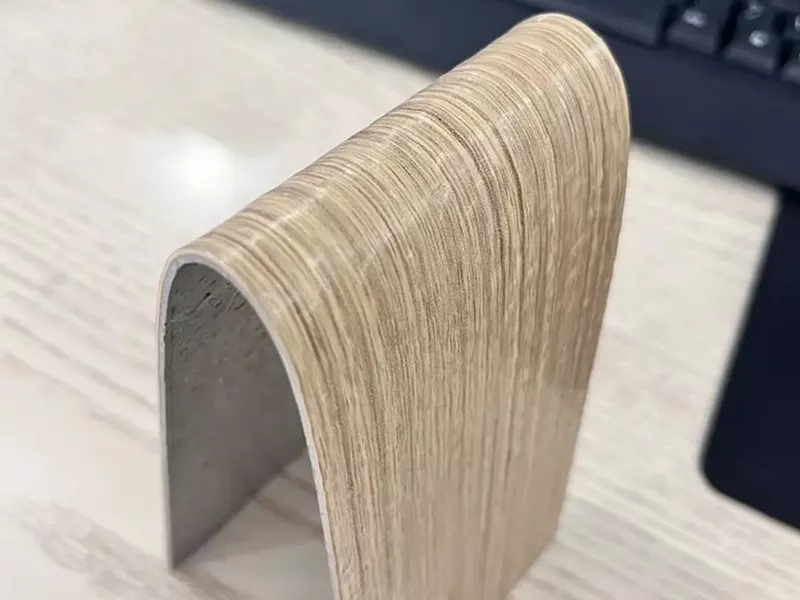
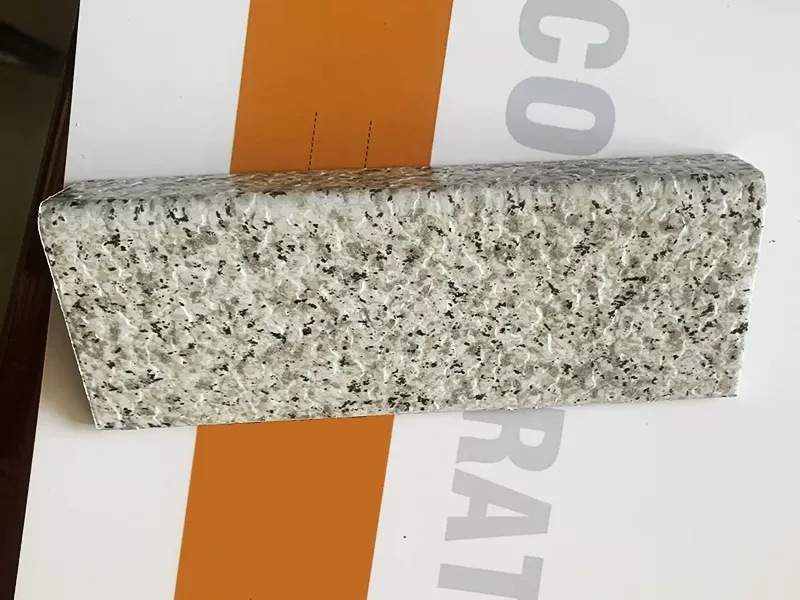
However, if wood grain or stone grain materials are used for building facades, balconies, shading systems, outdoor grilles, or areas exposed to long-term sunlight, it is recommended to clearly confirm the coating weather-resistance grade, surface treatment process, overall color fastness, and the climate conditions of the project location. Even if the decorative effect looks highly realistic, insufficient coating weather resistance may lead to fading over time and affect the overall quality and appearance of the building.
How to Choose: PE, HDP or PVDF?
Choose PE Coating When
- The project is mainly for indoor use
- Long-term outdoor service life is not required
- The project has a limited budget
- The sheet requires complex bending or stamping
- The environment has no strong UV exposure, salt spray or industrial pollution
Choose HDP Coating When
- The material is intended for general outdoor environments
- Better weather resistance than PE is desired
- A balance between budget and service life is needed
- The roofing or wall system requires medium- to long-term service
- A certain level of color retention is required
Choose PVDF Coating When
- The material is intended for long-term outdoor building facades
- The project is located in a coastal, high-temperature or high-UV environment
- The material will be exposed to salt spray, acid rain or industrial pollution
- Building maintenance or replacement is difficult
- The project prioritizes long-term color retention and appearance stability
Before placing the final order, it is recommended to confirm the coating type, total dry film thickness, front and back coating, color code, gloss level, aluminum alloy grade, sheet thickness, width, coil weight, surface protection film and applicable quality standards. For more purchasing and selection guidance, see How to choose color coated aluminum coil .
FAQ – PE vs PVDF Coated Aluminum
Can PE coated aluminum be used outdoors?
Yes. PE coated aluminum is suitable for short-term outdoor applications or relatively mild environments, such as general signage, temporary structures and decorative components with low maintenance requirements. For projects exposed to strong sunlight, frequent rain, salt spray, acid rain or industrial pollutants over long periods, HDP or PVDF coating is generally a better choice.
Is PVDF coating always better than PE coating?
Not necessarily. PVDF offers better weather resistance, corrosion resistance and color retention, but it also costs more. For interior decoration, appliance panels, short-term projects or components requiring extensive forming, PE can be a more economical and practical option. The right coating should be selected according to the actual application rather than simply choosing the highest-grade coating.
Can PVDF coated aluminum be bent?
Yes, PVDF coated aluminum can be bent, but the bending radius and forming method should be considered carefully. PVDF coatings are generally harder than PE coatings, so sample testing is recommended for very tight bends, deep drawing or complex stamping processes to help prevent coating cracks, peeling or surface damage.
Which coating is better for aluminum roofing?
For standard roofing projects, PE or HDP coated aluminum can be selected according to the project budget and service requirements. For premium roofing systems, long-term outdoor projects, coastal areas, regions with strong UV exposure or applications where maintenance is difficult, PVDF is generally the more suitable choice.
What should be considered besides the coating when choosing coated aluminum?
In addition to the coating type, buyers should consider the aluminum alloy, thickness, width, coating thickness, color, gloss, back-coating requirements, protective film, coil weight, fabrication method and service environment. Different applications have different requirements for strength, formability and corrosion resistance, so the intended application should be clearly defined before purchasing the material.
PE vs PVDF Coated Aluminum: Which Coating Is Right for Your Project?
When choosing between PE vs PVDF Coated Aluminum, PE offers advantages in cost, flexibility and ease of processing, making it suitable for interior decoration, appliance panels, advertising materials and general short-term outdoor applications; PVDF offers better weather resistance, color retention, corrosion resistance and lower maintenance requirements, making it more suitable for curtain walls, exterior facades, roofing, coastal buildings and long-term outdoor projects.
If the main priority of a project is controlling the initial budget and the material will be used mainly indoors or in short-term outdoor environments, PE coated aluminum is a reliable choice. For high-rise curtain walls, metal roofing, coastal buildings or projects exposed to sunlight and pollutants for extended periods, PVDF coated aluminum is generally a more worthwhile investment.
Before finalizing a purchase, it is recommended to evaluate the aluminum alloy, coating thickness, color, fabrication method and local environmental conditions together. By selecting the appropriate PE, HDP or PVDF coating system, a more suitable balance can be achieved between material cost, processing efficiency, architectural appearance and long-term maintenance.
Users viewing this material also viewed the following
- Color Coated Aluminum Sheet Coil
- Copper mirror aluminum sheet coil
- Blue mirror aluminium sheet coil
- Gray mirror aluminum sheet coil
- Violet mirror aluminum sheet coil
- Red mirror aluminum sheet coil
- Pink mirror aluminum sheet coil
- Brown mirror aluminum sheet coil
- Golden mirror aluminum sheet coil
- Black aluminum mirror sheet coil
- Colored Coated Embossed Aluminum Roofing Coil
- 1050 Color Coated Aluminum Sheet Coil
- 3005 Pre-painted Aluminum Coil
- Color Coated Aluminum Strip
- PE Coated Aluminum Coil
- HDP Coated Aluminum Coil
- PVDF Coated Aluminum Coil
- Wood Grain Aluminum Coil
- Stone Grain Coated Aluminum Sheet
- 5052 Color Coated Aluminum Sheet
- 1100 Color Coated Aluminum Sheet
- Color Coated Aluminum Sheet Coil for Curtain Wall
- Color Coated Aluminum Foil
Recommended Content