
With its lightweight, high strength, and corrosion resistance, 5083 aluminum plate is an ideal material for automotive body manufacturing, especially suitable for chassis skid plates, fuel tanks, and body panels. It has excellent weldability, with weld strength reaching over 90% of the base material, and good cold working properties, making it suitable for complex stamped shapes.
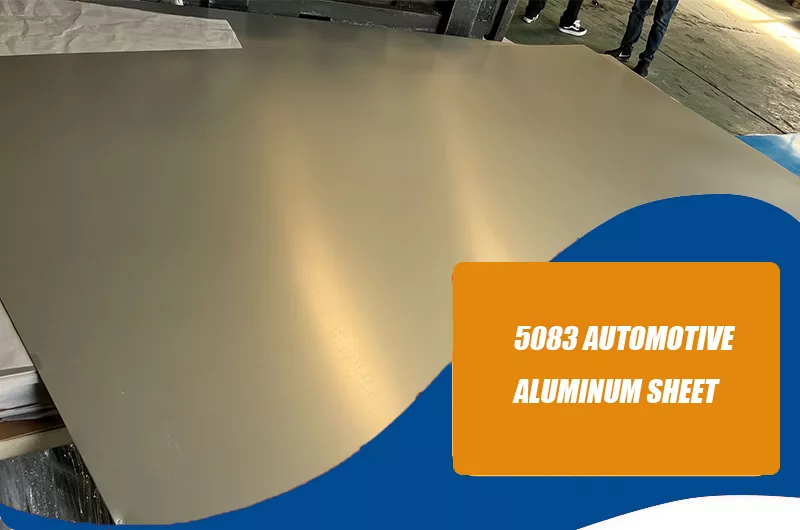
In lightweight design, 5083 aluminum plate can significantly reduce vehicle weight, improve fuel efficiency, and simultaneously meet crash safety requirements.
5083 aluminum plate is a very important aluminum alloy, but it is generally not used for the main occupant cabin structure of cars or SUVs (such as doors, roofs, or side panels). Instead, it is widely used in commercial vehicles, special-purpose vehicles, automotive structural supports, and truck bodies.
Why Choose 5083 Aluminum Plate?
- Lightweight: Compared to traditional steel, aluminum alloys are lighter, effectively reducing vehicle weight, which in turn lowers fuel consumption and emissions.
- High Strength: 5083 aluminum plate has relatively high strength, meeting the strength and rigidity requirements of automotive body structures.
- Corrosion Resistance: This alloy exhibits excellent corrosion resistance, making it suitable for applications in various environments.
5083 Automotive Aluminum Sheet Panel Sizes
| Alloy | Temper | Thickness(mm) | Width(mm) | Length(mm) |
| 5083 | O/H32/H111 | 4.0-8.0 | 1500-2650 | 2000-12000 |
Characteristics of 5083 Aluminum Plate
- Excellent Corrosion Resistance: Especially in marine and chemical industry environments, it has outstanding corrosion resistance. This makes it ideal for vehicle components that may be exposed to de-icing agents, salt spray, and other harsh conditions.
- High Strength: Among the 5000 series non-heat-treatable alloys, 5083 is one of the strongest. Its strength is significantly higher than the more common 5052 aluminum plate.
- Good Weldability: Weld joints have high efficiency, the strength of the welded area remains well after welding, and it is not prone to welding cracks.
- Work Hardening Capability: It cannot be strengthened by heat treatment, but its strength can be increased through cold working processes such as rolling and stamping.
- Moderate Formability: Its formability is not as good as some 5052 or 6000 series alloys (such as 6016, 6181A), so it is not suitable for deep drawing or very complex-shaped body panels.
- Low-Temperature Performance: Its mechanical properties improve uniformly at low temperatures, which is beneficial for certain applications, such as commercial vehicles.
The chemical composition of 5083 aluminum for automotive body sheet panels
| Element | Composition (%) |
| Si | 0.40 |
| Fe | 0.40 |
| Cu | 0.10 |
| Mn | 0.40-1.0 |
| Mg | 4.0-4.9 |
| Cr | 0.05-0.25 |
| Ni | - |
| Zn | 0.25 |
| Ti | 0.15 |
| Al | Remainder |
The mechanical property of 5083 automotive sheet metal body panels
| Alloy Temper | Thickness mm | Tension Strength Rm N/mm2 | Yield Strength R p0.2 N/mm2 | Elongation A 50 min % |
| 5083 O H111 | 6.30-12.50 | 270-345 | 115 | ≥16 |
| 5083 H32 | 0.70-1.50 | 305-380 | 215 | ≥6 |
Advantages and Disadvantages of 5083 Aluminum Plate in Automotive Body Applications
Advantages of 5083 Automotive Aluminum Sheet
- Lightweight: Compared to steel plates, the density of 5083 aluminum plate is only about one-third of steel. Using it can significantly reduce vehicle weight, lowering fuel or electricity consumption and increasing driving range.
- High Strength and Stiffness: Provides good structural support, ensuring the durability and solidity of key components.
- Excellent Durability: Outstanding corrosion resistance means longer life for body components, better rust resistance, and lower maintenance costs.
- Easy Welding: 5083 is an ideal choice for vehicle body structures that require welded assembly.
Disadvantages of 5083 Automotive Aluminum Sheet
- Relatively Poor Formability: Modern passenger car body panels (such as hoods, doors, and fenders) have complex shapes and require excellent stamping formability. 5083 is prone to cracking or excessive springback during complex stamping, leading to lower yield rates.
- Surface Finish: Exterior components for cars usually require a high-quality paint finish. 6000 series alloys (such as 6016) achieve a smoother surface after stamping and painting. 5083 is slightly inferior in this aspect.
- Cost-Performance Balance: For passenger car bodies, 6000 series alloys (such as 6016, 6181A) strike a better balance between formability, strength, and paint hardening, making them the mainstream choice.
Applications of 5083 Automotive Aluminum Sheet
Applications of 5083 Aluminum Plate in Automobiles
- Body Structural Components: Used for inner body panels and components requiring high strength and complex processing.
- Underbody Skid Plates and Fuel Tanks: Suitable for manufacturing automotive underbody protection plates and fuel tanks.
- Other Components: Also used for bus body panels, tank bodies, and some commercial vehicle parts.
- Structural Parts: Bumpers, chassis, and other structural elements.
- Body Panels: Side panels, fenders, doors, and outer body shells.
- Additional Parts: Fuel tanks, wheel hubs, and underbody protection plates.
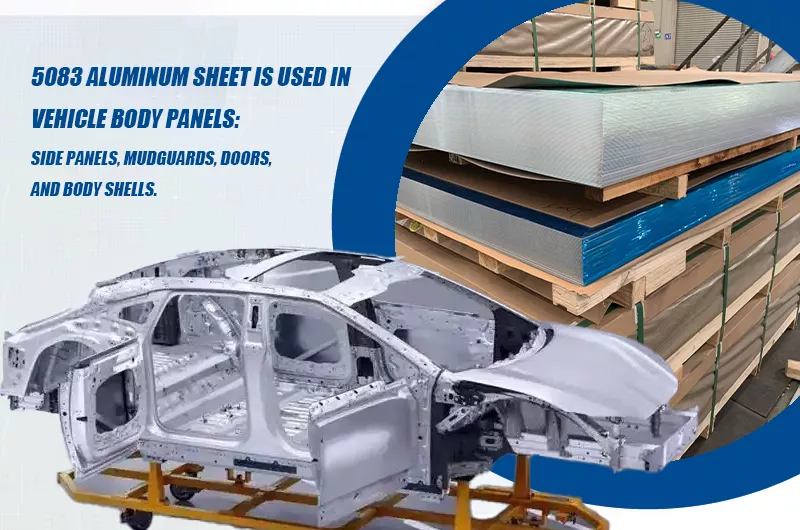
Body Structural Components
- Doors, Hood: H32/H111 temper plates achieve lightweight design while ensuring rigidity. Using 5083-H32 for doors reduces weight by 25% and improves dent resistance by 18%.
- Chassis and Suspension: H112 temper plates are used for suspension brackets and underbody skid plates, capable of withstanding complex road impacts. Skid plates made of 5083-H112 retain 92% of their room-temperature strength even at -30℃.
Panels and Functional Components
- Roof and Side Panels: O temper plates can be roll-formed into curved structures. Roofs using 1.2mm thick 5083-O aluminum plates achieve surface flatness of ±0.15mm, meeting Class A surface requirements.
- Fuel Tanks and Air Reservoirs: 5083 aluminum plates have better fuel corrosion resistance than steel. For heavy truck fuel tanks using 5083-H111, service life extends from 5 to 10 years, and weight is reduced by 40%.
Interior and Footboards
5083 patterned aluminum plates (e.g., diamond pattern) are used for footboards, with surface roughness Ra≤1.6μm, slip coefficient ≥0.6, and can achieve customized appearance through anodizing.
Automotive Applications of 5083 Aluminum: From Trucks to EVs
Commercial Vehicles and Truck Bodies:
- Refrigerated Trucks/Container Boxes: High strength and corrosion resistance of 5083 make it an excellent choice for refrigerated truck panels.
- Truck Trailers: Used for dump truck beds, freight truck bodies, tankers, etc., able to withstand heavy loads and harsh conditions.
- Cement Mixer Drums: Its wear and corrosion resistance make it highly suitable for this application.
Special Vehicles:
- Fire trucks and rescue vehicles: body structures and equipment racks.
- Mining trucks: body components.
- Armored personnel carriers: ballistic armor plates (higher-spec 5083 or similar alloys).
Non-Exterior Structural Components in Passenger Cars:
- Reinforcements and crossbeams in vehicle chassis.
- Some load-bearing structural components in the body frame.
- Battery enclosures: For new energy vehicles, 5083 is often considered for battery protection shells due to its strength, stiffness, and corrosion resistance.
Comparison of 5083 Automotive Aluminum Sheet with Common Automotive Body Aluminum
| Property | 5083 Aluminum Plate | 5052 Aluminum Plate (More General) | 6016 Aluminum Plate (Mainstream Passenger Car Body) | 6061 Aluminum Plate (Structural Components) |
| Main Advantages | High strength, corrosion-resistant, good weldability | Good formability, corrosion-resistant | Excellent stamping formability, paint hardening | High strength, good machinability, heat-treatable |
| Main Disadvantages | Poor formability | Lower strength | Strength lower than 5083/6061 | Moderate weldability, average corrosion resistance |
| Typical Automotive Applications | Truck bodies, tankers, structural supports | Interior components, fuel tanks, simple panels | Engine hoods, doors, fenders, and other exterior panels | Chassis frames, suspension parts, crash beams |
Precautions for 5083 Automotive Aluminum Sheet
- Non-Heat-Treatable: 5083 is a non-heat-treatable alloy, and its strength characteristics are mainly achieved through cold working and tempering.
- Machinability: Although it has high strength, its machinability is limited, making it more suitable for structural or specific part applications.
- Cost: Compared to some other materials, aluminum alloys may have relatively higher costs, but this is justified by improved vehicle performance and fuel economy.
What is the Best Aluminum for Automotive?
When choosing the most suitable aluminum for automotive applications, it depends on the specific component and performance requirements (e.g., structural parts, body panels, heat exchangers, or battery enclosures).
5xxx Series Aluminum Alloys (Al-Mg alloys, e.g., 5083, 5754, 5182)
Best for: Body panels, truck beds, chassis, automotive structural components.
Advantages:
- Excellent corrosion resistance (especially in coastal and high-salt environments)
- Good stamping and bending formability
- Weldable
- Good impact resistance
Examples: Pickup truck beds, van panels, EV battery enclosures, commercial vehicle bodies.
6xxx Series Aluminum Alloys (Al-Mg-Si alloys, e.g., 6061, 6082, 6016)
Best for: Structural components requiring higher strength and moderate corrosion resistance.
- Higher strength than 5xxx series alloys (heat-treatable)
- Good corrosion resistance
- Excellent machinability
Examples: Chassis parts, suspension components, structural frames.
7xxx Series Aluminum Alloys (Al-Zn-Mg alloys, e.g., 7075)
Best for: High-performance or lightweight automotive components requiring extremely high strength.
- Extremely high strength
- Lightweight
Limitations:
- Corrosion resistance is lower than 5xxx or 6xxx series alloys
- Welding and forming are more challenging
Examples: Sports car components, high-performance brackets, racing car parts.
Considerations for EVs and Lightweighting
Aluminum alloys used for EV battery enclosures and frames need to balance the following:
- Corrosion resistance
- High stiffness and strength
- Formability (suitable for complex shapes)
Common choices: 5083, 5182, 6061, depending on structural or corrosion requirements.
- For general automotive body and structural panels: 5xxx series (e.g., 5083, 5754) is the best choice due to corrosion resistance and formability.
- For structural frames and high-strength components: 6xxx series is usually preferred.
- For ultra-high-performance applications: 7xxx series may be used.
With its combination of lightweight, high corrosion resistance, and ease of processing, 5083 aluminum plate has become a key material in automotive body manufacturing, particularly showing significant advantages in new energy vehicles and commercial vehicles. Although slightly more expensive than alloys like 6061, its lifecycle economic benefits and environmental properties make it indispensable in high-end vehicles and harsh environment applications.