
5083 h111 aluminum plate sheet
5083-H111 aluminum plate is a typical 5000 series Al-Mg corrosion-resistant aluminum alloy sheet, with magnesium (approximately 4.0–4.9%) as the main alloying element, supplemented by trace elements such as manganese and chromium to form a high-magnesium alloy. This material is a non-heat-treatable alloy, and its properties are mainly obtained through work hardening. It has extensive application value in marine grade aluminum plates and welded structural fields.
H111 is a common supply temper of the 5083 alloy, indicating that the sheet has only undergone light strain hardening after final annealing, with a lower degree of work hardening than the H11 temper requirement. This temper achieves a good balance between strength and formability: compared with the O temper, it has higher mechanical strength while still maintaining excellent ductility and processing adaptability, suitable for bending, forming, and subsequent structural manufacturing. Therefore, 5083 H111 aluminum sheet is often regarded as an ideal material choice for general-purpose medium-strength welded structures.
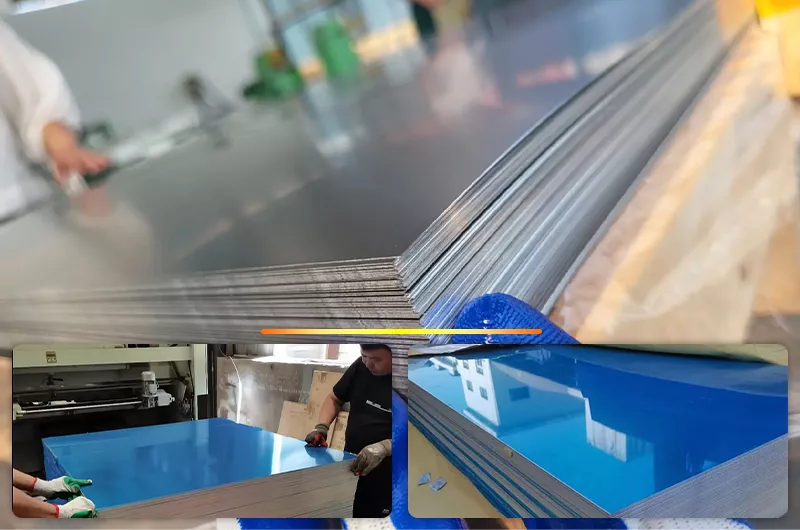
As one of the marine-grade aluminum alloys, 5083 H111 exhibits outstanding corrosion resistance, especially stable performance in seawater or high-humidity salt spray environments, effectively reducing long-term maintenance costs. At the same time, it has excellent weldability, with reliable welded joint quality, and is widely used in shipbuilding, pressure vessels, transportation equipment, and engineering structures.
In terms of temper performance comparison:
- Compared with H116: strength and corrosion resistance are slightly lower, but plasticity and formability are better
- Compared with O temper: strength is significantly improved
- Suitable for applications emphasizing processing and bending performance rather than ultimate strength
5083-H111 aluminum alloy plate combines corrosion resistance, weldability, and moderate strength, making it a reliable material option that balances processing flexibility and durability in marine aluminum sheets, structural plates, and general manufacturing fields.
Haomei 5083 H111 Aluminum Alloy Product Specifications
| Alloy | 5083 |
| Material temper | h111 |
| Thickness (mm) | 0.1-500 |
| Width (mm) | 100-2800 |
| Length (mm) | Customize |
| Typical product | boat buling, vehicle bodies, welding parts, tread plate, etc. |
Haomei 5083 H111 Aluminum Product Forms
5083 H111 Sheet
5083 H111 aluminum sheet is a thin, flat form of aluminum alloy with excellent corrosion resistance and moderate strength. It is widely used in marine, transportation, and construction applications where lightweight and durability are required. The sheet can be easily cut, bent, or formed into complex shapes.
5083 H111 Plate
5083 H111 aluminum plate is a thicker version of the alloy, offering higher strength and rigidity compared to the sheet. It is suitable for heavy-duty structural components, pressure vessels, and marine equipment. Its excellent weldability and corrosion resistance make it ideal for harsh environments.
5083 H111 Round Bar
5083 H111 round bar is a cylindrical aluminum alloy form, designed for machining into shafts, rods, and other mechanical components. It retains excellent corrosion resistance and good mechanical strength, suitable for marine, automotive, and aerospace industries. The round bar can be cut, drilled, or machined to precise specifications.
Aluminium 5083 H111 Features
5083 H111 aluminum is a typical Al-Mg corrosion-resistant alloy and a non-heat-treatable material. The H111 temper represents light work hardening while maintaining high ductility, thus achieving a good balance between strength, formability, and corrosion resistance. It is widely used in marine aluminum plates, shipbuilding aluminum, and cryogenic tank materials. Its main performance features are as follows:
Excellent Corrosion Resistance
Thanks to its high magnesium content, 5083 H111 exhibits strong corrosion resistance in seawater, marine atmospheres, and industrial chemical environments. It is especially suitable for structural components exposed long-term to humid and high-salt environments, making it a typical marine-grade aluminum.
Moderate Strength with High Ductility
Compared with stronger tempers such as H116, H111 has slightly lower strength but is still significantly higher than pure aluminum and 1xxx/3xxx series alloys. At the same time, it retains plasticity close to the annealed state, suitable for stamping, bending, cold forming, and other complex forming requirements. It usually meets the balance of strength and workability required for most non-heavy-duty structural applications.
Excellent Forming and Machining Performance
The H111 temper has good cold working adaptability, suitable for shearing, stamping, rolling, and structural processing, improving manufacturing efficiency and reducing the risk of processing cracks.
Stable Low-Temperature Performance
5083 does not become brittle at low temperatures; instead, it maintains or even increases strength and toughness. It remains reliable under extremely low-temperature conditions (such as liquefied gas storage and transportation equipment), making it commonly used in cryogenic aluminum applications.
Non-Heat-Treatable Strengthening
As a non-heat-treatable alloy, its strength improvement relies mainly on work hardening rather than quenching and aging, meaning the material structure is stable and performance fluctuations during service are minimal, suitable for long-term service environments.
5083 H111 Aluminum Plate Corrosion Resistance
5083 H111 aluminum plate is a typical Al-Mg high-magnesium corrosion-resistant aluminum alloy, known for its excellent corrosion resistance. Its high magnesium content provides outstanding resistance in seawater, humid marine atmospheres, and industrially polluted environments, effectively resisting pitting and long-term corrosion. Therefore, it is widely used in marine aluminum plates, shipbuilding materials, and offshore structures.
In practical engineering applications, the corrosion resistance of 5083 alloy is a key reason for its adoption in shipbuilding and marine engineering. Whether used for hull structures, deck components, or offshore equipment, it maintains stable performance and a long service life in high-salt spray environments.
It should be noted that different tempers emphasize corrosion resistance differently. In addition to the H111 temper, 5083-H116 and 5083-H321 aluminum plates undergo stabilization treatment, showing particularly excellent performance in exfoliation corrosion resistance and stress corrosion cracking resistance, suitable for more severe marine service conditions.
With its stable and reliable corrosion resistance, 5083 H111 aluminum plate has become a common and mature marine-grade aluminum solution in shipbuilding and marine engineering.
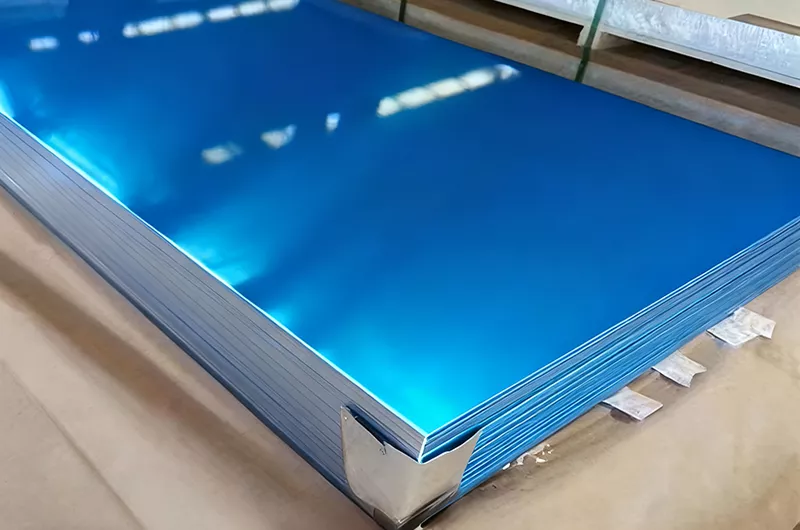
5083 H111 Aluminum Sheet Plate Chemical Composition
| Element | Composition % |
| Al | REM |
| Si | ≤0.4 |
| Cu | ≤0.10 |
| Mg | 4.0-4.9 |
| Zn | ≤0.25 |
| Mn | 0.40-1.0 |
| Ti | ≤0.15 |
| Cr | 0.05-0.25 |
| Fe | ≤0.40 |
| Note: Single≤0.05; Total≤0.15 | |
Mechanical Properties of 5083 H111 Aluminum Plate Sheet
| Alloy | Temper | Thickness mm | Tensile Strength RmMPa | Specified non-proportional tensile strength Rp0.2 Mpa | Elongation% | |
| A50 mm | A | |||||
| 5083 | O | 3.00-50.00 | 275-350 | ≥125 | ≥16 | ≥14 |
| 5083 | H111 | 3.00-50.00 | 275-350 | ≥125 | ≥16 | ≥14 |
| 5083 | H22, H32 | 3.00-6.00 | 305-380 | ≥215 | ≥8 | - |
| 5083 | H116 | 3.00-50.00 | ≥305 | ≥215 | ≥10 | ≥10 |
| 5083 | H321 | 3.00-50.00 | 305-385 | ≥215 | ≥12 | ≥10 |
| 5083 | H112 | 6.00-50.00 | ≥275 | ≥125 | ≥12 | ≥10 |
5083 H111 Aluminum Plate Sheet Reference Data for some Physical Properties
| Property | Value |
| Density | 2.65 kg/m³ |
| Melting Point | 570 °C |
| Thermal Expansion | 25 x 10⁻⁶ /K |
| Modulus of Elasticity | 72 GPa |
| Thermal Conductivity | 121 W/m·K |
| Electrical Resistivity | 0.058 x 10⁻⁶ Ω·m |
5083 H111 Equivalent
Standard equivalent grades of 5083 aluminum alloy
| Standard System | Equivalent Grade |
| USA (UNS) | A95083 |
| International Standard (ISO) | AlMg4.5Mn |
| UK (BS) | N8 |
| Germany (DIN) | 3.3547, AlMg4.5Mn |
| European Standard (EN) | EN AW-5083 |
Alternative aluminum alloys to 5083
| Alloy | Main Features | Applications |
| 5005 | Medium strength, good corrosion resistance | General use |
| 5052 | Medium strength, excellent corrosion resistance | General structural components |
| 5251 | Slightly higher strength than 5052 | Construction applications |
| 5383 | High strength, good weldability | High-strength structural components |
| 5086 | High corrosion resistance, moderate strength | Marine environments |
| 5454 | Medium strength, good weldability | Pressure vessels |
| 5754 | Good corrosion resistance, medium strength | General structural components |
These 5xxx series alloys have different chemical and mechanical properties, allowing selection of suitable alternative materials from low to high strength according to application needs.
5083 H111 Aluminum Plate Sheet Welding
When welding 5083 to itself or to other alloys from the same subgroup, the recommended filler metal is 5183. Other suitable filler materials include 5356 and 5556.
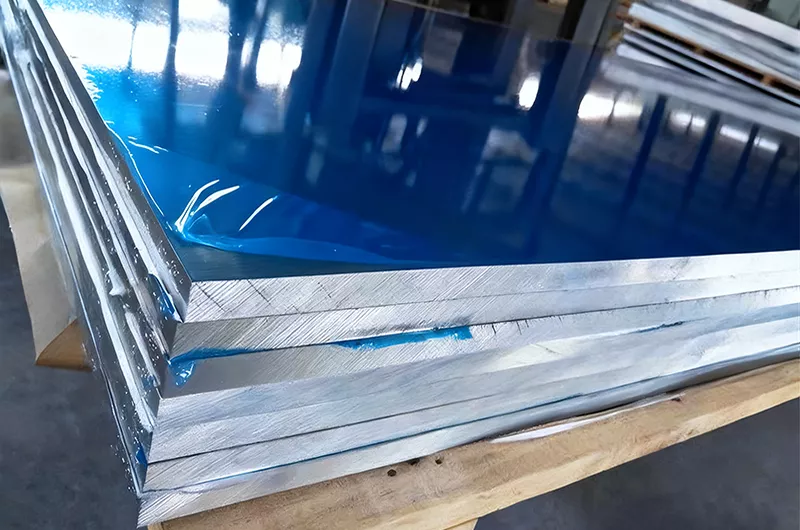
5083 H111 Aluminum Plate Sheet Stock List
| Description | Temper | Thickness/in | Form |
| ASTM B209 ASME SB209 5083-H111 Aluminum Sheet | H111 | 0.04" | Sheet |
| AMS4056, QQ-A-250/6 5083-H111 Aluminum Sheet | H111 | 0.04" | Sheet |
| ASTM B209, ASTM B928 5083-H111 Aluminum Sheet | H111 | 0.06" | Sheet |
| ASTM B209 ASME SB209 5083-H111 Aluminum Sheet | H111 | 0.06" | Sheet |
| AMS4056, QQ-A-250/6 5083-H111 Aluminum Sheet | H111 | 0.08" | Sheet |
| ASTM B209 ASME SB209 5083-H111 Aluminum Sheet | H111 | 0.08" | Sheet |
| AMS4056, QQ-A-250/6 5083-H111 Aluminum Sheet | H111 | 0.1" | Sheet |
| ASTM B928 5083-H111 Aluminum Sheet | H111 | 0.12" | Sheet |
| AMS4056, QQ-A-250/6 5083-H111 Aluminum Sheet | H111 | 0.16" | Sheet |
| ASTM B209, ASTM B928 5083-H111 Aluminum Sheet | H111 | 0.16" | Sheet |
| AMS4056, QQ-A-250/6 5083-H111 Aluminum Sheet | H111 | 0.2" | Sheet |
| ASTM B209 ASME SB209 5083-H111 Aluminum Plate | H111 | 0.24" | Plate |
| ASTM B209 ASME SB209 5083-H111 Aluminum Plate | H111 | 0.31" | Plate |
| ASTM B209 ASME SB209 5083-H111 Aluminum Plate | H111 | 0.39" | Plate |
| ASTM B209 ASME SB209 5083-H111 Aluminum Plate | H111 | 0.47" | Plate |
| ASTM B209 ASME SB209 5083-H111 Aluminum Plate | H111 | 0.63" | Plate |
| ASTM B209, ASTM B928 5083-H111 Aluminum Plate | H111 | 0.71" | Plate |
| ASTM B209 ASME SB209 5083-H111 Aluminum Plate | H111 | 0.87" | Plate |
| ASTM B209 ASME SB209 5083-H111 Aluminum Plate | H111 | 0.98" | Plate |
| ASTM B209 ASME SB209 5083-H111 Aluminum Plate | H111 | 1.1" | Plate |
| ASTM B209 ASME SB209 5083-H111 Aluminum Plate | H111 | 1.38" | Plate |
| AMS4056, QQ-A-250/6 5083-H111 Aluminum Plate | H111 | 1.77" | Plate |
| AMS4056, QQ-A-250/6 5083-H111 Aluminum Plate | H111 | 1.97" | Plate |
| AMS4056, QQ-A-250/6 5083-H111 Aluminum Plate | H111 | 2.36" | Plate |
| ASTM B209 ASME SB209 5083-H111 Aluminum Plate | H111 | 2.56" | Plate |
| AMS4056, QQ-A-250/6 5083-H111 Aluminum Plate | H111 | 2.76" | Plate |
| ASTM B209 ASME SB209 5083-H111 Aluminum Plate | H111 | 3.15" | Plate |
| ASTM B928 5083-H111 Aluminum Plate | H111 | 3.54" | Plate |
Applications of 5083 H111 Aluminum Plate Sheet
The 5083-H111 aluminum plate is widely used in various industries due to its excellent performance, including marine, aerospace, construction, and transportation sectors.
Marine and Shipbuilding Applications
5083 H111 aluminum alloy is an ideal material for shipbuilding, mainly used in:
- Hull structural components, including decks, sides, and bottom plates
- Superstructures of yachts and cruise ships
- Ship engine mounts
- Port infrastructure
- Offshore engineering structures
The high corrosion resistance and good weldability of 5083 H111 aluminum alloy make it particularly suitable for marine environments.
Transportation Applications
In the transportation sector, 5083 H111 aluminum alloy is mainly used for:
- Subway and light rail vehicle structural components
- Automotive body structures and panels
- Automotive fuel tanks and air reservoirs
- Bus and truck body panels
- Railway freight cars, such as C82 coal cars
The high strength and corrosion resistance of 5083 H111 aluminum alloy make it an ideal choice for lightweight transportation vehicles.
Pressure Vessels and Tanks
Applications of 5083 H111 aluminum alloy in pressure vessels include:
- Tanker trucks and transport containers
- Refrigerated trucks and refrigerated containers
- Aluminum ceilings for LNG storage tanks
- Air reservoirs
- GIS (Gas-Insulated Switchgear) housings
These applications take advantage of the excellent strength, corrosion resistance, and weldability of 5083 aluminum alloy.
Building and Structural Applications
In the construction field, 5083 H111 aluminum alloy can be used for:
- Building curtain walls and roof structures
- Architectural decorations and trims
- Bridge structural components
- Balcony and stair railings
- Building formwork and scaffolding
The corrosion resistance and moderate strength of 5083 aluminum alloy make it a reliable choice for construction applications.
Other Applications
Other applications of 5083 H111 aluminum alloy include:
- Drilling equipment and oil industry machinery
- Missile and aerospace components
- Rail transit equipment
- Side panels for power battery modules
- Precision machined components
5083 H111 Marine Grade Aluminum Plate
5083 H111 is a high-strength marine-grade aluminum alloy renowned for its excellent corrosion resistance, especially in marine environments. Due to its durability and performance, it is widely used in the construction of ships and structures.
| Property | Details |
| Corrosion Resistance | Excellent resistance to saltwater and marine environments. |
| Strength | High strength compared to other marine aluminum alloys. |
| Weldability | Good weldability for ease of fabrication and repair. |
| Typical Applications | Marine vessels, offshore platforms, structural components exposed to seawater. |
| Specifications | Thickness: 3mm to 100mm; Customizable width and length; Meets international marine and industrial standards. |
Aluminum 5083 H111 for Tankers
5083 H111 aluminum is specifically used in the construction of tankers due to its high strength and corrosion resistance. This alloy is suitable for harsh environments and demanding applications in the maritime industry.
| Property | Details |
| Strength | High tensile strength essential for structural integrity of tankers. |
| Corrosion Resistance | Superior resistance to seawater and corrosive substances. |
| Fabricability | Easily formed and welded, suitable for complex tanker designs. |
| Typical Applications | Tanker hulls, superstructures, storage tanks for marine fuels and cargo, various structural components. |
| Specifications | Thickness: 6mm to 50mm; Custom sizes based on design requirements; Conforms to industry standards for tanker construction. |
Aluminium 5083 H111 vs Other Tempers
| Temper | Strength Level | Formability | Typical Applications |
| O Temper | Lowest | Best | Deep-drawn parts, complex-shaped components |
| H111 | Medium | Good | General welded structures, ship superstructures, tankers |
| H112 | Similar to H111 | Good | Thick plates, extruded components |
| H116 | Higher | Medium | Marine engineering, ship decks (optimized stress corrosion resistance) |
| H32 | Higher | Medium | Load-bearing structures, mechanical parts |
- O: Fully annealed condition, the softest, suitable for further processing.
- H22: Semi-hard condition after solution treatment.
- H32: Hard condition after solution treatment and stabilizing annealing.
- H116: Provides higher corrosion resistance, suitable for harsh environments.
- H321: More stable than H32, suitable for applications requiring higher strength and stability.
- 5083-O (Annealed): The softest temper, lowest strength, but best plasticity and formability. Suitable for operations requiring severe deformation.
- 5083-H112 (Hot Worked): Temper achieved by forming at high temperature followed by natural cooling, with certain strength, typically used for thick plates or profiles.
- 5083-H116/H321: Tempers specifically designed for marine environments, with more stable resistance to exfoliation corrosion and higher strength than H111. Commonly used for high-performance marine aluminum plates.
5083 H111 vs H116
Production Process Differences
5083 H111
Suitable for products that have undergone sufficient work hardening but whose hardening level does not fully meet the H11 requirements. This temper is achieved by applying sufficient work hardening without reaching the full annealed state, but the hardening does not completely match the H1 temper.
5083 H116
Specifically suitable for 5xxx series alloys with magnesium content ≥3%. This is a special strain hardening treatment, where temperature is precisely controlled to enhance the corrosion resistance of the aluminum-magnesium alloy. H116 is a special heat-treated temper, between H112 and H321, optimizing corrosion resistance and strength.
It can be seen that the strength of 5083 H116 is significantly higher than H111, but its elongation is lower, making the material relatively harder and more brittle.
Corrosion Resistance Comparison
In terms of corrosion resistance, H116 is clearly superior to H111:
- H116 has excellent resistance to exfoliation corrosion, with exfoliation corrosion rating ≤ PB
- Intergranular corrosion value of H116 ≤ 15 Mg/cm²
- H111 temper does not have special treatments targeting corrosion resistance
This makes H116 particularly suitable for marine and other harsh corrosive environments.
Application Differences
5083 H111
Suitable for applications requiring good formability and weldability, such as ship hulls and decks, automotive body structural components, etc.
5083 H116
Mainly used for applications in marine environments requiring high corrosion resistance, such as underwater parts of ships, offshore engineering structures, and pressure vessels requiring high strength and corrosion resistance.
Aluminium 5083 H111 vs H112
Temper and Processing Differences
- H111: Undergoes moderate work hardening, providing medium strength and good ductility. More suitable for complex structural components that require bending or forming, such as curved hull panels or bent channels.
- H112: Standard commercial rolled temper, with slightly higher strength than H111. Suitable for flat plates or components with uniform thickness, ensuring mechanical strength while maintaining good corrosion resistance.
Corrosion Resistance
Both retain the excellent corrosion resistance of 5083 aluminum in seawater, humid air, and similar environments. The long-term corrosion performance of H111 and H112 in marine environments is almost identical.
Machining and Welding Performance
- H111: Soft and easy to work with, suitable for deep drawing, bending, and other complex processes; the strength of the heat-affected zone changes minimally during welding.
- H112: More suitable for applications requiring flatness and structural strength; welding performance is also good, typically using 5356 aluminum welding wire.
Application Scenarios
- 5083 H111 is commonly used for curved hull panels, storage tanks, pressure vessels, and lightweight structural components.
- 5083 H112 is commonly used for flat plate structures, ship decks, industrial equipment, and mechanical frames.
What is the difference between 5083 H116 and 5083 H321?
Production Process Differences
5083 H116
A special temper designed for 5xxx series alloys with magnesium content ≥3%, using controlled temperature strain hardening to enhance corrosion resistance.
5083 H321
Suitable for products that have undergone rolling work hardening followed by low-temperature heat treatment or mechanical property stabilization due to thermal effects during hot processing. H321 is a stabilized temper after cold working, typically improving ductility.
In some cases, H321 can be used interchangeably with H111 and H116, and it is considered a marine-grade material.
The strength range of H321 is relatively wide; the lower limit is comparable to H116, but the upper limit is higher, and elongation is also slightly greater, indicating better overall performance.
Corrosion Resistance Comparison
In terms of corrosion resistance:
- H116 has excellent resistance to exfoliation corrosion, with an exfoliation corrosion rating ≤ PB
- Intergranular corrosion value of H116 ≤ 15 Mg/cm²
- H321 also has good corrosion resistance, but the standards do not explicitly specify its exfoliation corrosion performance
Both tempers are suitable for marine environment applications requiring high corrosion resistance.
Application Differences
5083 H116
Mainly used in marine environments with extremely high corrosion resistance requirements, such as underwater parts of ships and offshore engineering structures.
5083 H321
Suitable for applications requiring high strength and good weldability, such as pressure vessels, tanker trucks, refrigerated trucks, and refrigerated containers.
H321 is an ideal choice for marine aluminum plates because it maintains excellent tensile strength in welded areas.
Aluminium 5083 H111 Processing Characteristics
5083 H111 aluminum alloy, with its excellent overall processing performance, is widely used in shipbuilding, transportation, and structural component manufacturing.
Machinability
5083 H111 aluminum alloy has slightly higher hardness than the annealed (O) temper but still maintains good machinability. Using specialized aluminum alloy cutting tools with proper cooling allows high-precision cutting and drilling, ensuring processing efficiency and surface quality.
Weldability
This alloy has excellent weldability and can be joined using various welding methods such as TIG and MIG. It is recommended to use matching 5356 welding wire, thoroughly clean the surface oxide layer before welding, and control heat input to avoid distortion and strength loss.
Formability
The 5083 aluminum alloy in H111 temper is soft yet strong, suitable for bending, stamping, and forming complex structures. Its cold working performance is excellent, and local strength can be enhanced through work hardening; however, it is not suitable for heat treatment strengthening.
Surface Treatment and Appearance
The material surface can undergo various treatments, including bright finishing, polishing, brushing, and sandblasting, which enhance both aesthetics and corrosion resistance. This makes it suitable for applications in shipbuilding, transportation, and construction where appearance and anti-corrosion performance are important.
Heat Treatment Limitations
5083 H111 is a non-heat-treatable aluminum alloy. Its strength can only be improved through cold working or mechanical work hardening, and cannot be enhanced by heat treatment.
5083 H111 aluminum alloy combines excellent machinability, weldability, and formability, making it a versatile and widely applicable aluminum material for marine and structural applications.
Aluminium 5083 H111 Precautions
- Temperature Limit: It is not recommended to use 5083 H111 alloy for long periods in environments above 65℃, as high temperatures may reduce material strength and affect corrosion resistance.
- Prevent Electrochemical Corrosion: Avoid direct contact with dissimilar metals during use to prevent galvanic corrosion and ensure long-term structural stability.
- Post-Welding Treatment: Light post-welding treatment is recommended to enhance the material’s structural stability and overall durability.
Tip: By properly controlling working temperature, avoiding contact with dissimilar metals, and applying post-welding treatment, the medium strength, high corrosion resistance, and excellent processing characteristics of 5083 H111 aluminum alloy can be fully utilized, ensuring long-term reliable use in ships, transportation, or structural components.
With its perfect balance of corrosion resistance, weldability, and medium strength, 5083-H111 aluminum plate has become a preferred material in many industrial fields, particularly suitable for welded structures that require both structural strength and processing convenience.
Aluminium 5083 H111 Selection and Purchasing Recommendations
As a professional supplier of 5083 H111 aluminum plates, Haomei Aluminum provides the following expert advice for customers during selection and use:
Certification and Quality Assurance
Our 5083 H111 aluminum plates can provide multiple authoritative classification society certifications, including CCS (China), ABS (USA), BV (France), DNV (Norway), etc., ensuring the material meets strict standards for shipbuilding and critical engineering applications. Customers can request the relevant certificates according to project requirements for peace of mind.
Specifications and Flexible Inventory
Haomei Aluminum offers a wide range of stock specifications, with thicknesses from 0.2mm to several hundred millimeters and widths up to several meters, meeting various design requirements. If standard stock does not fully match your drawings, we also provide customized cutting services to ensure smooth project execution.
Technical Data and Performance Support
We provide a complete material performance report for each batch of 5083 H111 aluminum plates, including key indicators such as tensile strength, yield strength, and elongation, ensuring reliable and stable product performance. Customers can use this data for design verification and engineering applications, reducing usage risks.
Haomei Aluminum is committed to providing customers with high-quality, reliable aluminum solutions, ensuring full support from material selection to technical guidance, allowing your projects to be executed smoothly.
Products you may be interested in
- 5083 Aluminum Plate Sheet
- 5083 h321 aluminum plate sheet
- 5083 h116 aluminum plate sheet
- 5083 h112 aluminum plate sheet
- 5083 h22 aluminum plate sheet
- 5083 h34 aluminum plate sheet
- 5083 o aluminum plate sheet
- 5083 H131 Aluminum Plate
Further reading
Users viewing this material also viewed the following