
Insulation aluminum coil is an aluminum metal jacketing material used as the outer protective layer of insulated pipes, storage tanks, HVAC ducts, and industrial equipment. It protects underlying insulation from moisture, UV exposure, weather, corrosion, and mechanical damage.
- Available in 1060, 1100, 3003, 3105, 5005 and 5052 alloys
- Thickness range from 0.30 mm to 1.50 mm
- Width: 914 mm, 1000 mm, 1200 mm or customized
- Tempers: H14, H16, H24, H26, O
- Mill finish, stucco embossed and corrugated surfaces
- Polykraft and Polysurlyn moisture barrier options
- Supplied in coil, slit coil, sheet and cut-to-length form
- MTC and inspection documents available on request
Get a Fast Quote View Specifications
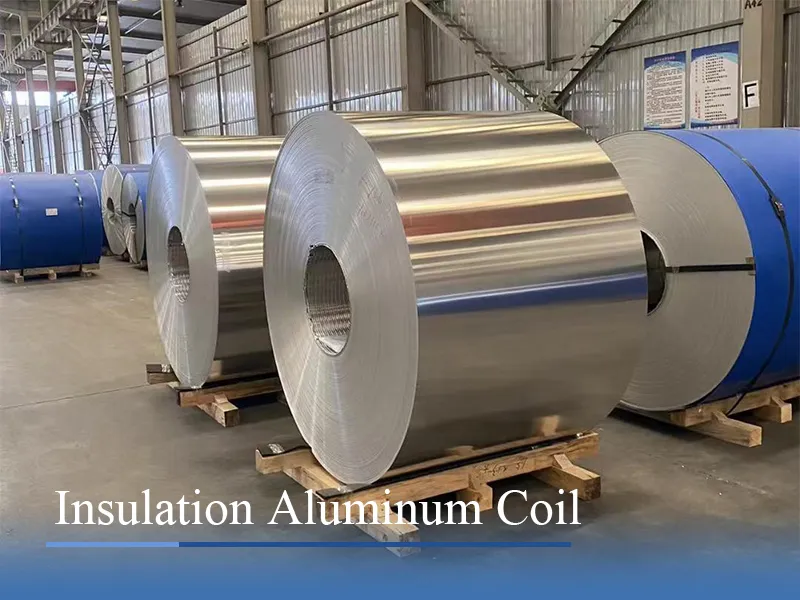
Insulation Aluminum Coil Specifications
| Item | Available Specification |
| Product Name | Insulation Aluminum Coil / Aluminum Jacketing Coil / Aluminum Cladding Coil |
| Available Alloys | 1050, 1060, 1100, 3003, 3105, 5005, 5052 and other grades upon request |
| Common Tempers | H14, H16, H24, H26, O |
| Thickness Range | 0.30 mm – 1.50 mm |
| Common Thickness | 0.30 mm, 0.40 mm, 0.50 mm, 0.60 mm, 0.80 mm, 1.00 mm |
| Common Width | 914 mm, 1000 mm, 1200 mm, or customized width |
| Coil Inner Diameter | Typically 405 mm or 505 mm, subject to order requirements |
| Surface Finish | Mill finish, stucco embossed, orange peel embossed, corrugated, brushed, anodized, PE coated, PVDF coated |
| Moisture Barrier Options | Polykraft, Polysurlyn, polyethylene film, polyurethane moisture barrier |
| Supply Form | Coil, slit coil, aluminum strip, sheet, cut-to-length sheet |
| Applicable Standards | ASTM B209, EN 485, EN 573, GB/T 3880 or project-specific requirements |
| Available Documents | Mill Test Certificate, packing list, certificate of origin, inspection report, third-party inspection support upon request |
What Is Insulation Aluminum Coil?
Insulation aluminum coil is commonly called aluminum jacketing coil, aluminum cladding coil, or aluminum insulation jacket. It is installed over thermal insulation materials to form a durable external protective layer.
Aluminum coil is not usually the main thermal insulation material. Instead, it is used as an external metal jacket to protect insulation materials such as mineral wool, glass wool, PIR, polyurethane foam, calcium silicate, elastomeric foam, and aerogel insulation.
The aluminum jacket helps maintain the integrity of the insulation system by reducing exposure to rain, moisture, sunlight, abrasion, impact, and atmospheric contaminants.
Important: Aluminum has relatively high thermal conductivity. Its value in insulation systems comes primarily from its function as a weather-resistant, corrosion-resistant, lightweight, and mechanically protective outer jacket rather than as the main insulating layer.
Advantages of Insulation Aluminum Coil
- Lightweight and easy to handle, reducing installation effort compared with heavier jacketing materials.
- Good resistance to atmospheric corrosion for long-term protection of insulated systems.
- Helps shield insulation from rain, moisture, sunlight, and mechanical damage.
- Available with moisture-barrier options for insulation systems exposed to humid conditions.
- Easy to fabricate by embossing, corrugating, slitting, coating, and cutting to size.
- Suitable for pipes, tanks, vessels, ducts, and industrial insulation equipment.
- Provides a clean and uniform appearance for exposed insulation jacketing systems.
- Recyclable after service, supporting material recovery and more sustainable insulation systems.
Typical Applications for Aluminum Insulation Jacketing
Industrial Pipeline Insulation
Used to cover insulated steam lines, chilled-water pipes, hot oil pipelines, process piping, and utility pipelines in industrial facilities.
- Petrochemical pipelines
- Steam and hot-water pipes
- Refrigeration pipe systems
Storage Tanks and Vessels
Applied as an external cladding layer for insulated storage tanks, process vessels, pressure equipment, and cylindrical industrial units.
- Oil and chemical tanks
- Water treatment vessels
- Insulated process equipment
HVAC Duct and Equipment Protection
Used as a protective jacket for air-conditioning ducts, chilled-water systems, ventilation equipment, and mechanical-room insulation.
- HVAC duct insulation
- Chiller and cooling systems
- Mechanical-room equipment
Cold Storage and Cold Chain Systems
Suitable for insulated refrigeration pipes, cold-room systems, cooling equipment, and temperature-controlled logistics infrastructure.
- Cold rooms and freezers
- Refrigeration pipe cladding
- Food processing facilities
Power and Energy Facilities
Used for insulation protection in power plants, district heating systems, boiler rooms, and utility infrastructure.
- Boiler and steam systems
- District heating pipelines
- Power-generation equipment
Chemical and Marine Environments
3003 and selected higher-corrosion-resistance options can be considered for humid, coastal, and moderately corrosive industrial locations.
- Chemical plant equipment
- Coastal industrial projects
- High-humidity locations
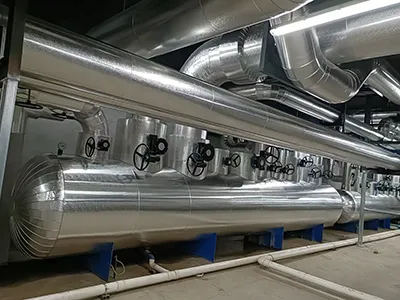
Industrial Pipeline Insulation
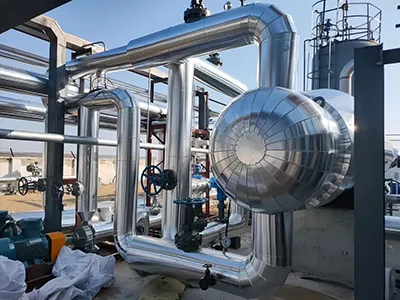
Storage Tanks and Vessels
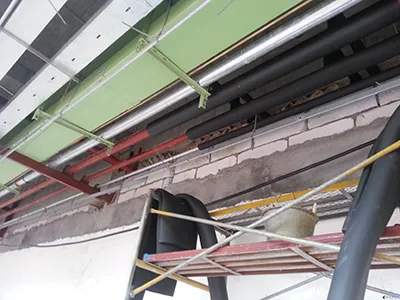
HVAC Duct and Equipment Protection
Choose the Right Aluminum Alloy for Your Insulation Project
1060 / 1100 Aluminum Coil
1060 and 1100 are high-purity aluminum grades commonly used for economical insulation jacketing applications. They offer good formability, light weight, and good atmospheric corrosion resistance in general environments.
- Cost-effective option for general insulation projects.
- Suitable for indoor and non-severe outdoor environments.
- Good ductility for bending and fabrication.
- Commonly used for pipe insulation and building-service applications.
3003 Aluminum-Manganese Alloy Coil
3003 aluminum contains manganese and generally provides higher strength and improved corrosion resistance compared with 1060 or 1100. It is widely specified for industrial insulation jacketing.
- Higher strength than pure aluminum grades.
- Good resistance to atmospheric corrosion and rusting.
- Suitable for humid, coastal, and industrial environments.
- Common choice for chemical, power, oil, and gas applications.
3105 Aluminum Coil
3105 is an aluminum-manganese alloy often used in building cladding, coated aluminum products, and applications requiring good forming performance. It can be considered where coating quality and bending behavior are important.
- Good formability and processing performance.
- Suitable for coated and fabricated aluminum products.
- Frequently used in building and cladding-related markets.
- Available in tempers selected for bending requirements.
5052 Aluminum-Magnesium Alloy Coil
5052 aluminum alloy provides higher strength and good corrosion resistance. It may be selected when the insulation jacket requires more demanding mechanical performance, fatigue resistance, or marine-environment capability.
- Higher strength than 1060 and 3003 grades.
- Good corrosion resistance in marine-related environments.
- Suitable for special fabrication or mechanical requirements.
- Selection should follow project specifications and forming needs.
For many standard insulation-jacketing projects, 1060 or 1100 is selected for cost-sensitive general applications, while 3003 is widely chosen for industrial environments requiring improved strength and corrosion resistance. If you are unsure, send us your operating environment, pipe diameter, insulation type, thickness requirement, and project standard for a technical recommendation.
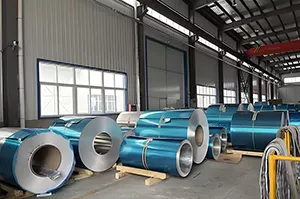
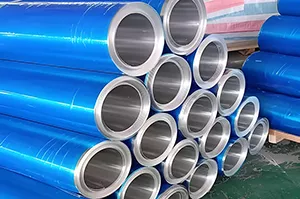
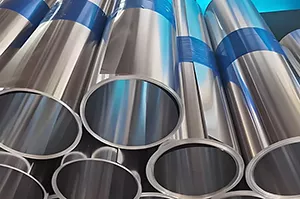
Polykraft and Polysurlyn Moisture Barrier Options
Moisture barriers are laminated to the inner side of aluminum jacketing to help reduce direct contact between aluminum and wet insulation systems. They are commonly specified in pipe, tank, duct, and equipment insulation projects where moisture management is important.
Polykraft Aluminum Insulation Coil
Polykraft is generally a multilayer moisture barrier that may include kraft paper and polyethylene layers. It is commonly used as a practical and economical backing layer for aluminum insulation jacketing.
- Helps reduce moisture contact with the aluminum jacket.
- Suitable for many conventional industrial insulation applications.
- Can improve handling and installation convenience.
- Often selected for general pipe and equipment jacketing systems.
Polysurlyn Moisture Barrier Aluminum Coil
Polysurlyn is a polymer moisture barrier commonly used for aluminum insulation jacketing. It can help reduce the risk of moisture-related corrosion issues when used with proper insulation design and installation practices.
- Frequently used for pipe, tank, and equipment insulation systems.
- Suitable for humid industrial environments and outdoor projects.
- Designed to support moisture management in insulation systems.
- Often specified where corrosion under insulation is a concern.
Surface Treatments and Finish Options
Mill Finish Aluminum Coil
Natural aluminum surface without additional decorative coating. Suitable for many standard industrial jacketing and cladding applications.
Stucco Embossed Aluminum Coil
Also called orange peel embossed aluminum. The textured finish helps hide scratches, reduce glare, improve appearance, and increase surface rigidity.
Corrugated Aluminum Jacketing
Corrugated profiles may be used where additional stiffness, profile strength, or a specific installation appearance is required.
PE Coated Aluminum Coil
Polyester-coated aluminum provides decorative color and basic weather resistance for indoor, semi-outdoor, and moderate exposure conditions.
PVDF Coated Aluminum Coil
PVDF coatings are commonly selected for demanding outdoor environments because of their resistance to UV exposure, weathering, and color degradation.
Anodized Aluminum Coil
Anodizing can improve surface hardness and corrosion resistance. It may be selected for projects requiring a more durable decorative or protective surface.
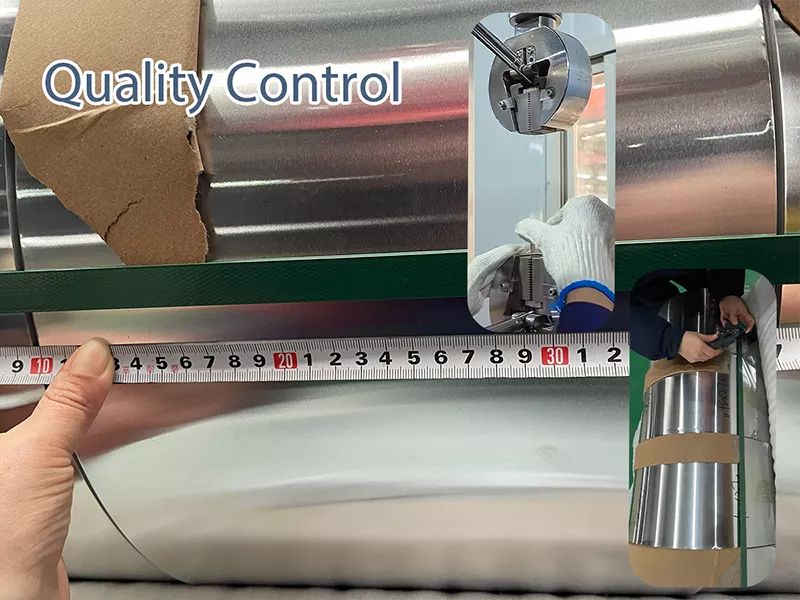
Haomei Insulation Aluminum Coil Quality Control
Haomei controls insulation aluminum coil quality from alloy selection and dimensional inspection to surface condition, mechanical properties, coating performance, and moisture-barrier bonding. Inspection requirements can be adjusted according to the aluminum jacketing application, coil specifications, coating system, and customer requirements.
- Alloy and chemical composition: Verify the aluminum alloy and chemical composition against the specified grade and applicable material requirements.
- Thickness and tolerance: Measure coil thickness at defined inspection points to confirm the specified thickness and tolerance.
- Width, weight, and flatness: Check coil width, net weight, edge condition, flatness, and dimensional consistency before shipment.
- Surface quality: Inspect the aluminum surface for scratches, dents, stains, oil marks, oxidation, edge damage, and other defects that could affect jacketing fabrication or appearance.
- Temper and mechanical properties: Verify temper, tensile strength, yield strength, and elongation when these properties are specified for the application.
- Coating performance: For PE or PVDF coated insulation aluminum coil, inspect coating thickness, adhesion, surface uniformity, and visible coating defects.
- Moisture-barrier bonding: For laminated jacketing materials, check moisture-barrier coverage, bonding condition, and lamination integrity.
- Documentation and traceability: Provide Mill Test Certificates and relevant inspection or packing documents to support material traceability and shipment verification.
- Third-party inspection: SGS, BV, TÜV, or customer-appointed inspection agencies can be supported when third-party inspection is required.
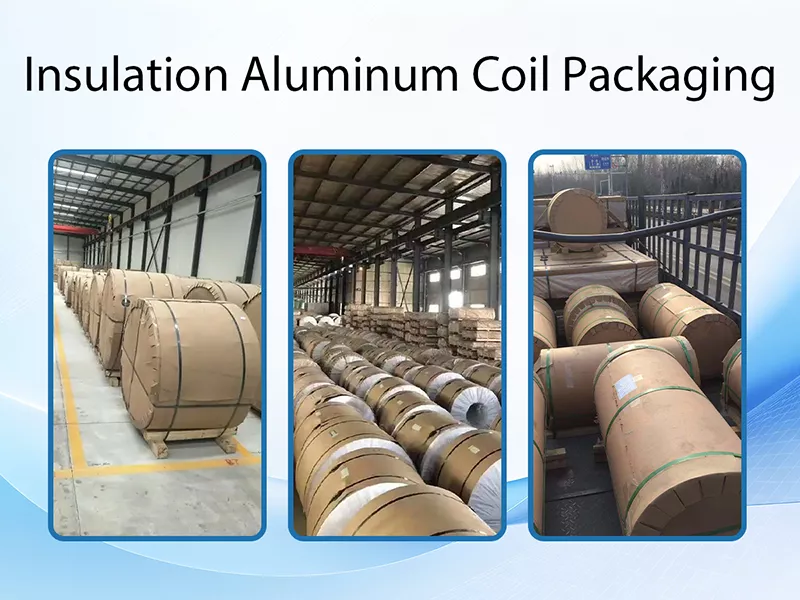
Export Packaging for Insulation Aluminum Coil
-
Surface Protection
Protective film, moisture-proof paper, plastic film, and edge protection can be applied according to the coil surface and shipping requirements.
-
Coil Support
Insulation aluminum coils can be packed in eye-to-wall or eye-to-sky orientation according to handling, storage, and container-loading requirements.
-
Export Pallets
Export-grade wooden pallets, wooden frames, reinforced packaging, or fumigated wood materials can be provided when required for international shipment.
-
Shipping Documents
Packing lists, commercial invoices, mill test certificates (MTC), certificates of origin, and inspection documents can be prepared according to order requirements.
FAQ – Insulation Aluminum Coil
Is aluminum coil itself an insulation material?
No. Aluminum coil is generally used as a metal jacketing or protective outer layer for insulation systems. The actual thermal insulation layer may consist of mineral wool, glass wool, PIR, polyurethane foam, calcium silicate, elastomeric foam, aerogel blanket, or other insulation materials. Aluminum jacketing helps protect the insulation system from weather, moisture, UV exposure, corrosion, and mechanical damage.
Which alloy is commonly used for pipe insulation jacketing?
1060 or 1100 aluminum coil is commonly selected for economical general-purpose applications. 3003 aluminum coil is widely used when improved strength and corrosion resistance are required for industrial, humid, coastal, or moderately corrosive environments. Final alloy selection should follow the project specification and operating conditions.
What is the difference between 1060 and 3003 insulation aluminum coil?
1060 is a high-purity aluminum alloy with good formability and a cost advantage. 3003 contains manganese, giving it higher strength and generally improved corrosion resistance than 1060. 1060 is often suitable for standard applications, while 3003 is commonly selected for more demanding industrial environments.
What is a Polysurlyn moisture barrier?
Polysurlyn is a polymer moisture barrier laminated to the inner side of aluminum jacketing. It helps reduce direct moisture contact between the aluminum jacket and wet insulation systems. It is commonly used for industrial pipe, tank, and equipment insulation. Proper installation, overlap treatment, sealing, drainage, and insulation maintenance are also important.
What thickness is suitable for outdoor pipe insulation?
For many outdoor industrial pipe-jacketing projects, aluminum coil thicknesses between 0.50 mm and 0.80 mm may be considered. The appropriate thickness depends on pipe diameter, insulation thickness, climate, wind load, mechanical impact risk, fabrication method, and project specifications. Larger pipes and high-impact areas may require thicker material.
Is stucco embossed aluminum better than smooth aluminum jacketing?
Stucco embossed aluminum has a textured surface that can help hide minor handling scratches, reduce glare, improve appearance, and provide additional surface rigidity. Smooth aluminum may be preferred when a clean, flat appearance is required. The choice depends on installation preferences, appearance, and fabrication requirements.
Can insulation aluminum coil be slit into narrow strips?
Yes. Insulation aluminum coil can be slit into narrower widths according to project requirements. Slit coils and aluminum strips are commonly used for pipe-cladding fabrication, banding, flashing, edging, and customized insulation-jacketing components.
Can you provide Mill Test Certificates and third-party inspection?
Yes. Mill Test Certificates, packing lists, commercial invoices, and standard export documents can be provided according to the order. Third-party inspection by organizations such as SGS, BV, TÜV, or a customer-appointed inspection company can also be arranged when required.
How should insulation aluminum coil be stored?
Aluminum coils should be stored in a dry, clean, and well-ventilated environment and protected from rain, condensation, standing water, corrosive chemicals, and direct ground contact. Opened packaging should be resealed where possible. Proper storage helps reduce the risk of oxidation marks, moisture staining, and surface damage.