
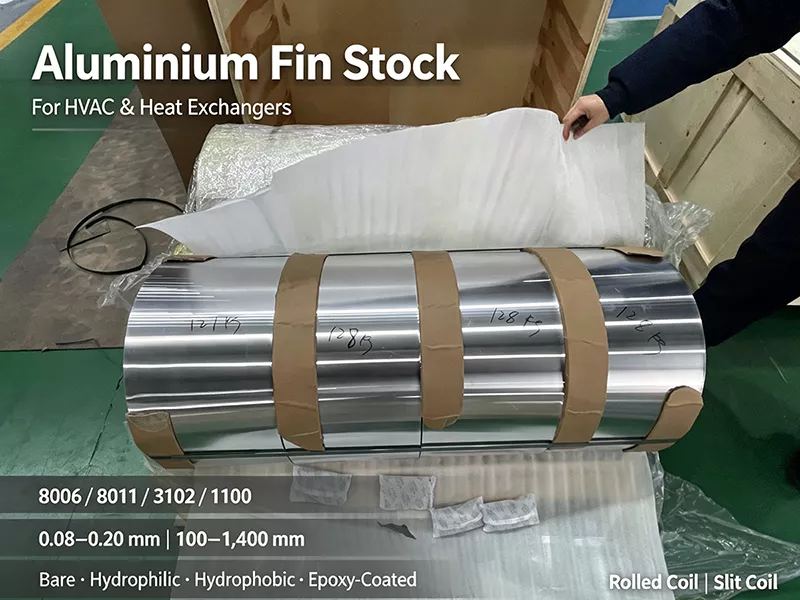
Haomei Aluminum supplies aluminium fin stock for HVAC, refrigeration and automotive heat exchanger manufacturing. Selected 1000, 3000 and 8000 series alloys are available in different tempers, thicknesses, widths and surface conditions according to forming, brazing and corrosion-resistance requirements.
- Product form Rolled coil / slit coil
- Primary use Formed heat transfer fins
- Reference thickness 0.08–0.20 mm, to confirm
- Reference width 100–1, 400 mm, to confirm
- Material options 8006/8011/3102/1100
- Coating Options Bare/Hydrophilic/Hydrophobic/Epoxy-Coated
What is aluminium fin stock?
Aluminium fin stock is thin aluminum strip or coil supplied for conversion into heat exchanger fins. It is typically formed into corrugated, louvered or other fin structures to increase the effective heat transfer surface area.
Aluminum fins are essentially extended surface heat exchange elements. Their working principle is based on the synergistic effect of thermal conduction and convective heat transfer. When the heat medium flows inside the base tube, heat is conducted through the tube wall to the aluminum fins, which then rapidly dissipate the heat into the surrounding air, achieving efficient cooling.
The core function of aluminum fins is to increase the heat dissipation area and improve heat exchange efficiency, thereby addressing the bottleneck problem of "insufficient surface area" in traditional plain tubes.
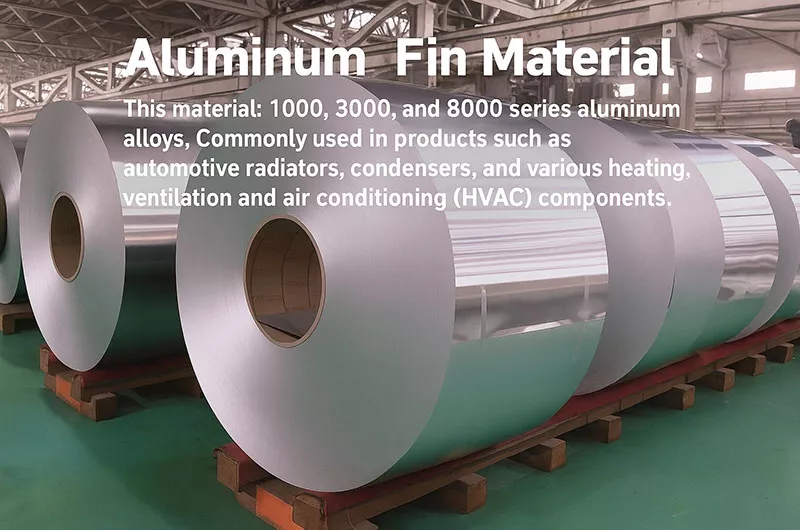
Aluminium Fin Stock Specifications
| Product | Aluminium Fin Stock / Aluminum Fin Stock |
| Typical Alloys | 1100, 1200, 3003, 3102, 8011, 8006 |
| Typical Tempers | O, H22, H24, H26, H18 and selected customer-specified conditions |
| Thickness | 0.08–0.20 mm |
| Width | 100–1400 mm |
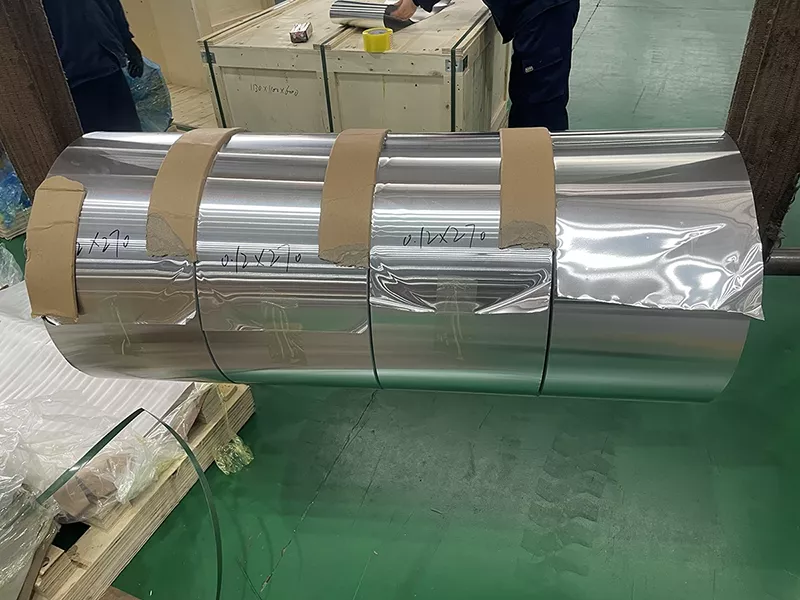
| Supply Form | Coil, strip and fin-stock foil |
| Surface | Bare / mill finish / coated |
| Coating Options | Hydrophilic, protective and selected application-specific coatings |
| Applications | HVAC, refrigeration, automotive heat exchangers and selected industrial heat transfer systems |
| MOQ and lead time | Depend on alloy, gauge, coating, slit pattern and volume. |
| Documentation | Material and inspection documentation available according to order requirements |
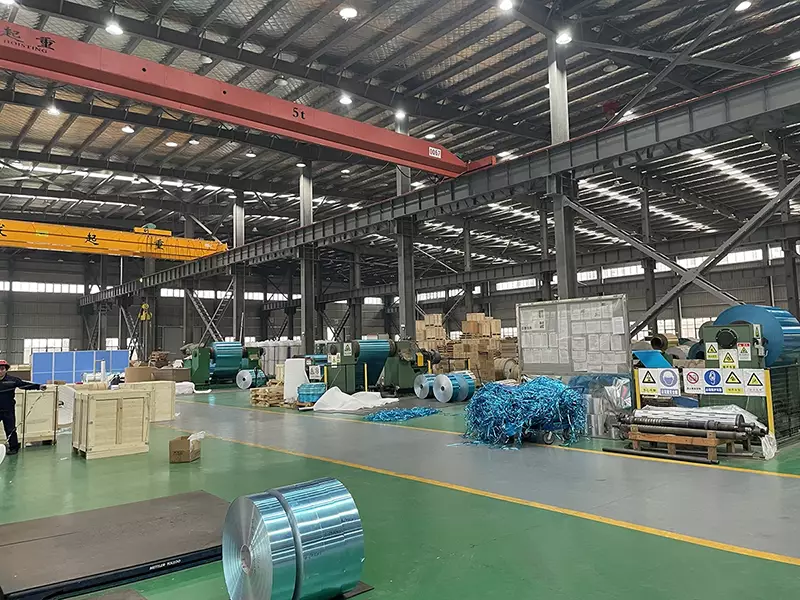
Aluminum Fin Stock Alloys and Tempers
Common Fin Stock Alloys
| Alloy | Main Characteristics | Typical Fin Stock Applications |
| 1100 | High formability and good thermal conductivity; suitable where deep forming and ductility are important. | HVAC, refrigeration and general heat exchanger applications. |
| 1200 | Industrial-purity aluminum with good workability and thermal performance. | Selected heat transfer and formed fin applications. |
| 3003 | Aluminum-manganese alloy offering a useful balance of strength, formability and corrosion resistance. | HVAC, refrigeration and automotive heat exchanger applications. |
| 3102 | Heat-exchanger-oriented alloy option with good formability and processing characteristics. | Selected HVAC and refrigeration fin applications. |
| 8011 | Specialized wrought aluminum alloy used in a range of foil and fin-stock applications where good processing performance is required. | HVAC, refrigeration and selected heat exchanger applications. |
| 8006 | Higher-strength foil alloy option for selected forming and fin-stock applications. | Selected heat exchanger and forming applications. |
Common Fin Stock Tempers
- O Temper – high ductility and formability
- H22 – strain-hardened and partially annealed
- H24 – strain-hardened and partially annealed
- H26 – higher hardness condition for selected applications
- H18 – harder temper for applications requiring higher strength
- Custom temper – subject to material and production requirements
Aluminium Fin Stock Surface Coating Options
Bare Aluminium Fin Stock
Bare material has no intentionally applied organic protective coating. Aluminium still develops a natural oxide film, but that film does not make it immune to chloride attack, unsuitable cleaners or galvanic corrosion.
- Simple surface structure
- Good thermal conductivity
- Suitable for selected conventional heat exchangers
- Available according to alloy and temper
Hydrophilic Aluminium Fin Stock
A hydrophilic surface encourages condensate to spread rather than remain as isolated droplets. In a suitable fin design, this can help manage water bridging and drainage during wet operation.
- Suitable for humid operating conditions
- Improved condensate spreading
- Available in selected coated systems
- Commonly used in HVAC heat exchangers
Hydrophobic Fin Stock
A hydrophobic surface is intended to reduce wetting and encourage droplet release. The result depends on contact angle hysteresis, surface durability, orientation and airflow.
Epoxy-Coated Fin Stock
An epoxy-based system may be selected where additional corrosion protection is required. Suitability depends on the complete coating system, coverage, forming damage and exposure conditions.
Blue or Gold Coatings
Colour identifies appearance, not a universal performance grade. Compare the underlying coating chemistry, wettability, adhesion and corrosion test results.
Self-Lubricating Treatments
A lubricating surface may reduce friction during forming. Residue, tool compatibility, joining requirements and any post-forming cleaning step must be assessed together.
Anti-Mould Treatments
Claims about mould or bacterial inhibition require an applicable test method and clearly defined conditions. A coating does not replace drainage, cleaning or maintenance.
Role of Aluminum Fins in Heat Dissipation
| Functional Role | Description | Practical Effect |
| Expand Heat Dissipation Surface Area | Through dense fin arrays (e.g., louvered/wavy designs), the surface area increases 10 to 100 times compared to the base | Significantly increases contact area with air, accelerating convective heat exchange |
| Establish Effective Thermal Conduction Path | Aluminum’s high thermal conductivity (237 W/m·K) rapidly transfers heat from the source (e.g., copper tubes/chips) to the fin tips | Lowers local temperature at the heat source, avoiding overheating damage |
| Enhance Air Convective Heat Transfer | Fin spacing forms air channels that enable forced airflow (fans) or natural convection to carry heat away | Improves heat dissipation rate by 3–8 times compared to flat surfaces without fins |
| Lightweight Structural Support | Aluminum’s low density (2.7 g/cm³) ensures strength while reducing overall weight | Suitable for weight-sensitive applications such as automobiles |
Classification of Aluminum Fin Stock
Classified by Alloy Composition
- Pure aluminum fin stock (1000 series)
- Aluminum-manganese alloy fin stock (3000 series)
- Aluminum-magnesium alloy fin stock (8000 series)
- Aluminum-silicon alloy fin stock (4000 series)
Classified by Structural Form
- Clad aluminum fin stock
- Non-clad aluminum fin stock
- Single-metal fin stock
- Bimetal composite fin stock
Classified by Surface Treatment
- Bare/Non-coated Aluminum Fin
- Pre-coated Aluminum Fin
- Hydrophilic Aluminum Fin
- Hydrophobic Aluminum Fin
- Anti-mold Aluminum Fin
- Color-coated Aluminum Fin
- Clad aluminum fin stock: A layer or two of different aluminum alloys is clad onto the surface of the core aluminum alloy, such as the composite structure 4343/3003/4343 aluminum foil, mainly used in brazed heat exchangers.
- Non-clad aluminum fin stock: Fin stock made from a single aluminum alloy without cladding, suitable for applications that do not require brazing or special surface treatment.
- Single-metal fin stock: The fin and the base tube are made from the same material, usually aluminum alloy, offering good thermal conductivity and consistency.
- Bimetal composite fin stock: The fin and base tube are made from different materials, such as an aluminum fin clad onto a steel base tube, combining the high strength of steel with the excellent thermal conductivity of aluminum.
Characteristics of Aluminium Fin Stock
Thermal Conductivity
Aluminum provides good thermal conductivity for heat exchanger applications while maintaining much lower density than copper.
Lightweight Construction
Low density helps manufacturers reduce component weight while maintaining the surface area required for heat transfer.
Formability
Appropriate alloys and tempers can be selected for stamping, corrugating, louvering and other forming operations.
Corrosion Resistance
Aluminum naturally develops a surface oxide layer. Alloy choice and coating selection remain important in humid or aggressive environments.
Processing Flexibility
Fin stock can be supplied in different coil dimensions, tempers and surface conditions to suit downstream manufacturing requirements.
Application-Specific Coating
Coating systems can be selected when condensate behavior, surface protection or corrosion resistance is part of the application requirement.
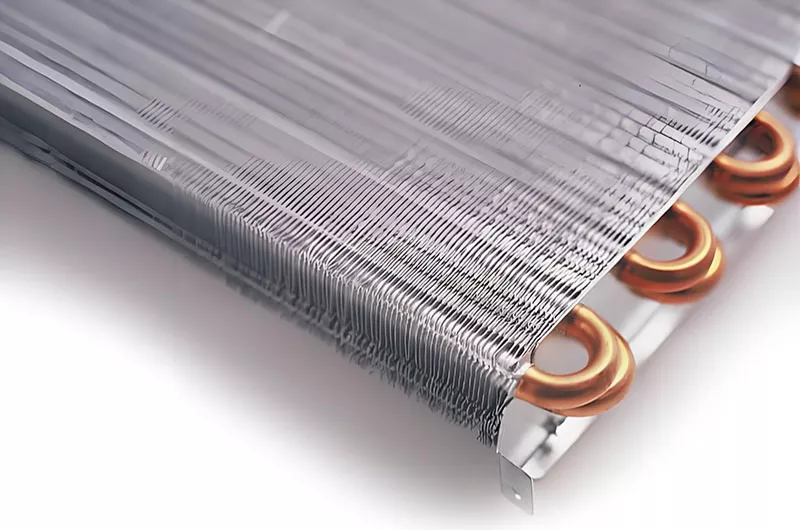
Common Fin Stock alloys and tempers include
- 1100 O Aluminum Fin Stock: Soft annealed condition for general formability.
- 1100 H14 Aluminum Fin Stock: Slightly strain-hardened, suitable for moderate strength and formability.
- 1100 H18 Aluminum Fin Stock: Higher strength than H14 due to further strain hardening.
- 1100 H19 Aluminum Fin Stock: Similar to H18 but with higher strength characteristics.
- 1100 H25 Aluminum Fin Stock: Strain-hardened to achieve increased strength.
- 1100 H111 Aluminum Fin Stock: Fully annealed to achieve maximum ductility.
- 1100 H211 Aluminum Fin Stock: Strain-hardened and partially annealed for improved strength and formability.
- 1100 H113 Aluminum Fin Stock: Strain-hardened and partially annealed with a controlled amount of cold work.
- 3003 O Aluminum Fin Stock: Soft annealed condition for good formability and corrosion resistance.
- 3003 H14 Aluminum Fin Stock: Strain-hardened, suitable for moderate strength and formability.
- 3003 H18 Aluminum Fin Stock: Higher strength than H14 due to further strain hardening.
- 3003 H19 Aluminum Fin Stock: Similar to H18 but with higher strength characteristics.
- 3003 H25 Aluminum Fin Stock: Strain-hardened to achieve increased strength.
- 3003 H111 Aluminum Fin Stock: Fully annealed to achieve maximum ductility.
- 3003 H211 Aluminum Fin Stock: Strain-hardened and partially annealed for improved strength and formability.
- 3003 H113 Aluminum Fin Stock: Strain-hardened and partially annealed with a controlled amount of cold work.
These aluminum fin stocks, ranging from annealed (O) to fully hardened (H113) tempers in both 1100 and 3003 alloys, are commonly used in heat exchangers and HVAC components such as air conditioners, radiators, and evaporators.
Chemical Composition of Different Alloy Aluminum Fin Stock
| Chemical composition of Aluminium fin stock Alloy (%) | AA1050 | AA1100 | AA1200 | AA3003 | AA8006 | AA8011 |
| Fe | 0.40 | 0.95 | 1.00 | 0.70 | 1.40 — 1.60 | 0.6 — 1.00 |
| Si | 0.25 | (Fe Si) | (Fe Si) | 0.60 | 0.02 | 0.5 — 0.90 |
| Mg | 0.05 | – | – | – | 0.02 | 0.05 |
| Mn | 0.05 | 0.05 | 0.05 | 1.0 — 1.50 | 0.4 — 0.50 | 0.20 |
| Cu | 0.05 | 0.05 — 0.20 | 0.05 | 0.05 — 0.20 | 0.05 | 0.10 |
| Zn | 0.05 | 0.10 | 0.10 | 0.10 | 0.05 | 0.10 |
| Ti | 0.03 | – | 0.05 | 0.1(Ti Zr) | 0.03 | 0.08 |
| Cr | – | – | – | – | – | 0.05 |
| Each(Others) | 0.03 | 0.05 | 0.05 | 0.05 | 0.05 | 0.05 |
| Total (Others) | – | 0.15 | 0.125 | 0.15 | 0.15 | 0.15 |
| Al | 99.50 | 99.00 | 99.00 | Remainder | Remainder | Remainder |
Applications of Aluminium Fin Stock
HVAC and Refrigeration
Fins for evaporators, condensers and other air-to-refrigerant heat exchangers. Wet operation makes condensate management, coating durability and cleaning compatibility important.
Automotive Thermal Systems
Radiators, charge-air coolers and condensers may use thin corrugated or louvered fins. Material selection must consider brazing, vibration and road-salt exposure.
Industrial Heat Exchangers
Process cooling and heat recovery applications require an assessment of temperature, contaminants and maintenance. Aluminium is not suitable for every industrial environment.
Appliances and Electronics Cooling
Stamped or folded fins may be used in compact cooling assemblies. Extruded, cast and skived heat sinks belong to different manufacturing routes and require separate specifications.
Building Heating and Ventilation
Fan coils, air heaters and ventilation heat exchangers can use formed fins. Select the surface treatment for actual humidity, cleaning practice and exposure.
Specialised Thermal Equipment
Selected energy and drying systems may use rolled fin material. Food, pharmaceutical, offshore or high-temperature service requires application-specific qualification.
8011 O Aluminium Fin Stock for Air Conditioning
8011 O aluminium fin stock is a soft, formable material used to manufacture heat exchanger fins for air conditioning and HVAC equipment. The O-temper condition provides good ductility for fin forming, while the aluminum substrate offers efficient heat transfer and reliable processing performance.
- Alloy: 8011 aluminum alloy
- Temper: O (annealed / soft condition)
- Application: Air conditioner and HVAC heat exchanger fins
- Processing: Suitable for fin forming and high-speed production
- Performance: Good thermal conductivity, formability and service durability
3003 Pre-Coated Hydrophilic Aluminum Fin Stock for Heat Exchangers
3003 pre-coated hydrophilic aluminum fin stock is designed for heat exchanger applications where condensate management is important. Its hydrophilic surface helps condensed water spread across the fin surface instead of remaining as isolated droplets, supporting efficient drainage and heat exchange performance.
- Alloy: 3003 aluminum alloy
- Surface: Pre-coated hydrophilic treatment
- Water management: Promotes rapid spreading of condensed water
- Application: Air conditioning and other heat exchanger systems
- Benefits: Improved condensate drainage, corrosion protection and heat exchanger performance
8011 Pre-Coated Gold Color Aluminum Fin Stock for HVAC Heat Exchangers
8011 pre-coated gold color aluminum fin stock combines an aluminum fin substrate with a colored protective coating for HVAC heat exchanger applications. The gold-colored surface provides a distinctive appearance while the coating can add surface protection during service and handling.
- Alloy: 8011 aluminum alloy
- Surface: Pre-coated gold color protective coating
- Application: HVAC and air conditioning heat exchanger fins
- Appearance: Uniform gold-colored surface
- Benefits: Combines surface protection, appearance and fin-forming performance
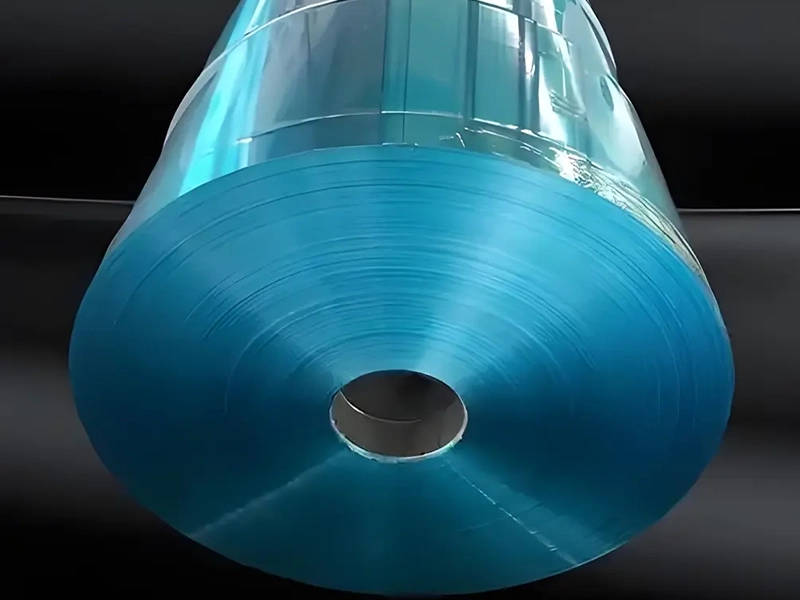
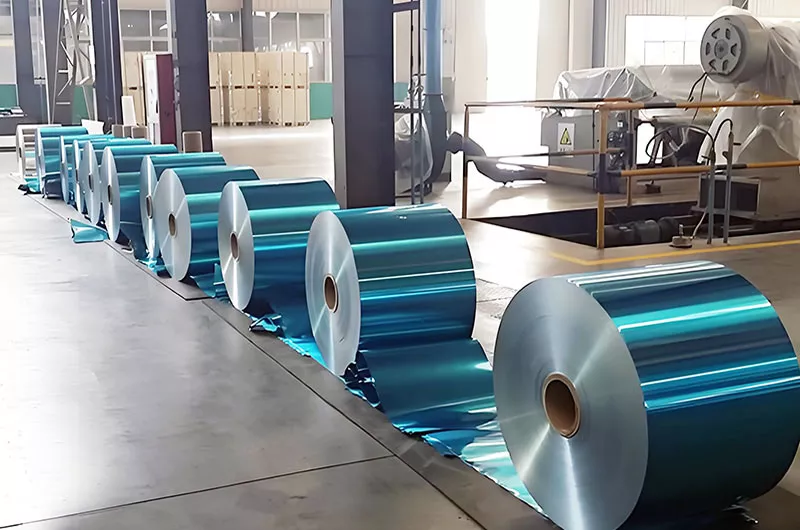
8011 O Blue Pre-Coated Hydrophilic Aluminium Fin Stock for Household Air Conditioners
8011 O blue pre-coated hydrophilic aluminium fin stock is developed for household air conditioner heat exchangers. The soft O-temper aluminum is suitable for fin forming, while the blue hydrophilic coating helps condensed water spread over the fin surface for improved drainage and heat exchanger operation.
- Alloy: 8011 aluminum alloy
- Temper: O (soft / annealed condition)
- Coating: Blue hydrophilic pre-coating
- Application: Household air conditioner heat exchanger fins
- Hydrophilicity: Helps condensed water spread quickly across the fin surface
- Benefits: Good formability, condensate drainage, surface protection and distinctive appearance
Why Choose Haomei Aluminium Fin Stock?
Alloy Control
Selected aluminum alloys and tempers can be matched to forming, brazing, strength and corrosion-resistance requirements.
Gauge & Width Control
Rolling and slitting control helps maintain consistent thickness and width for downstream fin-forming equipment.
Surface Quality
Surface inspection focuses on scratches, folds, contamination, edge defects and other conditions that could affect forming or final appearance.
Custom Supply
Coil dimensions, packaging, surface condition and selected technical requirements can be discussed according to the customer's production line.
Haomei Aluminum Fin Stock Quality Inspection
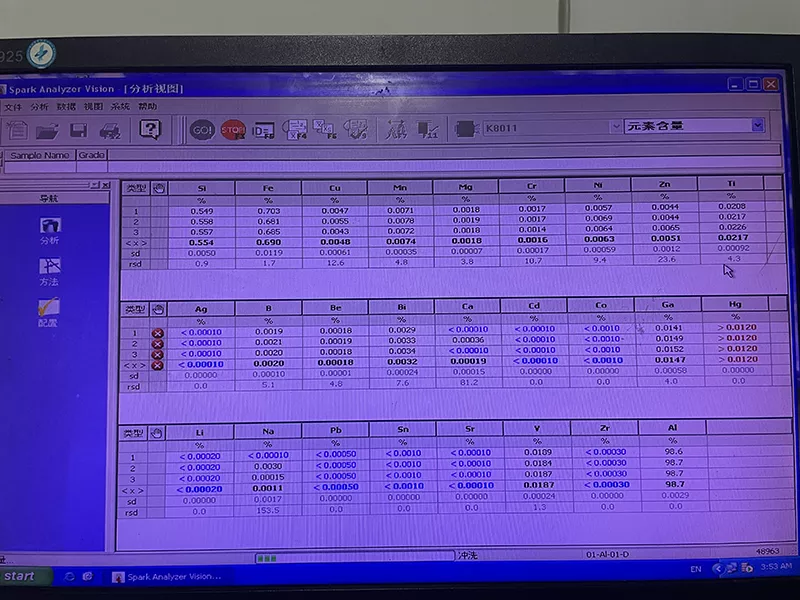
Chemical Composition
Alloy composition is checked against the applicable material specification and purchase requirements.
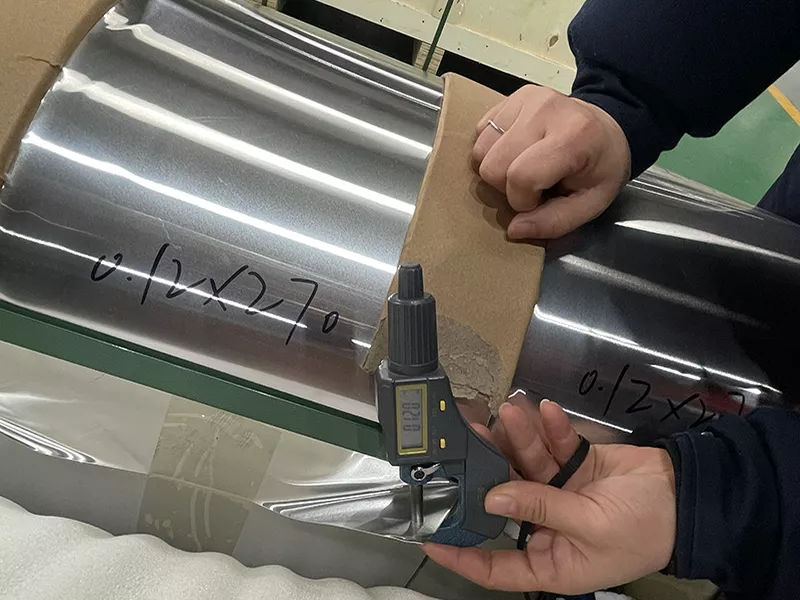
Thickness
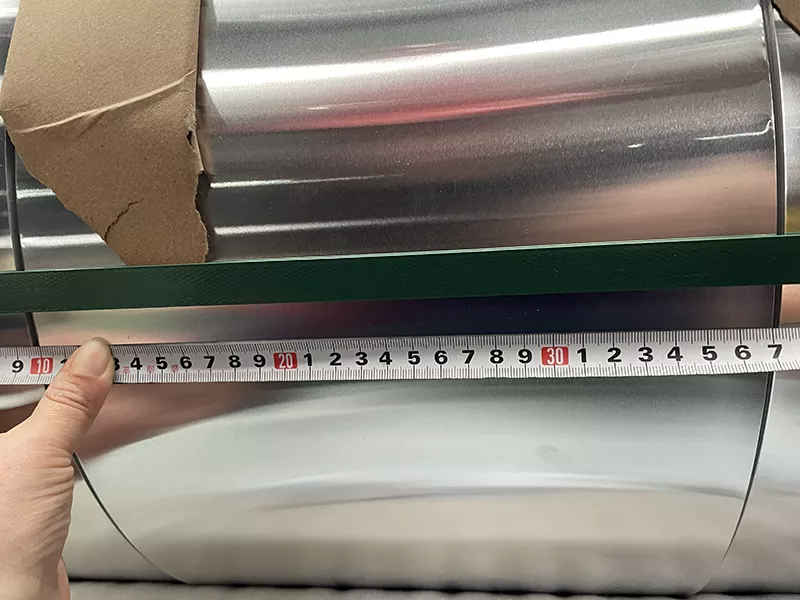
Gauge measurements help verify material thickness consistency across the defined inspection positions.
Width
Slitting width and dimensional accuracy are inspected before shipment.
Mechanical Properties
Tensile strength and elongation can be evaluated according to the applicable material specification.
Surface Inspection
Surface checks focus on scratches, folds, contamination, black spots, discoloration and other visible defects.
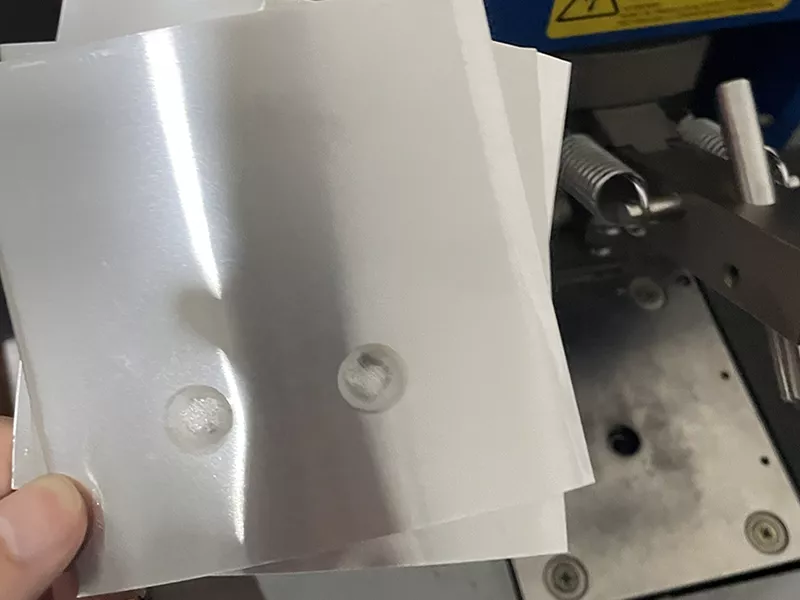
Coating Inspection
Coated products can be inspected for coating condition, adhesion and application-specific performance criteria.
Aluminium Fin Stock Packaging and Storage
Export Packaging
- Export-suitable wooden pallets where required
- Protective wrapping for coil surfaces
- Moisture-control measures during shipment
- Coil stabilization for transport
- Packaging adapted to loading
Storage Recommendations
- Store in a clean and dry indoor environment
- Avoid direct exposure to rain or condensation
- Keep away from corrosive chemicals and gases
- Minimize sudden temperature changes
- Maintain suitable moisture-control conditions
Frequently Asked Questions About Aluminium Fin Stock
What alloys are commonly used for aluminium fin stock?
Common alloy options include 1100, 1200, 3003, 3102, 8011 and selected 8000 series alloys. The preferred grade depends on formability, strength, corrosion resistance, brazing requirements and the finished fin design.
What is the difference between bare and hydrophilic fin stock?
Bare fin stock has an uncoated aluminum surface. Hydrophilic fin stock has a water-spreading surface coating designed to improve condensate behavior and drainage in humid HVAC heat exchanger applications.
What thickness is available for aluminium fin stock?
Typical fin-stock gauges can fall within the thin-foil range, but the available thickness depends on the alloy, temper, production line and customer requirements. Haomei should confirm the final range for the specific order.
Can aluminium fin stock be supplied in coil form?
Yes. Fin stock is commonly supplied as coil or strip material for downstream forming equipment. Coil ID, OD, weight and width should be confirmed according to the customer's production line.
Which aluminium fin stock is suitable for automotive heat exchangers?
Automotive applications often use aluminum fin materials designed around the brazing process, including selected clad structures. Alloy, cladding, temper, thickness and anti-sag requirements should be reviewed together before material selection.
Can Haomei supply custom width and temper?
Custom width and selected temper options can be discussed according to the available production range and the customer's required forming and heat exchanger process. The required specification should be confirmed before quotation and production.
What information is needed for an aluminium fin stock quotation?
Useful quotation information includes alloy, temper, thickness, width, surface condition, coating requirements, coil dimensions, estimated quantity, packaging requirements and intended application. Drawings or existing material specifications can also help with technical review.