
5083 cast aluminum plate is an aluminum plate produced by a casting process using 5083 aluminum alloy as the base material. By adopting precision casting technology, 5083 aluminum plate can achieve a highly flat surface (such as ultra-flat precision cast aluminum plate), meeting the requirements of one-time forming for complex structural parts, while maintaining the fatigue resistance of the raw material and good cold working performance.
5083 aluminum is a non-heat-treatable aluminum-magnesium alloy that combines high strength, excellent resistance to marine and chemical corrosion, good weldability and machinability, as well as dimensional stability. It is an ideal choice for ship hulls, tooling and fixture plates, architectural cladding, and industrial components.
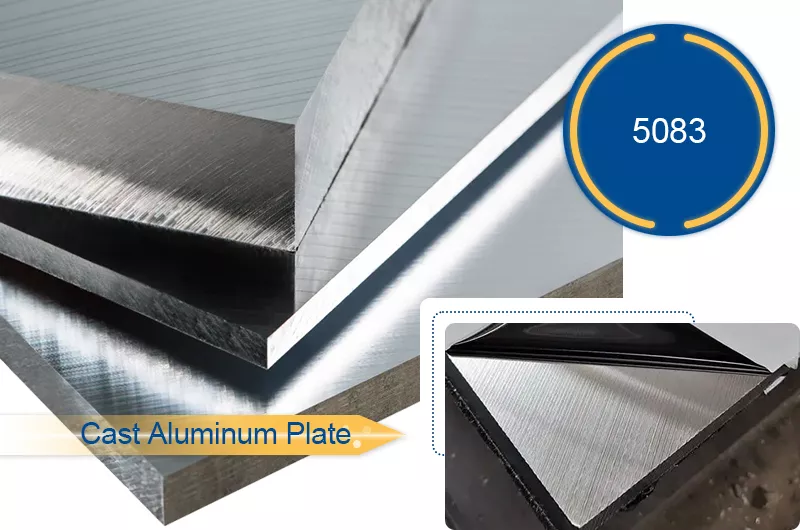
5083 cast aluminum plate belongs to the 5000 series aluminum-magnesium alloys. Its strengthening mechanism is achieved through cold working and solid solution strengthening rather than precipitation hardening. Casting followed by precision grinding can produce stress-free plates with strict dimensional control, and flatness tolerances are typically within ±0.005 inches, which is critical for mold and fixture applications.
5083 cast aluminum plate is a cost-effective solution for applications that require a balance of strength, corrosion resistance, and weldability. It is suitable for marine, industrial, and military fields, has obtained special-purpose certifications, and is a preferred choice for engineers and manufacturers.
Why 5083 Precision Cast Aluminum Plate Is More Recommended for Thick Plate Machining
5083 precision cast aluminum plate demonstrates superior performance in terms of uniformity, machining stability, and high-temperature adaptability, making it an ideal choice for thick plate precision machining.
Outstanding Performance Uniformity
5083 (5A83) is a non-heat-treatable strengthened aluminum alloy, with highly consistent microstructure and properties throughout the thickness direction. In comparison, as the thickness of 6061-T6 plate increases, its hardenability decreases significantly, making it prone to lower strength and hardness in the core than at the surface. In contrast, 5083 (5A83) maintains uniform internal and external properties regardless of thickness, making it more suitable for thick plates and high-precision machining requirements.
Extremely Low Residual Stress, Minimal Deformation Risk
5083 (5A83) precision cast aluminum plate is produced from large aluminum alloy slabs, which are fully annealed at high temperature to thoroughly eliminate internal stress before being sawn into plates. This process reduces residual stress to an extremely low level, making it one of the aluminum plates with the least machining deformation currently available. During machining, no additional aging treatment is required, enabling one-time forming and significantly improving machining efficiency and dimensional stability.
Excellent High-Temperature Stability
When the temperature of 6061 aluminum alloy exceeds approximately 170°C, its strength and hardness decrease rapidly, the original heat-treatment-strengthened microstructure is destroyed, and the properties are difficult to recover after cooling. In contrast, as a non-heat-treatable strengthened alloy, 5083 (5A83) exhibits much slower performance degradation at elevated temperatures. After cooling back to room temperature, its strength and hardness can basically recover to their initial levels, making it more suitable for thick plate applications involving temperature rise or thermal processing conditions.
5083 Cast Aluminum Plate Chemical Composition
Typical Alloying Elements
- Aluminium (Al): Balance (≈92.6–95.6 wt %)
- Magnesium (Mg): 4.0–4.9 wt %
- Manganese (Mn): 0.4–1.0 wt %
- Chromium (Cr): 0.05–0.25 wt %
- Silicon (Si): ≤ 0.4 wt %
- Iron (Fe): ≤ 0.4 wt %
- Copper (Cu): ≤ 0.1 wt %
- Titanium (Ti): ≤ 0.15 wt %
- Zinc (Zn): ≤ 0.25 wt %
Physical Properties of 5083 Cast Aluminum Plate
- Density: 2.66–2.65 g/cm³
- Melting Point: ≈570 °C
- Elastic Modulus: ≈70–72 GPa
- Thermal Conductivity: 110–130 W/m·K
- Coefficient of Thermal Expansion: ≈23.3–25 × 10⁻⁶/K
- Electrical Resistivity: ≈0.58 × 10⁻⁶ Ω·m
Mechanical Properties of 5083 Cast Aluminum Plate
- Ultimate Tensile Strength: 290–317 MPa (42–46 ksi)
- Yield Strength (0.2% offset): 145–228 MPa (21–33 ksi)
- Elongation at Break: 12–23% (varies with temper)
- Hardness (Vickers): ~70–75 HV
- Fracture Toughness: ≈43 MPa·m^½
- Fatigue Strength (R = -1): ≈159 MPa
Common Tempers and Certifications of 5083 Cast Aluminum Plate
- H116/H321: Marine-grade tempers with excellent corrosion resistance, certified by classification societies (ABS, DNV, LR, etc.).
- H131/H32: Used for armor plates, compliant with MIL-DTL-46027 military vehicle and ballistic protection standards.
- O (Annealed): Offers high ductility (14%), suitable for forming low-temperature tanks and pressure vessels.
- H111: Stress-relieved to ensure dimensional stability for tooling and fixtures.
Corrosion Resistance of 5083 Cast Aluminum Plate
Due to its high magnesium content and fine-grain structure, 5083 exhibits excellent resistance to seawater, industrial chemicals, and marine atmospheres. It is widely used in hulls, offshore platforms, and pressure vessels where chloride-induced pitting is a concern.
Manufacturing, Machinability, and Weldability of 5083 Cast Aluminum Plate
5083 cast plate can be easily machined using conventional methods, with moderate machinability (machinability index approximately 30%) and excellent surface finish after precision grinding. It is fully weldable using all standard methods (MIG, TIG, FSW), retaining high post-weld strength with minimal softening in the heat-affected zone. It is especially suitable for friction stir welding, preserving microstructure and reducing distortion. Additionally, it can be anodized to form a uniform oxide layer that enhances conductivity and provides decorative or protective finishes.
Standards and Specifications for 5083 Cast Aluminum Plate
Aluminum plates and sheets are typically supplied according to ASTM B209 and ASME SB 209 standards, with the Unified Numbering System designation UNS A95083. Temper designations include O (annealed), H111, and H112, indicating slight strain hardening to enhance formability or strength.
Typical Applications of 5083 Cast Aluminum Plate
- Tooling and Fixtures: Precision-ground base plates for CNC milling, die-casting molds, and precision jigs
- Architecture: Exterior walls, curtain walls, canopies, and decorative panels (due to weather resistance and aesthetics)
- Industry: Storage tanks, pressure vessels, conveyor chutes, and food machinery components (compliant with food contact standards)
- Transportation: Trailer floors, truck bodies, bus frames, and lightweight structural panels
- Marine: Hulls, decks, brackets, and offshore platforms
Manufacturing Advantages of 5083 Cast Aluminum Plate
- Dimensional Stability: Precision milling with tolerances down to ±0.2 mm, minimizing warping during processing.
- Surface Finish: Mold plates with surface roughness (Ra) as low as 0.4 microns, suitable for CNC machining and mold manufacturing.
- Custom Dimensions: Thicknesses up to 600 mm and widths up to 2200 mm, meeting large-scale industrial demands.
Availability and Supply Forms of 5083 Cast Aluminum Plate
5083 cast aluminum plates are available in thicknesses from 5 mm to 200 mm or more, widths up to 2.5 meters, and lengths customizable per customer requirements. Both sides of the plate are precision ground, typically with protective plastic film, and custom sizing, milling, or chamfering services are available.
Quality Assurance and Heat Treatment of 5083 Cast Aluminum Plate
5083 ATP plates from Ellwood Specialty Metals are rigorously certified, featuring extremely high flatness (<0.001 inch/12 inch), internal stress relief, and grain refinement to minimize warping. All products undergo ultrasonic inspection, hardness verification, and chemical analysis in accordance with ISO/ASTM standards.
Combining strength, corrosion resistance, weldability, and precise flatness, 5083 cast aluminum plate is widely used in demanding applications in marine, industrial, architectural, and mold manufacturing fields. It offers engineers a reliable and cost-effective material solution for harsh environments and precision projects.
5083 Aluminum Comparison with Other Alloys
| Property | 5083 | 6061 | 7075 |
| Corrosion Resistance | Excellent (marine) | Moderate | Good (requires coatings) |
| Strength | High | Moderate | Very High |
| Weldability | Excellent | Prone to cracking | Requires preheating |
| Machinability | Moderate | Easy | Challenging |
5083 Cast Aluminum Plate Selection and Machining Recommendations
When selecting and machining 5083 aluminum alloy plates, the following points should be noted:
- Pay attention to the material temper: the properties of the plate are closely related to its “temper.” Common tempers include O (annealed) and H116/H321 (strain-hardened), which show significant differences in strength and hardness. For example, the yield strength of the H321 temper can be nearly twice that of the annealed temper. When purchasing, the temper designation should be clearly specified according to the design strength requirements.
- Machining characteristics: this alloy has average machinability and cannot be strengthened by heat treatment. During cold working (such as bending), attention should be paid to its work-hardening behavior, and intermediate annealing may be required to restore ductility.