
3105 h14 aluminum sheet plate
3105-H14 aluminum refers to 3105 aluminum in the H14 temper, with strength generally falling between the annealed (O) condition and the full-hard (H18) condition.
3105 H14 aluminum alloy is an aluminum-manganese alloy. Its temper (H14) is achieved through a combination of strain hardening and partial annealing, providing a balance of strength and hardness while maintaining good workability.
3105 H14 is a 3000 series strain-hardened, non-heat-treatable aluminum alloy. It has been optimized to offer medium strength, excellent formability, and outstanding corrosion resistance. These properties make 3105-H14 particularly suitable for architectural facades, roofing, signage, and other applications that require painted or coated aluminum sheets.
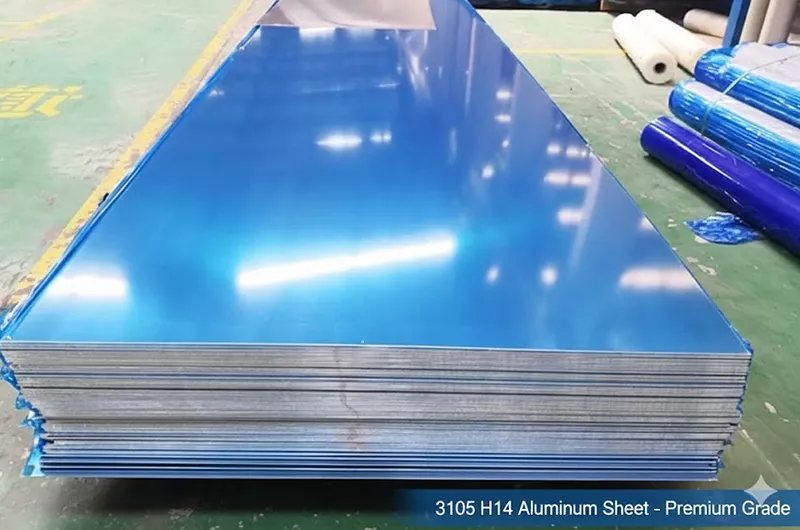
Specification of 3105 h14 aluminum sheet
| Alloy | 3105 aluminum |
| Temper | H14 |
| Thickness(mm) | 0.1-600 |
| Width(mm) | 20-2650 |
| Length(mm) | 500-16000 |
| Application | Liquor bottle caps, beverage bottle caps, cosmetic caps, coating rolls, etc. |
Haomei 3105-H14 Aluminum Sheet and Coil – Common Supply Forms
The most common product forms of 3105 H14 are mainly sheets and coils.
| Product Form | Typical Thickness Range | Surface Treatment | Typical Width |
| Flat Sheet | 0.4mm - 4.0mm | Mill finish, matte, brushed, color coated | 1000mm, 1220mm, 1500mm |
| Coil | 0.2mm - 3.0mm | Polyester (PE) or Fluorocarbon (PVDF) coating | 600mm - 2600mm |
| Aluminum Strip | 0.1mm - 0.5mm | Lubricated (for stamping caps) | 20mm - 600mm |
3105 H14 Color Coated Aluminum Coil/Sheet (Color Coated Aluminum)
This is the core product form of the 3105 alloy. Thanks to its excellent surface treatment performance, it is an ideal substrate for paint coatings.
- Applications: Residential siding, mobile housing panels, roofing systems.
- Features: Strong coating adhesion, capable of withstanding long-term exposure to sunlight and rain without peeling.
3105 H14 Aluminum Foil Stock & Strips (Foil & Strips)
3105-H14 is often processed into thin strips for high-volume stamped components.
- Closure stock: Widely used for caps (screw caps) for alcoholic beverages, drinks, and cosmetics. The hardness of H14 is sufficient to ensure crack-free stamping while maintaining the structural strength of the cap.
- Lamp shades and lamp holders: Used for manufacturing metal bases and decorative parts of lighting fixtures.
3105 H14 Profiled / Corrugated Aluminum Sheets
Taking advantage of its good bending performance (H14 temper resists cracking during bending), 3105 is commonly processed into specially shaped architectural sheets.
- Rainwater systems: Gutters, downspouts, and soffits.
- Louvers: Used for sunshades or architectural ventilation louvers.
3105 H14 Aluminum Sign Blanks (Sign Blanks)
- Applications: Road signs, advertising sign substrates.
- Form: Typically pre-cut flat sheets, usually with thicknesses ranging from 0.5mm to 2.0mm.
Why Choose the H14 Temper for 3105 Aluminum?
H14 represents a "half-hard temper." In this condition, the 3105 alloy achieves an optimal balance between strength and formability:
- If H18 (full hard) is selected, although the strength is higher, cracking is more likely to occur during bending.
- If the O temper (annealed) is selected, the metal is too soft, and finished products are prone to deformation or collapse.
- H14 allows 90-degree or even larger-angle bending without cracking, making it highly suitable for products manufactured through roll forming or stamping processes.
3105 H14 aluminum properties
- Corrosion resistance: As a rust-resistant aluminum alloy, 3105 exhibits excellent corrosion resistance in atmospheric and freshwater environments, making it suitable for outdoor or humid applications.
- Durability: Through strain hardening, the material’s durability and load-bearing capacity are enhanced, making it suitable for applications requiring a certain level of strength.
- Moderate strength: Due to the addition of magnesium, its strength is higher than that of 1100 and 3003 alloys, making it well-suited for applications requiring medium strength.
- Hardness characteristics: Strain hardening increases the hardness and stiffness of the material, improving load-bearing capacity while retaining a degree of ductility.
- Processing performance: Supports both cold and hot working (such as rolling, bending, and stamping) and can be processed into various shapes and sizes.
- Excellent weldability, suitable for arc welding, gas welding, spot welding, and other welding methods.
- Mechanical properties: 3105 aluminum has relatively high tensile strength, shear strength, and yield strength. Copper (Cu) content is controlled below 0.2% to balance strength and corrosion resistance.
- Surface finish: It features a “smoother” surface specifically optimized for painting and coating, which is why it is almost always used for pre-painted aluminum products.
3105 H14 Aluminum Designation and Standards
- UNS: A93105
- ISO: AlMn0.5Mg0.5
- ASTM: B209 for sheet and strip
3105 Aluminum Temper H14 and Processing
- H14 Temper: Strain-hardened and partially annealed to a quarter-hard state; balances strength and workability.
- Forming: Primary forming into sheet or coil, followed by cold rolling to achieve the H14 temper.
- Heat Treatment: Not heat-treatable; strength is gained solely through cold work.
Chemical compositon of 3105 aluminum sheet
| Grade | Si | Fe | Cu | Mn | Mg | Cr | Ni | Zn | Al |
| 3105 | 0.6 | 0.7 | 0.3 | 0.30-0.8 | 0.20-0.8 | 0.2 | - | 0.4 | remains |
3105 Aluminum Sheet Mechenical Property
| Alloy/Temper | Thickness | Tensile strength | Yield strength | Elongation % |
| mm | Mpa | Mpa | ||
| 3105 O/H111 | >0.2-0.5 | 100-155 | 40 | 14 |
| >0.5-1.5 | 15 | |||
| >1.5-3 | 17 | |||
| 3105-H12 | >0.2-0.5 | 130-180 | 105 | 3 |
| >0.5-1.5 | 4 | |||
| >1.5-3 | 4 | |||
| 3105-H22 | >0.2-0.5 | 130-180 | 105 | 6 |
| >0.5-1.5 | 6 | |||
| >1.5-3 | 7 | |||
| 3105-H14 | >0.2-0.5 | 150-200 | 130 | 2 |
| >0.5-1.5 | 2 | |||
| >1.5-3 | 2 | |||
| 3105-H24 | >0.2-0.5 | 150-200 | 120 | 4 |
| >0.5-1.5 | 4 | |||
| >1.5-3 | 5 | |||
| 3105-H16 | >0.2-0.5 | 175-225 | 160 | 1 |
| >0.5-1.5 | 2 | |||
| >1.5-3 | 2 | |||
| 3105-H26 | >0.2-0.5 | 175-225 | 150 | 2 |
| >0.5-1.5 | 3 | |||
| >1.5-3 | 3 | |||
| 3105-H18 | >0.2-3.0 | 195 | 180 | 1 |
| 3105-H28 | >0.2-1.5 | 195 | 170 | 2 |
| 3105-H19 | >0.2-1.5 | 215 | 190 | 1 |
3105 H14 Aluminum Physical and Thermal Properties
- Density: 2.72 g/cm³ (0.0983 lb/in³)
- Thermal Conductivity: 171 W/m·K (99 BTU/ft·hr·°F)
- Coefficient of Thermal Expansion: 23.6 µm/m·°C (20–100°C)
- Melting Range: 635–654°C (1175–1210°F)
3105 H14 Aluminum Corrosion Resistance
The 3105 alloy has excellent atmospheric corrosion resistance, making it suitable for external building applications. Due to its manganese and magnesium content, its performance surpasses that of pure 1100 alloy and is comparable to 3003 alloy.
3105 H14 Aluminum Formability and Weldability
- Formability: Excellent bending, drawing, and stamping capabilities, not prone to cracking; ideal for complex shapes and deep drawing applications.
- Weldability: Can be welded using conventional methods (MIG, TIG, resistance welding); however, painted/coated H14 sheets may require protection to prevent coating damage during torch welding.
3105 H14 Aluminum Fabrication and Processing
- Formability: Excellent, suitable for bending, stamping, and deep drawing.
- Weldability: Compatible with all commercial welding techniques (arc welding preferred).
- Machinability: Moderate (aluminum alloy grade 30%); use of oil-based lubricants is recommended.
- Heat Treatment: Non-heat-treatable; strain hardened through cold working (H14).
3105 H14 Aluminum Advantages and Limitations
- Advantages: High corrosion resistance, lightweight, good electrical/thermal conductivity, easy to fabricate.
- Limitations: Lower strength compared to heat-treatable alloys (e.g., 6000 series); limited machinability at higher temper conditions.
Comparison of 3105 Aluminum with Similar Alloys
- 3105 vs 3003: 3105 has higher strength (e.g., Brinell hardness of 46 compared to 3003-H14's 42).
- 3105 vs 5052: 5052 (magnesium-based) has higher strength but poorer formability.
What is 3105 aluminum used for?
3105 aluminum alloy is primarily used in construction, industrial, and household applications, offering excellent formability and corrosion resistance.
3105-H14 aluminum alloy improves durability and load-bearing capacity while maintaining appropriate ductility.
- Construction: roofing, wall panels, gutters, exterior cladding, downspouts, and mobile homes.
- Signage and Decorative Panels: pre-painted sheets, sign blanks, trailer siding—durable and aesthetically pleasing.
- Sheet Metal Work: HVAC components, truck trailer covers, and industrial baffles.
- Consumer Products: bottle caps, ceiling fans, and PCB drilling covers.
- Signs and Display Stands: featuring smooth surface and paintability.
- Heat Exchangers and Fins: applications where moderate strength and formability are critical.
- Architectural Decoration: room dividers, mobile home panels, eaves troughs, shutters, etc.
- Packaging Materials: bottle caps, stoppers, cake trays, can bodies, and non-food packaging such as screw caps and foil applications (H14/H16).
- Industrial Uses: lamp cap materials, color-coated aluminum base materials, heat sinks, pressure vessels, and piping.
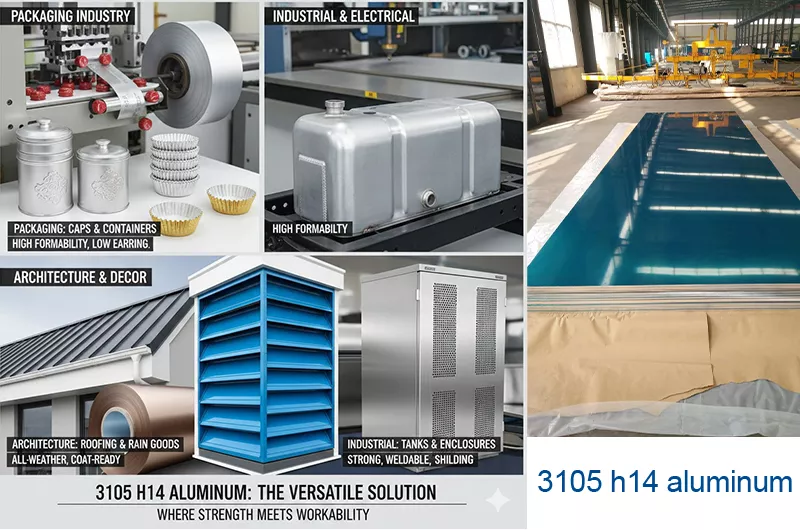
| Application Area | Main Product Form | Typical Thickness Range | Key Requirements |
| Closure Packaging | 3105 H14 coated / lubricated aluminum strip | 0.20 - 0.30 mm | Deep drawability, earing rate control |
| Light Industrial Forming | 3105 H14 narrow aluminum coil | 0.15 - 0.45 mm | Fine surface quality, low springback |
| Building Rainwater Systems | 3105 H14 color-coated aluminum strip / coil | 0.40 - 0.90 mm | Weather resistance, crack-free bending of coating |
| Industrial Enclosures / Fuel Tanks | 3105 H14 mill-finished aluminum sheet / plate | 1.0 - 3.0 mm | Weldability, structural strength |
Packaging Industry
In the packaging sector, 3105 H14 is a preferred material for metal containers due to its high cleanliness and isotropic properties.
- Twist-off tamper-evident caps (such as those used for alcoholic beverages, cosmetics, and pharmaceutical packaging), taking advantage of its deep drawing performance and corrosion resistance.
- Thin-gauge formed products such as tea tins, cake trays, and candle cups.
Roll-On Pilfer-Proof Caps (ROPP Caps):
- Form & specifications: DOS lubricated aluminum strip or pre-coated aluminum strip; thickness 0.20mm - 0.28mm.
- Low earing rate, deep drawing performance, coating adhesion.
- The mechanical properties of 3105 H14 are extremely stable. During high-speed stamping operations, it ensures uniform skirt height without wavy edges, which is critical for the sealing safety of alcoholic beverages and pharmaceuticals.
Lightweight Formed Containers (Cake Trays, Candle Cups):
- Form & specifications: Half-hard narrow coils (Narrow Strips); thickness 0.15mm - 0.40mm.
- Technical keywords: Tensile strength, ductility, food-grade surface.
- By utilizing the moderate hardness of the H14 temper, the material maintains container rigidity (compression resistance) while withstanding multiple drawing operations without cracking.
Architectural Decoration
In architectural applications, 3105 alloy is commonly used as a substrate combined with surface coating processes, balancing visual appeal and structural protection.
- Outdoor components such as louvers, gutters, and downspouts benefit from long-term use due to their weather resistance and ease of fabrication.
- Prepainted aluminum coils, interior partitions, and mobile housing roof panels meet requirements for aesthetics and lightweight construction.
Rainwater Collection Systems (Gutters, Downspouts):
- Form & specifications: Prepainted aluminum coils; thickness 0.40mm - 0.80mm.
- T-bend performance (crack-free bending of coating), corrosion resistance, roll forming.
- 3105 H14 exhibits excellent atmospheric corrosion resistance and remains more durable than ordinary steel sheets even in acid rain environments. The H14 temper allows complex profile forming on roll forming machines without cracking.
Modern Building Panels (Mobile Homes, Partitions):
- Form & specifications: Corrugated sheets or flat sheets; thickness 0.80mm - 1.20mm.
- Flatness, lightweight design, PVDF coating.
- When used for large wall panels, 3105 provides higher yield strength than 1000 series alloys, helping maintain panel flatness under high wind loads and reducing the risk of bulging or deformation.
Industrial & Electrical Applications
In industrial environments, 3105 H14 primarily demonstrates its mechanical strength and processing tolerance.
- Automotive fuel tanks, offering resistance to fuel corrosion and reduced weight.
- Electrical equipment enclosures, balancing electrical conductivity and protection.
Automotive Transportation Components (Fuel Tanks, Fender Panels):
- Form & specifications: Medium plates; thickness 1.2mm - 3.0mm.
- Weldability, vibration fatigue resistance, forming limits.
- Compared with 3003 alloy, 3105 contains a small amount of magnesium (Mg), which enhances the strength of welded joints. It is commonly used for non-load-bearing liquid tank sidewalls, providing resistance to fuel corrosion and vibration.
Electrical Equipment Enclosures:
- Form & specifications: Cold-rolled mill-finished aluminum sheets; thickness 1.0mm - 2.5mm.
- Electromagnetic shielding, thermal conductivity, punching.
- 3105 H14 is well suited for precision punching and bending. With aluminum content still above 98%, it retains good electrical conductivity and shielding effectiveness, helping protect internal electronic components from electromagnetic interference.
3105 vs 3003: What’s the Difference?
Although they are very similar, 3105 is often referred to in the industry as “recycled 3003” because its chemical composition allows a wider range of impurities. This makes it more cost-effective for large-scale construction projects. Structurally, 3105 offers slightly higher strength, while 3003 is “softer” and easier to deep draw into complex shapes (such as cookware).
What is the difference between 3003 H14 and 3105-H14?
Compared to 3003-H14, 3105-H14 generally has higher strength and slightly lower elongation, making it suitable for applications requiring greater durability and strength. Both alloys offer excellent corrosion resistance and are used in a variety of industrial and commercial applications.
- Corrosion resistance: 3105 H14 has a higher manganese content, providing better pitting corrosion resistance than 3003 H14, especially in high-humidity or mildly corrosive environments.
- Strength and formability: Both alloys have similar strength levels, but 3105 H14 has slightly lower formability than 3003 H14, making it more suitable for applications with higher corrosion resistance requirements.
- Electrical conductivity: 3105 H14 has higher electrical conductivity (41% IACS) compared to 3003 H14 (approximately 35% IACS), making it more suitable for electrical applications.
| Property | 3105-H14 Aluminum Alloy | 3003-H14 Aluminum Alloy |
| Corrosion Resistance | Excellent: Similar to 3003, providing good corrosion protection in various environments. | Excellent: Provides good corrosion resistance in various environments, including food and beverage applications. |
| Typical Applications | Residential exterior walls, mobile homes, rainwater transport items, and packaging materials, generally requiring higher strength and durability. | Cookware, tanks, chemical equipment, and basic materials requiring good formability and corrosion resistance. |
| Machinability | Good: Offers good machinability but with slightly higher strength and reduced ductility. Still easily formable and machinable for various applications. | Excellent: Known for its excellent machinability and ease of forming, widely used in applications requiring extensive shaping and forming. |
When Should You Consider 3105 H14?
If you need a material that is easy to stamp and form, while also offering moderate strength and good corrosion resistance for products such as bottle caps and decorative panels, 3105 H14 is an economical and practical choice.
What should you pay attention to?
Its strength is at a medium level and it is not suitable for load-bearing structural applications. In addition, although it offers good weldability, its machinability is relatively average.
Products you may be interested in
Further reading
Users viewing this material also viewed the following
- 3105 Aluminum for Wine Bottle Caps
- 3105 Aluminum for Roofing Panels
- 3105 Corrugated Aluminum Sheet
- 3105 Aluminum for Lamp Holders
- 3105 Coated Aluminum Coils
- 3105 Aluminum Coil for Venetian Blinds
- 3105 Aluminum for Beverage Cans
- 3105 Aluminum for Bottle Caps
Recommended Content