
5754 aluminum plate is an Al-Mg series alloy, containing 2.6%-3.6% magnesium, with medium strength, excellent corrosion resistance, and weldability, suitable for the manufacture of tanker truck bodies and other pressure vessels. Its O temper (annealed) has the best plasticity, while H111 is a strain-hardened temper with higher strength.
Both the O temper and H111 temper of 5754 aluminum alloy indicate that the material is relatively soft and easy to form, making it very suitable for manufacturing tanker bodies that require extensive cold working and stamping.
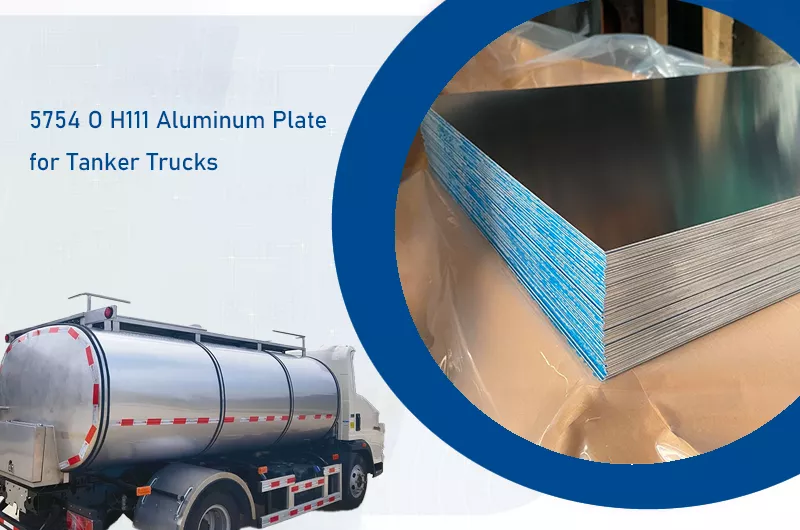
The 5754 aluminum plate can withstand corrosion from fuels and other chemicals, has good weldability and formability, and its density is lower than that of steel, thereby improving the fuel efficiency and payload capacity of the tanker.
Specifications of 5754 Aluminum Sheet Plate for Tanker Trucks
| Alloy | Thickness(mm) | Width(mm) | Length(mm) |
| 5754 | 2.0-8.0 | 1000-2000 | 2000-12000 |
Why Choose 5754 Aluminum Alloy for Tankers?
Excellent Corrosion Resistance
5754 contains magnesium (Mg) as the main alloying element, providing good resistance to atmosphere, seawater, and various chemicals (especially salts).
This is crucial for tankers transporting food, chemicals (such as certain alcohols, diluted acids, and alkalis), or operating frequently in coastal areas or on roads treated with deicing salts, effectively preventing tank corrosion and ensuring the purity of transported materials and the long service life of the tank.
Good Weldability
Tanker bodies are welded from large aluminum plates, and 5754 aluminum alloy exhibits excellent weldability.
Common MIG and TIG welding methods can be used, producing high-strength weld joints with stable quality, and welding cracks are unlikely to occur.
Balance of Medium Strength and Excellent Formability
O temper: Fully annealed, it is the softest state of aluminum plate with very high elongation, suitable for severe forming processes such as deep stamping and stretching, commonly used for complex curved components such as tank end caps.
H111 temper: After final annealing, it undergoes slight strain hardening (straightening), with slightly higher strength than O temper while maintaining good formability. It also has better flatness and dimensional stability than O temper, commonly used for cylindrical parts of the tank body.
Lightweight
Aluminum has a density of about 2.7 g/cm³, only one-third that of steel (≈7.85 g/cm³). Using aluminum alloy for tank construction significantly reduces vehicle weight, allowing more cargo within legal weight limits, improving transport efficiency, and reducing fuel/electricity consumption.
Easy Maintenance and Attractive Appearance
The surface of aluminum alloy forms a dense oxide film, which is resistant to rust and usually does not require complex protective coatings like steel tankers, reducing maintenance costs. The silver-white appearance is simple and aesthetically pleasing.
5754 Tanker Aluminum Plate: O Temper vs H111
| Properties | 5754-O (Annealed) | 5754-H111 (Slightly Strain-Hardened after Annealing) |
| Features | Softest material, lowest strength, excellent plasticity and ductility. | Slightly stronger than O temper, maintains good plasticity, better flatness. |
| Main Applications on Tankers | Tank end caps: Require deep stamping using large molds; O temper material avoids cracks or orange peel during stamping. Other complex-formed components. | Tank cylindrical body: Requires rolling into cylinders with good formability and flatness. Reinforcing rings, baffles, and other internal structural parts. |
5754-O Tanker Aluminum Plate
5754-O aluminum plate is fully annealed, with the lowest strength but optimal plasticity, suitable for extremely complex cold forming.
Features:
- High ductility and easy formability: suitable for complex bending and welding processes.
- Good corrosion resistance: 5754 alloy contains magnesium, showing excellent resistance to seawater and atmospheric corrosion.
- Low strength: Tensile strength is relatively lower than H111, suitable for components with complex shapes but not high load requirements.
- Excellent weldability: very suitable for welding without additional annealing.
Typical Applications:
- Tank outer shell: formed into curved structures through deep drawing, bending, etc., such as oil tanker end caps and side panels.
- Non-load-bearing components: such as liners, baffles, and other parts requiring high formability.
5754-H111 Tanker Aluminum Plate
5754-H111 aluminum plate is naturally aged after hot working, with medium strength, elongation ≥18%, combining deformation resistance and processing adaptability.
Features:
- Higher strength: Higher tensile and yield strength than O temper, suitable for parts with slightly higher load requirements.
- Good ductility: Slightly harder than O temper but still meets general bending and forming requirements.
- Excellent corrosion resistance: similar to O temper, suitable for marine and chemical environments.
- Good weldability: weldable, but excessive cold working may require attention to stress concentration.
Typical Applications:
- Structural support parts: such as tank frames, stiffeners, partitions, which need to withstand mechanical stress and impact loads during transportation.
- Thick plate components: such as chassis brackets, connecting angles, balancing lightweight and load-bearing requirements.
| Properties | 5754-O | 5754-H111 |
| Strength | Low | Medium-high |
| Ductility/Formability | Very high | Good |
| Weldability | Excellent | Good |
| Typical Applications | Liners, complex bent parts | Outer panels, load-bearing plates |
| Suitable Environment | Marine / humid environments | Marine / humid environments |
Chemical Composition of 5754 Aluminum Sheet Plate for Tanker Trucks
| Element | Composition % |
| Si | 0.40 |
| Fe | 0.40 |
| Cu | 0.10 |
| Mn | 0.05 |
| Mg | 2.6-3.6 |
| Cr | 0.3 |
| Ni | - |
| Zn | 0.2 |
| Ti | 0.15 |
| Al | Remainder |
Mechanical Properties of 5754 Aluminum Sheet Plate for Tanker Trucks
| Temper | Thickness/mm | Tensile Strength /MPa | Specified non-proportional Tensile Strength/MPa | Elongation After Break/% | A50 mm | Bending Radius |
| O, H111 | 3.00-6.00 | 190-240 | ≥80 | ≥21 | ≥4320 | 1.0t |
| >6.00-12.00 | 190-240 | ≥80 | ≥19 | ≥4320 | 2.0t |
Advantages of 5754 Tanker Aluminum Plate
- Lightweight: Density is 1/3 of steel, reducing transportation energy consumption.
- Corrosion Resistance: Salt spray resistance is more than three times that of steel, suitable for chemical transport.
- Recyclable: Recycling rate up to 95%, meeting environmental protection requirements.
- Medium Strength and Lightweight: Significantly reduces vehicle weight and improves fuel efficiency.
- Forming and Welding Performance: O temper has excellent plasticity, suitable for deep drawing, bending, and other complex forming processes.
- Workability: The material is easy to cut, bend, and weld, simplifying the manufacture of complex tank shapes.
- Weldability: 5754 aluminum can be welded into strong, leak-proof seams, ensuring the structural integrity and safety of the tank.
Forming Processes and Surface Treatment Options for 5754 Tanker Aluminum Plate
5754 Tanker Aluminum Plate Forming Processes
- O temper aluminum plate can be processed into complex curved surfaces through stamping and deep drawing, such as the curved structure of tank end caps.
- H111 temper aluminum plate is suitable for bending, rolling, and other medium-deformation processes, used for manufacturing reinforcing rings and support beams.
5754 O Aluminum Plate
- Features: O temper is annealed, the aluminum plate is soft with very high ductility, almost no work hardening, making it easy to undergo large deformations.
- Suitable Processes: Can be used for stamping, deep drawing, rolling, and other processes, capable of forming complex curved structures.
- Application Scenarios: In tanker manufacturing, O temper aluminum plates are often used for the curved structures of tank end caps, spherical or elliptical tank tops, ensuring no cracks or wrinkles during forming.
5754 H111 Aluminum Plate
- Features: H111 is a lightly strain-hardened temper, with slightly higher strength than O temper while maintaining certain ductility, suitable for medium-deformation processing.
- Suitable Processes: Suitable for bending, rolling, and local stretching, but not for large deep drawing.
- Application Scenarios: Commonly used for manufacturing reinforcing rings, support beams, connecting plates, and other load-bearing structural components of tankers, ensuring strength while facilitating subsequent welding and assembly.
5754 Tanker Aluminum Plate Surface Treatment
Anodizing can improve corrosion resistance and aesthetics, suitable for exposed components; applying anti-corrosion coatings (such as epoxy paint) can further protect welds and corrosion-prone areas.
Anodizing
- Function: Forms a dense, hard oxide film on the aluminum surface through electrochemical treatment.
- Advantages: Enhances corrosion resistance, wear resistance, and aesthetics; can also be colored as needed (silver-white, champagne, etc.).
- Suitable Applications: Exposed parts, such as tank exterior walls or decorative components, can resist marine atmosphere, chemical media, and UV degradation over the long term.
Anti-Corrosion Coating (e.g., Epoxy Paint)
- Function: Forms a protective layer on the aluminum surface, effectively preventing moisture, salt spray, or chemical corrosion.
- Advantages: Especially suitable for welds, joints, and corrosion-prone areas, extending the service life of structural components.
- Suitable Applications: Liners, welded joints, or areas exposed to corrosive media, where coating protection reduces maintenance costs.
Comparison of 5754 Aluminum with Other Common Tanker Alloys
- 5083: Higher strength than 5754, commonly used in applications requiring higher strength, such as large pressure tankers or liquefied natural gas (LNG) tankers. However, its formability is slightly inferior to 5754, and it is more expensive.
- 5454: Performance is between 5083 and 5754, with slightly better corrosion resistance and strength than 5754.
- 5052: 5754 aluminum alloy has higher mechanical strength and tensile strength than 5052 aluminum alloy, making it more suitable for applications requiring high strength.
- Compared to Steel: 5754 aluminum alloy is much lighter than steel, saving fuel and improving transport efficiency.
5754 O/H111 aluminum plates are one of the ideal materials for manufacturing liquid transport tankers (especially atmospheric or low-pressure tankers). They achieve a perfect balance between corrosion resistance, weldability, formability, and lightweight properties, making them a mainstream choice in the industry.
With their combined advantages of corrosion resistance, lightweight, and easy processing, 5754 O/H111 aluminum plates are ideal for tanker manufacturing. O temper is suitable for complex-formed tank shells, while H111 temper meets the strength requirements of structural components. By strictly following industry standards, optimizing welding processes, and enhancing maintenance, tankers can ensure long-term safety and reliability while achieving a balance of economic efficiency and environmental protection.