
Non-Stick Round Aluminum Circle Disc
Non-stick aluminum circles refer to metal processing components in which a non-stick coating is applied to the surface of aluminum or aluminum alloy round discs. They combine the lightweight and excellent thermal conductivity of aluminum with the easy-to-clean properties of non-stick coatings, and are widely used in cookware manufacturing and the food processing industry.
For “non-stick aluminum circles, ” this term usually refers to circular aluminum blanks used in the production of non-stick cookware such as frying pans. The core requirement lies in selecting specific aluminum alloys with excellent deep-drawing performance and strong surface adhesion.
- Substrate: Typically 1050/1060/1070 pure aluminum or 3003 aluminum alloy circles, precisely stamped and formed.
- Non-stick coating: One or multiple layers of special coating applied to the surface to prevent food from sticking and to facilitate cleaning.
Non-stick round aluminum discs are versatile industrial components, mainly used as “blanks” or starting materials for manufacturing high-quality cookware and specialized industrial parts.
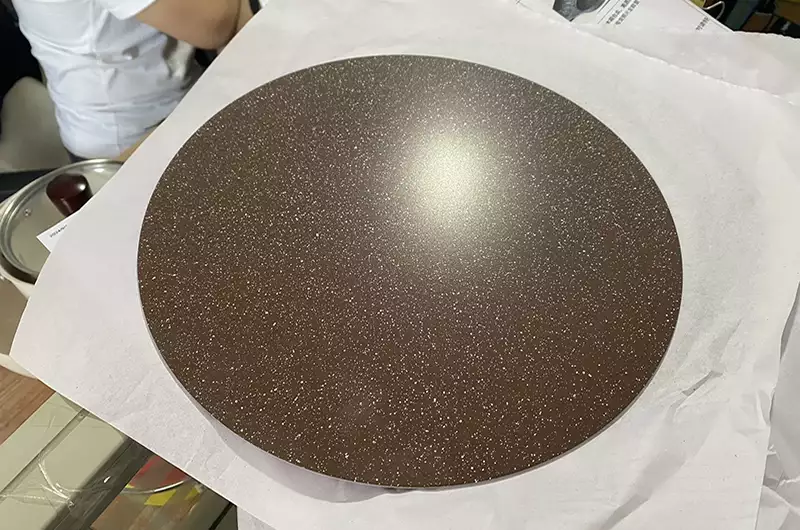
Non-Stick Round Aluminum Circle Disc Technical Specifications
| Feature | Common Specifications |
| Alloy Grades | 1050/1100: High purity, easy to shape. |
| 3003: Most popular for cookware (adds manganese for strength). | |
| 5052: High corrosion resistance, often used for high-end pans. | |
| Thickness | Generally ranges from 0.3mm to 8.0mm. |
| Diameter | Ranges from small 80mm discs to large 1200mm circles. |
| Surface Finish | Non-stick coating (PTFE/Ceramic), Anodized, or Mill Finish. |
Non-Stick Round Aluminum Circle Disc Characteristics
| Feature | Description |
| Fast and even heat conduction | Aluminum conducts heat three times faster than iron, ensuring even heating and shorter cooking time. |
| Lightweight and durable | Weighs only one-third of steel with the same volume, easy to handle and transport, while offering good corrosion resistance. |
| Easy to clean | The non-stick coating allows food residue to be easily released, reducing detergent use and cleaning effort. |
| Excellent formability | Suitable for deep drawing and spinning processes to produce cookware, baking trays, and various shapes. |
| High temperature resistance | High-quality coatings can withstand temperatures above 260°C, suitable for a wide range of cooking applications. |
Non-Stick Round Aluminum Disc Materials
- Pure aluminum series (1050/1060/1100): High purity (over 99.5%), excellent ductility, suitable for thin cookware.
- 3003 aluminum alloy: Contains 1.2–1.6% manganese, higher strength and better corrosion resistance than pure aluminum, suitable for thick-walled cookware.
| Alloy Grade | Main Features and Suitability | Typical Applications |
| 3003 | Most commonly used, excellent deep-drawing performance, easy to form complex cookware. | High-end cookware (e.g., non-stick pans, pressure cookers). |
| 3004 / 5052 | Higher strength and corrosion resistance than pure aluminum and 3003, for more demanding cookware. | Premium cookware (e.g., non-stick pans). |
| 1050 / 1060 / 1100 | Pure aluminum series, good formability, lower cost, suitable for general stamping. | Standard cookware (e.g., pot lids, aluminum kettles). |
- 3003: Offers good formability, corrosion resistance, and thermal conductivity—commonly used for cookware bases.
- 1050/1060/1100: High-purity aluminum with excellent thermal conductivity.
Types of Non-Stick Coatings for Aluminum Circles
Aluminum circles are coated with non-stick coatings (typically PTFE/Teflon or similar materials), which prevent food from sticking and make cleaning easier—ideal for frying pans and other cookware.
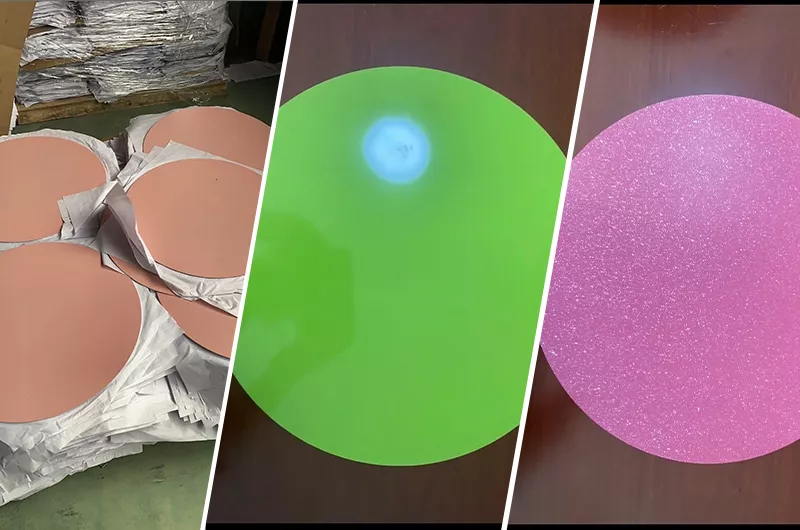
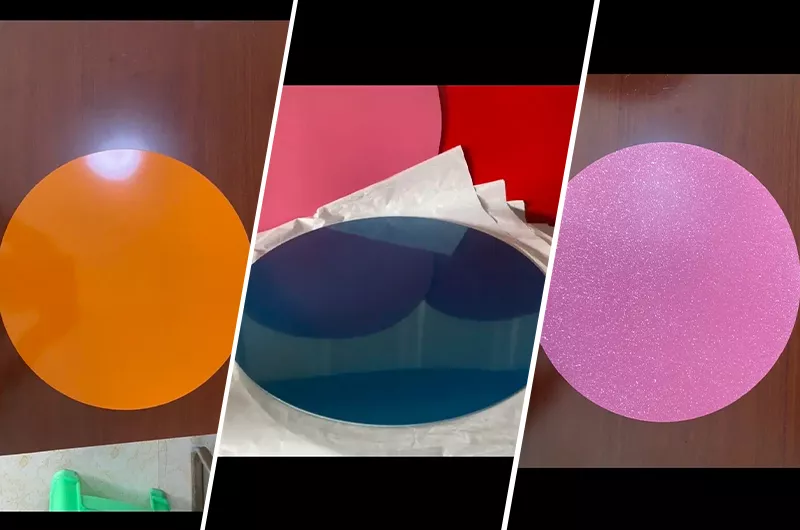
| Coating Type | Composition | Features | Applications |
| PTFE (Teflon) | Polytetrafluoroethylene | Heat resistance up to 260°C, excellent chemical stability, best non-stick performance. | Household cookware, low-temperature baking. |
| Ceramic coating | Inorganic ceramic materials | High heat resistance (up to 450°C), environmentally friendly, high hardness. | High-temperature cooking, health-conscious users. |
| Nano coating | Special nano materials | Combines advantages of ceramic and PTFE, wear-resistant and durable. | High-end cookware, commercial equipment. |
| Double-layer coating | Primer + topcoat system | Enhanced adhesion and durability, extended service life. | Frequently used cookware and equipment. |
Typical Sizes of Non-Stick Aluminum Circles
- Diameter: 50mm–1200mm (customized according to finished product size)
- Thickness: 0.3mm–6.0mm (1.5–3.0mm commonly used for cookware)
- Surface: Free from scratches and burrs, smooth edges, uniform coating without pinholes
Non-Stick Aluminum Circle Surface and Quality
As Haomei Aluminum, we consistently adhere to high manufacturing standards in surface quality and overall quality control of non-stick aluminum circles.
During production, aluminum circles undergo precision rolling and strict leveling to achieve a smooth and fine surface with no obvious scratches and uniform thickness. This effectively ensures coating adhesion and even heat distribution during end use.
In terms of material selection, we offer various aluminum alloys and tempers according to application requirements, including O temper, H12, and H14. Each temper balances strength, ductility, and formability differently, ensuring stable performance during stamping, spinning, and deep drawing processes, and guaranteeing consistency and reliability from the source.
Why Use “Non-Stick” Aluminum Circles?
More and more cookware manufacturers choose non-stick aluminum circles because of their comprehensive advantages in performance, processing, and user experience.
First, they offer excellent thermal conductivity. Aluminum heats up quickly and evenly, transferring heat more efficiently than stainless steel or cast iron, which improves cooking efficiency and reduces localized overheating.
Second, daily use and maintenance are more convenient. Applying a non-stick coating—either at the raw material stage or after forming—significantly reduces food adhesion. After cooking, simple rinsing is usually sufficient, greatly enhancing ease of use.
From a processing perspective, aluminum has outstanding formability. Compared with harder metals, aluminum’s good ductility allows smooth deep drawing and spinning, making it suitable for tall or deep cookware shapes without cracking or deformation.
In addition, aluminum offers stable and reliable corrosion resistance. A dense natural oxide layer forms on the surface, allowing the material to maintain durability and appearance even in humid and high-temperature kitchen environments.
Applications of Non-Stick Aluminum Circles
In practical applications, non-stick aluminum circles are widely used across multiple fields due to their combined material and surface advantages.
- In cookware and kitchenware manufacturing, non-stick aluminum circles are key raw materials for frying pans, woks, flat pans, milk pans, and various baking trays. Rapid and even heat transfer combined with non-stick coatings reduces food adhesion and improves cooking efficiency and product consistency.
- In kitchen appliance components, they are commonly used for rice cooker inner pots, heating plates, and air fryer trays. Their easy-to-clean surfaces reduce oil residue while supporting efficient temperature response during heating.
- In the food processing and baking industry, non-stick aluminum circles are often formed into molds or trays for mass production. Smooth non-stick surfaces reduce product loss and improve demolding efficiency, meeting both hygiene and productivity requirements.
- From an industrial processing perspective, non-stick aluminum circles offer good ductility and stable coating adhesion, making them suitable for spinning, stamping, and deep drawing processes, and are often used for containers or functional components requiring smooth inner surfaces.
In addition, for OEM and customized applications, non-stick aluminum circles can be flexibly matched with different alloys, thicknesses, sizes, and coating solutions to meet diverse market and brand requirements.
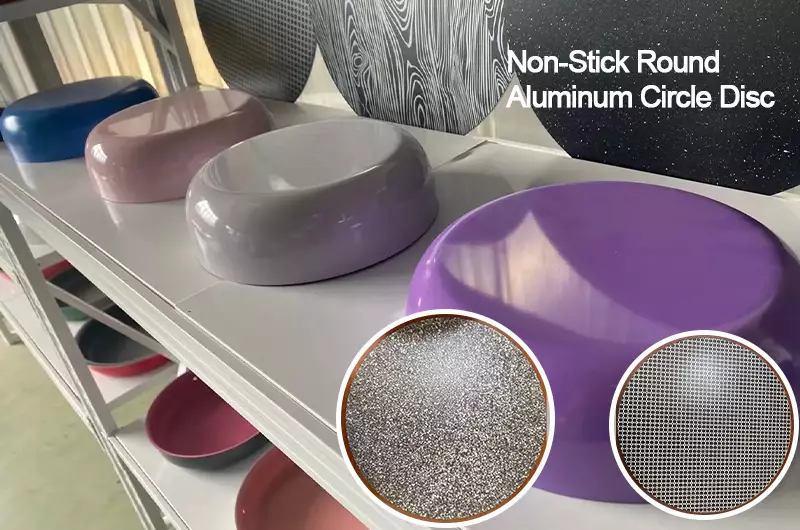
Manufacturing Process of Non-Stick Aluminum Circles
Aluminum sheets or coils are cut or stamped into circular shapes.
- Surface treatment: cleaning → primer application → non-stick coating.
- Coating curing to firmly bond it to the aluminum substrate.
- The discs are then ready to be formed into finished cookware components.
Key Points of the Non-Stick Aluminum Circle Production Process
Substrate preparation: aluminum coil → slitting → stamping into circles → deburring → surface treatment (sandblasting / brushing) to enhance coating adhesion.
Coating application
Pretreatment: cleaning → sandblasting → drying to ensure a contaminant-free surface.
Spraying: primer (to enhance adhesion) → topcoat (to provide non-stick properties); some products use multi-layer spraying.
Curing: high-temperature baking (180–400°C) to firmly bond the coating to the substrate.
Quality inspection: coating thickness, adhesion, scratch resistance, and high-temperature resistance testing to ensure compliance with food-grade standards (RoHS/ISO9001).
Manufacturers purchase these blank aluminum circles and then form them into specific cookware shapes through stamping, spinning, and deep drawing, followed by the application of non-stick coatings. They are also referred to as aluminum blanks, aluminum circles, or aluminum discs.
How to Select and Purchase Non-Stick Coated Aluminum Circles
As a long-term supplier to the cookware industry, Haomei Aluminum believes that when selecting non-stick coated aluminum circles, it is essential to evaluate multiple key factors beyond alloy composition to ensure stable forming and coating performance.
Temper and Specification Selection
The temper of aluminum circles directly affects deep-drawing performance.
- O temper (soft): Excellent ductility, suitable for multiple drawing and deep forming, commonly used for non-stick cookware blanks.
- H temper (hard): Higher strength, suitable for structural components with lower forming requirements.
In terms of specifications, the common thickness range is 0.3–6.0mm, with diameters customized according to customer molds and product designs. We recommend determining specifications early based on cookware shape, drawing depth, and mold parameters.
Surface Quality and Pretreatment
The stability of non-stick coatings largely depends on the surface condition of the aluminum circles.
High-quality blanks should feature:
Clean, flat surfaces without oil stains or indentations, and uniform microstructure to ensure proper coating adhesion.
Haomei Aluminum can provide polished, bright, or other customized surface finishes to ensure smooth subsequent spraying or roll-coating processes.
Select a Reliable Aluminum Circle Supplier
During procurement, it is recommended to prioritize manufacturers with stable production capacity and experience in the cookware industry. Communication should clearly specify:
- Final application (e.g., non-stick cookware)
- Required alloy grade
- Material temper
- Thickness and diameter tolerances
- Surface quality and subsequent processing requirements
Complete and accurate information enables manufacturers to provide better-matched material solutions and more targeted technical support.
Haomei Aluminum Procurement Recommendations Summary
Priority recommendation: 3003 alloy
For most non-stick cookware applications, 3003 aluminum circles offer an excellent balance of deep-drawing performance, stability, and cost control, making them a mature and reliable industry choice.
Clarify key technical parameters in advance
Including thickness, diameter, material temper (usually O temper), and surface finish requirements, to help reduce trial-and-error costs.
Sample testing before mass production
Conducting forming and coating adhesion tests before bulk purchasing is a critical step to ensure material-process compatibility. Haomei Aluminum consistently recommends sample validation to lay a solid foundation for stable production.
With mature production processes and a strict quality control system, Haomei Aluminum is committed to providing stable and sustainable aluminum circle solutions for non-stick cookware manufacturers.
Non-stick aluminum circles are a fundamental material in modern cookware manufacturing. Their performance directly affects the user experience and service life of finished cookware. Choosing high-quality products and using them correctly helps achieve both cooking efficiency and health safety.