
Anodized Aluminum Strips
Anodized aluminum strip refers to a metal strip in which a dense aluminum oxide protective layer is formed on the surface through the anodizing process. This process significantly enhances the aluminum's corrosion resistance, hardness, insulation properties, and decorative appearance, while retaining its lightweight characteristics.
Due to its high strength, wide range of color options, and low maintenance costs, anodized aluminum strips are highly suitable for use in construction (doors, windows, exterior walls), electronic products, and decorative moldings. They are lightweight and can be formed as a single piece, unlike paint, which may peel or flake off.
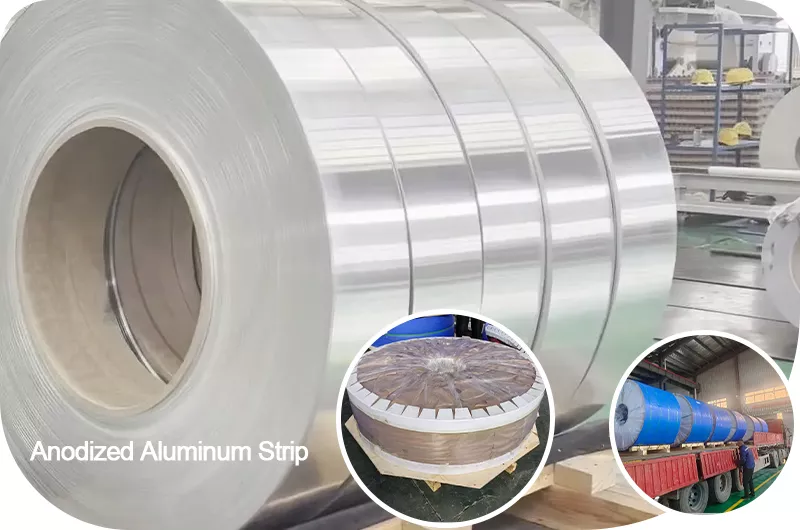
Anodized Aluminum Strip Specifications
| Feature | Typical Range / Options |
| Material Grades | 1000 series (Pure), 5000 (Marine/Structural), 6000 (Architectural) |
| Thickness | 0.1 mm to 6.0 mm |
| Anodizing Class | Class I: ≥ 18 microns (Exterior) | Class II: 10-18 microns (Interior) |
| Length | Standard coils or cut-to-size upon request |
| Surface Finish | Brushed, matte, glossy, or colored anodized |
| Temper | 0 (Soft), H14 (Half-hard), T6 (High strength) |
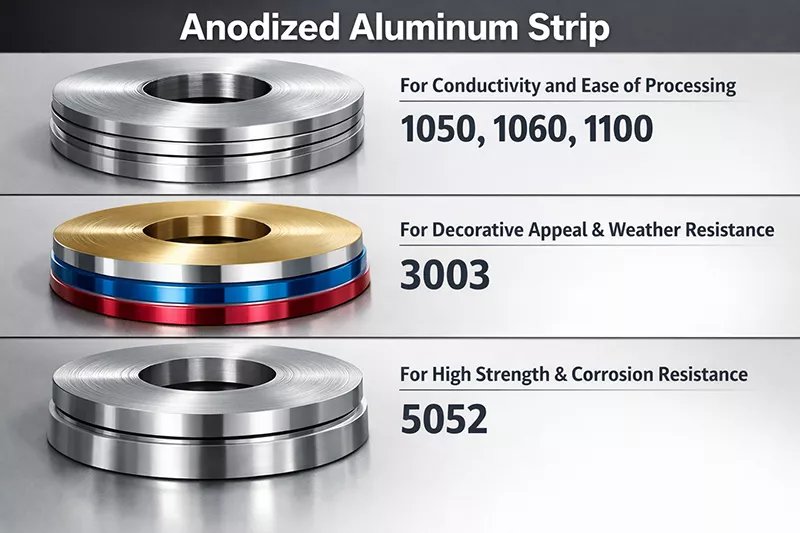
Anodized Aluminum Strip Alloys & Grades
| Series | Representative Grades | Features | Applications |
| 1000 Series | 1050, 1060, 1100 | High purity (over 99%), excellent anodizing effect, uniform color | Decoration, electronics, food packaging |
| 3000 Series | 3003, 3005 | Manganese alloy, higher strength, good corrosion resistance | Construction, refrigeration, chemical equipment |
| 5000 Series | 5052, 5056 | Magnesium alloy, high strength, fatigue-resistant, good weldability | Shipbuilding, automotive, aerospace |
| 6000 Series | 6061, 6063 | Aluminum-magnesium-silicon alloy, can be strengthened by heat treatment, excellent overall performance | Structural components, electronic enclosures, heat sinks |
1050 Anodized Aluminum Strip
Based on high-purity aluminum, it offers excellent electrical conductivity and corrosion resistance while retaining the inherent light weight and ease of processing of aluminum. After anodizing, the surface hardness is enhanced without sacrificing its good conductivity. Therefore, it is commonly used in applications that require high electrical and thermal performance, such as transformer windings, heat sinks, battery tabs, and it is also frequently used in architectural decorative strips and various lightweight components.
1060 Anodized Aluminum Strip
With extremely high aluminum content, it demonstrates excellent conductivity and corrosion resistance, and also possesses good ductility, making it easy for deep processing such as stretching and bending. After anodizing, the surface exhibits an attractive metallic luster, making it both functional and aesthetically pleasing. This type of aluminum strip is widely used in electrical components, heat sinks, capacitor housings, as well as functional and decorative door and window frames.
1100 Anodized Aluminum Strip
Classified as commercially pure aluminum, it is flexible, corrosion-resistant, and has moderate strength, making it very easy to cut, stamp, and coil. Its anodized layer is stable and allows for diverse color options, which makes it widely used in architectural decoration, kitchen hardware, signage, and electronic component housings.
3003 Anodized Aluminum Strip
As an aluminum-manganese alloy, it improves strength compared to pure aluminum, particularly with outstanding corrosion and weather resistance, making it suitable for long-term outdoor use. Anodizing provides rich and durable surface colors, which are both attractive and wear-resistant. Typical applications include building curtain walls, door and window decorative strips, automotive interior and exterior trims, and various outdoor signage.
5052 Anodized Aluminum Strip
Also part of the aluminum-magnesium alloy series, but with higher strength than 3003, and exceptional corrosion resistance, capable of withstanding marine environments and chemical media. After anodizing, surface hardness and wear resistance are further enhanced, making it ideal for demanding structural components. Common applications include ship parts, automotive structures, transportation exterior trims, protective components, and high-performance electronic heat dissipation parts.
Anodized Aluminum Strip Features
- Corrosion Resistance: Effectively prevents rust and environmental damage
- Durable Surface: Hard anodized layer resists scratches and wear
- Attractive Surface Finish: Available in natural aluminum color, silver, or custom colors
- Lightweight: Retains the natural light weight advantage of aluminum
- Good Formability: Can be bent, cut, or stamped without damaging the anodized layer
- Electrical Insulation: While aluminum is a good conductor, the anodized surface is an insulator, which is very useful for certain electronic component installations
- Easy Maintenance: Surface is easy to clean, naturally fingerprint-resistant and stain-resistant
- Enhanced Surface: The anodizing process transforms the aluminum surface into a thicker, tougher oxide layer that integrates naturally with the metal
- Non-Coated: Unlike paint, this oxide layer grows from the aluminum itself, so it will not peel, flake, or come off
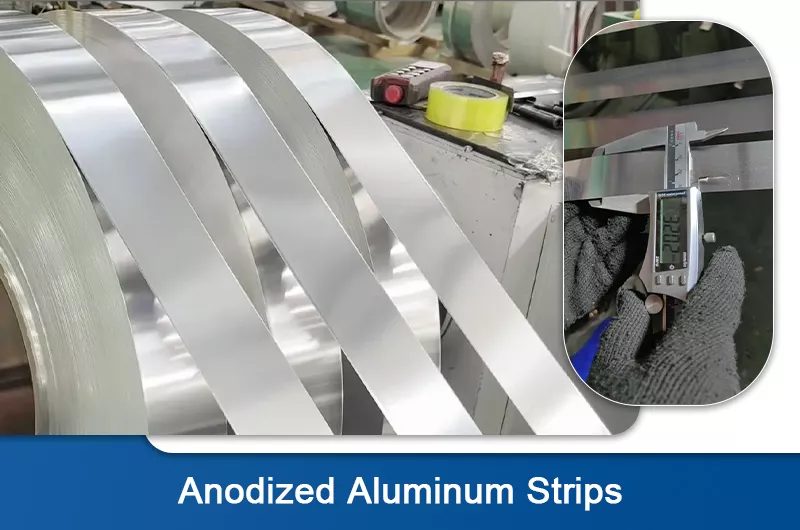
Applications of Anodized Aluminum Strips
Electronics & Electrical Industry
In the electronics and electrical fields, anodized aluminum strips are commonly used for transformer and reactor winding insulation tapes, battery tabs, capacitor housings, as well as circuit board heat sinks and electromagnetic shielding materials.
Common Aluminum Alloys:
- 1050, 1060: Excellent conductivity and corrosion resistance, suitable for electrical components.
- 1070: Easy to process and form, convenient for manufacturing complex structural parts.
- 5052: Used in some heat sinks or protective components, balancing strength and corrosion resistance.
Architectural & Decorative Applications
In construction and decorative projects, aluminum strips are widely used for curtain wall decorative strips, door and window frames, furniture hardware, kitchen and bathroom fittings, as well as signage and nameplates.
Common Aluminum Alloys:
- 3003, 3004: Cost-effective, easy to form, suitable for large-area decoration and indoor applications.
- 5052, 5754: Excellent corrosion resistance, suitable for outdoor or high-humidity environments, ensuring long-term use without oxidation.
Automotive & Transportation
In the automotive and rail transportation industries, anodized aluminum strips are commonly used for interior trims, exterior trims, rail transportation decorative panels and connectors, as well as protective components for marine equipment.
Common Aluminum Alloys:
- 5052, 5754: Corrosion-resistant, moderate strength, suitable for exterior or protective parts.
- 6061, 6063: High-strength alloys, suitable for load-bearing components or structural frameworks.
Other Applications
Anodized aluminum strips are also widely used in food packaging, medical devices (requiring special surface treatment), solar module frames, LED heat dissipation components, as well as precision instruments and optical equipment parts.
Common Aluminum Alloys:
- 8011: Specifically used for food packaging, safe and reliable.
- 6061, 6063: Suitable for high-precision parts and structural components, ensuring dimensional stability.
- 5052: Combines heat dissipation and corrosion resistance, used for electronic or optical device heat dissipation parts.
Comparison: Anodized Aluminum vs. Raw Aluminum
- Hardness: Anodized aluminum has approximately three times the hardness of untreated aluminum, making it more scratch- and wear-resistant.
- Weight: Both have essentially the same weight; anodizing only forms a thin oxide layer on the surface, adding almost no extra weight.
- Durability: Anodized aluminum can maintain its color and shine outdoors for decades without fading, whereas raw aluminum exposed to air oxidizes quickly, darkening and losing luster.