
Teflon Coated Aluminium Disc Circle
"Teflon Coated Aluminium Disc" refers to a material in which a Teflon (Polytetrafluoroethylene, PTFE) layer is coated onto an aluminum disc substrate.
The Teflon coated aluminum disc is a high-performance composite material formed through a special curing process, combining the lightweight and excellent thermal conductivity of aluminum with the non-stick and corrosion-resistant properties of Teflon.
Thanks to its unique composite performance, the Teflon coated aluminum disc has become an indispensable material in modern industry and daily life. With the development of environmentally friendly Teflon coating technologies (such as PFOA-free coatings), its application areas will further expand, providing more industries with efficient and eco-friendly surface solutions.
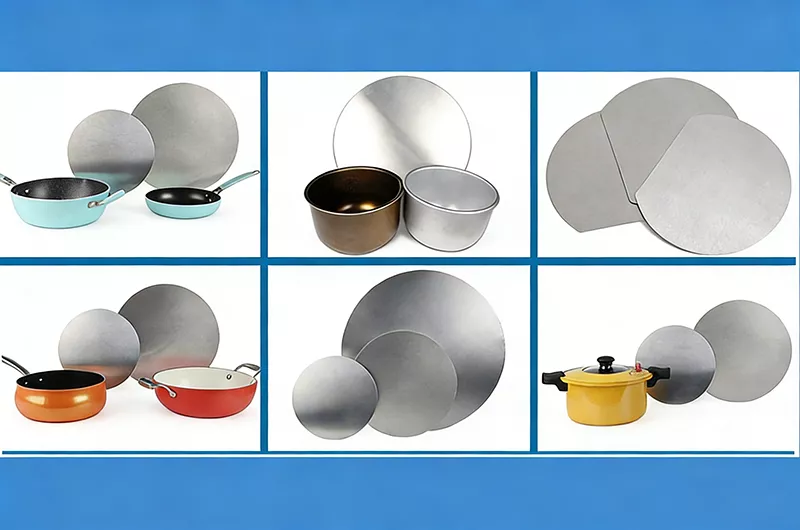
Haomei Aluminum produces Teflon coated aluminum discs that perfectly combine the lightweight, high-strength characteristics of aluminum with the excellent non-stick and corrosion-resistant performance of Teflon. We carefully design these discs to ensure smooth surfaces, easy cleaning, and high durability, meeting the requirements of various demanding applications. Whether used in cookware manufacturing, industrial molds, or other precision forming processes, Haomei Aluminum's Teflon coated aluminum discs offer uniform thickness, superior thermal conductivity, and long-term reliability, providing customers with stable and efficient solutions.
Teflon Coated Aluminium Disc Circle Specifications
| Feature | Standard Range |
| Diameter | 100 mm to 1, 200 mm (approx. 4" to 47") |
| Thickness | 0.3 mm to 6.0 mm |
| Common Alloys | 1050, 1100 (pure), 3003 (standard), 5052 (high strength) |
| Temper | O (soft/annealed), H12, H14, H24 |
| Color | Usually Black, Grey, or Dark Brown |
| Coating Thickness | 15μm~80μm |
| Surface Finish | Matte, Semi-Matte, High Gloss |
| Tolerance Control | Diameter ±0.1mm, Thickness ±0.02mm |
Teflon Coated Aluminium Disc Circle Structure and Material Selection
| Component | Common Materials | Core Properties |
| Substrate | 1050/1060/1100 pure aluminum, 3003 aluminum alloy | Excellent thermal conductivity, lightweight, easy to process, moderate cost |
| Coating | PTFE (standard Teflon), PFA (melt-processible PTFE), FEP (fluorinated ethylene-propylene) | Non-stick, high and low temperature resistance, chemical inertness, low friction coefficient |
| Pretreatment Layer | Phosphoric anodizing, sandblasting, chemical etching | Enhances coating adhesion, prevents peeling |
Teflon Coated Aluminium Disc Circle Features
Aluminum, as the substrate (e.g., aluminum sheet or pan), has the core advantage of excellent thermal conductivity. The Teflon coating provides the following key properties, making it widely used in both industrial and daily applications.
- Non-stick surface: The smooth Teflon coating ensures very low adhesion, making demolding easy.
- High thermal conductivity: Aluminum ensures fast and even heat transfer, preventing "hot spots" during cooking or industrial heating.
- Corrosion and chemical resistance: PTFE coating protects aluminum from oxidation and reacts minimally with most acids and bases.
- High temperature resistance: Most coatings can be used continuously up to 260°C (500°F).
- Formability: These discs are usually made from alloys like 3003 or 1100, which are ideal for deep drawing or spinning into shapes such as pots or bowls, without cracking.
- Uniform thickness: Ensures stable performance in stamping, forming, or cooking applications.
- Lightweight yet strong: Combines the strength of aluminum with the protective properties of Teflon.
- Customizable sizes and alloys: Available in various diameters, thicknesses, and aluminum grades.
- Chemical stability: Resistant to strong acids and bases, organic solvents, and nearly insoluble in all chemical media.
- Low friction coefficient: Extremely low surface friction reduces material adhesion and wear.
- Insulation properties: Teflon coating is an excellent insulator, suitable for electrical applications.
Teflon Coated Aluminum Disc Circle Applications
Cookware and Kitchen Appliances
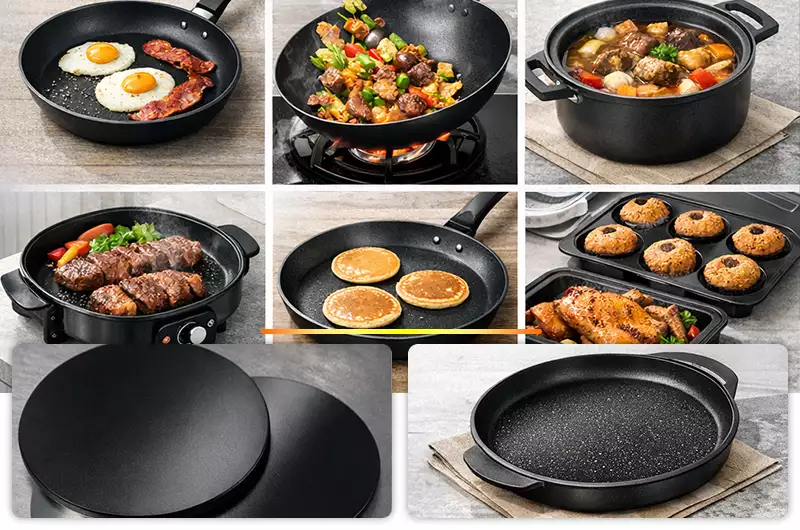
Due to their non-stick, corrosion-resistant, and excellent thermal conductivity properties, Teflon coated aluminum discs are widely used in various kitchen products. Common items include frying pans, woks, stew pots, electric frying pans, flat pans, baking trays, and molds. Aluminum provides lightweight and rapid heat conduction, while the Teflon coating ensures food does not stick, is easy to clean, and heats evenly.
Electronic and Electrical Components
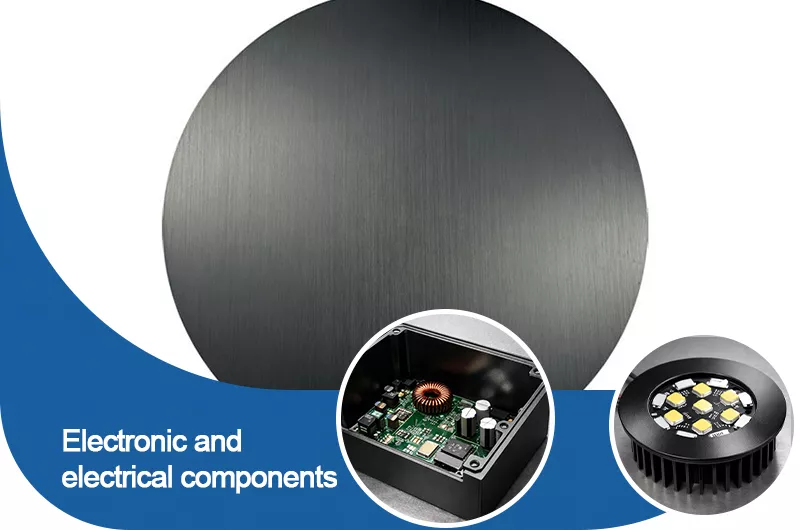
Teflon coated aluminum discs are also suitable for electronic product manufacturing, especially in applications requiring lightweight, heat resistance, or partial electrical insulation. For example, they can be used in LED heat sinks, reflectors, or electromagnetic shielding and housings for specialized equipment. The coating prevents aluminum oxidation while maintaining good heat dissipation.
Decorative and Functional Panels
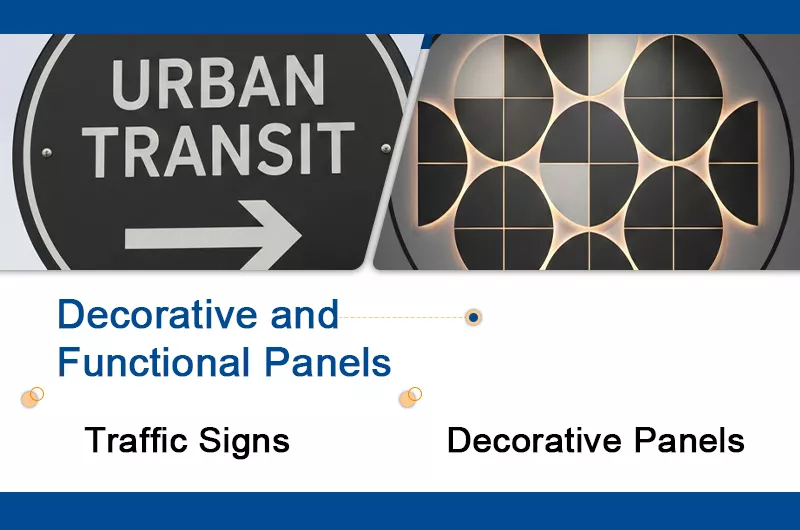
Teflon coated aluminum discs can also be used in architectural decoration and high-wear scenarios, such as ceilings, wall claddings, signage, and interior components of vehicles. The coating is not only scratch-resistant but also has a low-friction surface that requires minimal maintenance.
Industrial Molds and Forming Tools
In industrial production, these aluminum discs are often used as precision molds or forming surfaces, such as plastic thermoforming molds, rubber pressing plates, and die-casting molds. The smooth Teflon surface reduces friction, prevents material adhesion, extends mold life, and improves production efficiency.
Teflon Coated Aluminum Disc Circle Production Process
Manufacturing Process
- Stamping: Punching circular aluminum sheets from large aluminum coils or plates.
- Surface Treatment: Cleaning the aluminum, sometimes etching or sandblasting, to ensure the Teflon coating adheres firmly.
- Coating: Usually applied by roller coating (for large-scale production) or spraying PTFE.
- Curing: Heating the aluminum sheets in industrial ovens to "sinter" the Teflon, forming a hard and durable non-stick coating.
Substrate Pretreatment
- Degreasing: Use a phosphoric solution (15%~20%) to remove the aluminum oxide layer and grease.
- Surface activation: Increase surface roughness via sandblasting or chemical etching to form an "anchoring" structure.
- Ultrasonic cleaning: Thoroughly remove residual impurities to ensure a clean surface.
Coating Application
- Electrostatic spraying: Suitable for thick coatings (50~100μm), ensuring good uniformity.
- Dipping: Suitable for thin coatings (10~30μm), cost-effective.
- Electrostatic powder coating: Environmentally friendly, solvent-free, with dense coating quality.
Curing Treatment
- Pre-drying (80℃~120℃): Remove solvents from the coating.
- High-temperature curing (380℃~420℃): Melt Teflon particles into a film and bond firmly with the substrate.
- Cooling and shaping: Ensure coating hardness and stability.
Teflon Coated Aluminum Disc Circle Advantages and Disadvantages
| Advantages | Disadvantages |
| Strong non-stick, easy to clean, reduces detergent usage | Low coating hardness (2~4H), not resistant to sharp scratches |
| Uniform heat transfer, excellent cooking performance, energy-saving | Long-term high-temperature (>260℃) use may release harmful substances |
| Lightweight and portable, easier to handle than stainless steel products | Limited lifespan (typically 2~5 years under normal use), requires replacement |
| Good chemical stability, resistant to rust and corrosion | Difficult to repair, coating damage is hard to fix |
| Wide applicable temperature range, suitable for both hot and cold environments | Higher cost than ordinary aluminum products (approx. 30%~80% premium) |
Teflon Coated Aluminum Disc Circle Purchasing and Usage Notes
Purchasing Tips
- Confirm coating type: For food contact, prioritize PTFE/PFA certified products (compliant with FDA, LFGB standards)
- Check coating uniformity: Surface should be free of bubbles, pinholes, and sagging
- Pay attention to substrate thickness: Too thin may deform, too thick affects heat conduction efficiency
Usage Recommendations
- Avoid using metal spatulas, steel wool, or sharp tools; silicone or wooden utensils are recommended
- Keep cooking temperature ≤260℃, avoid dry burning (may damage coating and release toxic substances)
- Clean with a soft cloth + neutral detergent, rinse with warm water
- Store without heavy pressure to prevent coating cracking
Safety Tips
Choose products from reputable manufacturers to ensure the coating does not contain harmful substances like PFOA (perfluorooctanoic acid)
If the coating is damaged, replacement is recommended to avoid direct contact of aluminum with food
Is Teflon Coated Aluminum Safe?
Teflon-coated aluminum is generally safe in most cases, but its safety depends on several factors, including the usage environment and the condition of the coating.
Usage Environment
- High-Temperature Environment: Teflon coatings can withstand high temperatures, but when temperatures exceed 260°C (500°F), the coating may start to degrade and release harmful gases. Therefore, it is crucial to ensure that the coating is used within its temperature range.
- Chemical Environment: Teflon has good chemical corrosion resistance, but it should be kept away from strong acids or strong alkalis, as these can damage the coating.
Coating Condition
- Coating Integrity: Ensure that the coating is not damaged, scratched, or peeling. If the coating is compromised, the aluminum substrate may be exposed, leading to corrosion or other issues.
- Cleaning and Maintenance: Proper cleaning and maintenance help maintain the integrity and performance of the coating. Avoid using abrasive cleaning tools or strong acids and alkalis for cleaning.
Food Safety
Food-Grade Coating: Teflon coatings are widely used in cookware and are generally food-grade, which means they do not pose a hazard to food. Ensure that the Teflon coating used complies with standards for food contact materials.