
5005 h34 aluminum sheet plate
What is 5005 H34 aluminum?
5005 H34 aluminum is a corrosion-resistant alloy with well-balanced comprehensive properties. It strikes a good balance among strength, formability, and corrosion resistance, making it particularly suitable for architectural decoration and home appliance panels where certain strength and flatness are required.
5005 H34 aluminum alloy is a medium-strength material with magnesium as the main alloying element. It is suitable for applications requiring good corrosion resistance, workability, and high surface quality.
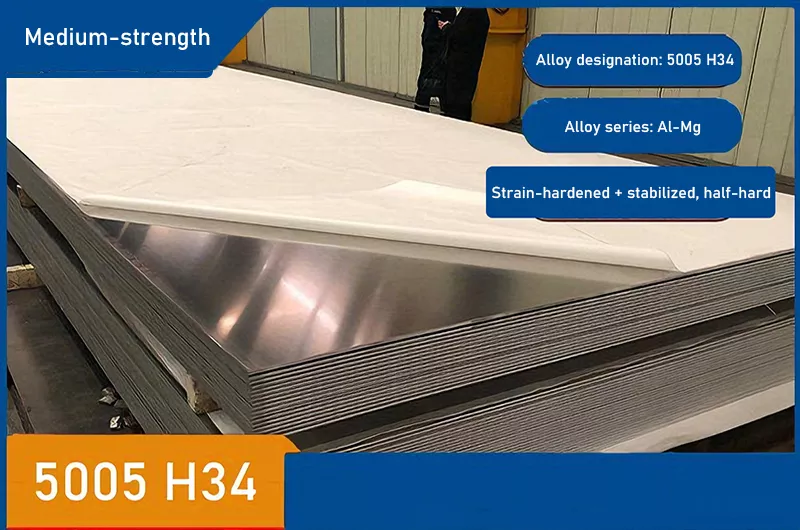
5005 H34 Aluminum Properties
- Alloy designation: 5005 H34
- Alloy series: Al-Mg (5xxx series corrosion-resistant aluminum)
- Temper: Strain-hardened + stabilized, half-hard
Main characteristics:
- Excellent corrosion resistance.
- Medium strength, higher than O temper and H12/H22 tempers.
- Good formability, though lower than O temper.
- Excellent surface finishing performance.
- Due to H3X stabilization treatment, it has good dimensional stability and is not prone to deformation caused by internal stress.
5005 H34 Aluminum Sheet Plate Specifications
- Aluminum Plate Alloy: 5005
- Tempers: H34
- Thickness: 0.2mm – 6mm, 6mm – 200mm; (DC material)
- Thickness Tolerance: +/-0.02mm, Width and Length Tolerance: -0 / +2mm, Diagonal (+/- 2mm)
- Surface: Smooth, bright, polished, coated with blue PVC film or paper.
- Width: 300mm-2600mm; Maximum width for large aluminum plates is 2600mm, maximum length is 11 meters.
Chemical composition of 5005 H34 aluminum sheet
| Element | Composition % |
| Si | 0.3 |
| Fe | 0.7 |
| Cu | 0.2 |
| Mn | 0.2 |
| Mg | 0.5-1.1 |
| Cr | 0.1 |
| Zn | 0.25 |
| Ti | - |
| Zr | - |
| Other | 0.2 |
| Al | Remainder |
Mechanical properties of 5005 H34 aluminum sheet
| Alloy | Temper | Thickness /mm | Tensile strength/MPa | Elongation strength/MPa | Elongation after break% |
| 5005 | H34 | 0.40-1.50 | 145-185 | ≥110 | ≥4 |
| >1.50-3.00 | ≥5 | ||||
| >3.00-8.00 | ≥7 |
Advantages of 5005 H34 Aluminum
- Excellent corrosion resistance: Magnesium forms a dense oxide film on the surface, giving the alloy outstanding resistance to atmosphere, seawater, and industrial environments, especially suitable for outdoor and marine applications.
- Good weldability: High-quality welding can be achieved without special processes, with minimal loss of weld strength, suitable for manufacturing structural components.
- Balanced medium strength and workability: The H34 temper (strain-hardening + stabilization) provides 145–185 MPa tensile strength and 115–155 MPa yield strength, while retaining some ductility for forming processes such as bending and stamping.
- Surface treatment compatibility: After anodizing, it can achieve a bright and uniform appearance. Its color tone matches well with alloy 6063, making it widely used in architectural decoration; however, for applications requiring exceptionally high surface appearance, “special anodizing quality” should be specified to avoid streaks.
5005 Aluminum Alloy
5005 belongs to the aluminum-magnesium alloy series and is a widely used corrosion-resistant aluminum. Its main characteristics include:
- Main alloying element: Magnesium, typically 0.5%–1.1%. The addition of magnesium increases the strength of aluminum while maintaining good corrosion resistance.
- Excellent corrosion resistance: Among all aluminum alloys, the 5xxx series (magnesium-based) has some of the best corrosion resistance, especially against marine and industrial atmospheric corrosion. It is also known as “marine-grade aluminum.”
- Medium strength: Stronger than pure aluminum (such as 1100) and 3003 alloy, but lower than 5052.
- Good formability: Capable of deep drawing, bending, and other forming processes.
- Excellent anodizing effect: After surface treatment, it can obtain a beautiful and durable oxide film, suitable for decorative materials.
- Good weldability: Suitable for various conventional welding methods.
Typical applications of 5005 aluminum alloy:
- Construction: Ceilings, wall panels, louvers, decorative strips, rolling shutters.
- Vehicle interiors: Interior panels of automobiles and trains.
- Home appliance panels: Exterior panels for refrigerators, washing machines, etc.
- Signs and nameplates.
- Kitchenware.
H34 Temper
"H" stands for "strain-hardened." This indicates a method that increases the material’s strength through cold working (such as cold rolling or cold drawing).
The numbers following "H" have specific meanings:
The first digit (HX): Indicates the basic type of strain-hardening treatment.
- H1X: Strength achieved solely through strain-hardening.
- H2X: Strain-hardened and then partially annealed.
- H3X: Strain-hardened and then stabilized by low-temperature heat treatment. This is particularly important for magnesium-containing 5xxx alloys to prevent “strain corrosion cracking” caused by natural aging during service while maintaining strength.
The second digit (HX4): Indicates the strength level of the material — the larger the number, the higher the strength.
HX4: Represents that the tensile strength is half the difference between the O temper (fully annealed) and the HX8 temper (full hard).
Therefore, the specific meaning of H34 is:
After work hardening, the material undergoes stabilization treatment to achieve a half-hard temper.
Compared with the fully annealed O temper, 5005 aluminum in the H34 temper has higher strength and better flatness.
5005 H34 Aluminum Sheet Applications
Building & Architectural Applications
Curtain Walls & Window Frames:
5005 H34 Aluminum Sheet offers excellent weather resistance and surface smoothness. After anodizing, its color is uniform and resistant to color variation, allowing it to match perfectly with materials such as glass and stone.
Roofing & Wall Panels:
5005-H34 aluminum sheet does not fade or corrode even after long-term outdoor exposure, making it an ideal material for high-rise building façades.
Interior Decorative Parts:
Such as ceilings and partition panels. 5005 aluminum alloy provides good formability and anodizing performance, enabling various decorative finishes such as silver, black, and copper.
Transportation
Automotive Panels & Components:
5005-H34 aluminum sheet is suitable for door panels, roof panels, and interior components. With a density about 30% that of steel, it enables significant weight reduction while maintaining good corrosion resistance.
Marine Structures:
Used for decks, bulkheads, railings, and more. The corrosion resistance of 5005 aluminum alloy in seawater is superior to that of common carbon steel, extending service life.
Rail Transit:
Interior panels, exterior cladding, and roof structures of subway cars frequently use 5005 H34 Aluminum Sheet, which provides lightweight performance, aesthetic appearance, and weather resistance.
Electronics & Appliances
3C Device Housings:
Such as smartphone frames and tablet casings. After anodizing, 5005-H34 aluminum alloy exhibits a premium metallic texture and excellent electromagnetic shielding performance.
Heat Sinks & Enclosures:
5005 H34 Aluminum Sheet has high thermal conductivity and strong corrosion resistance, making it suitable for heat-dissipation components and outdoor electronic equipment housings.
Packaging & Signage
Food & Beverage Packaging:
Although not the mainstream material for cans, 5005 H34 can replace 3004 alloy in certain applications, with corrosion resistance and stability meeting food-contact requirements.
Traffic Signs & Advertising Boards:
5005-H34 aluminum sheet is easy to cut and stamp, and offers excellent aging resistance. It can maintain its appearance outdoors for long periods and is a common choice for traffic signage materials.
Comparison Between 5005 H34 Aluminum and Other Alloys
5005-h34 vs 5052-h32
5005-H34 offers good formability and corrosion resistance for decorative purposes, while 5052-H32 provides higher strength and superior corrosion resistance, making it suitable for more demanding structural applications.
| Property | 5005-H34 | 5052-H32 |
| Corrosion Resistance | Excellent | Superior |
| Workability | Good | Good |
| Surface Finish | Anodizable | Anodizable or paintable |
| Typical Applications | Architectural panels, home appliances, general sheet metal work | Marine environments, automotive fuel tanks, pressure vessels |
5005 H34 vs 6061 T6
| Performance Dimension | 5005 H34 | 6061 T6 |
| Tensile Strength | 145–185 MPa | 290–310 MPa |
| Corrosion Resistance | Excellent (especially seawater resistance) | Good (slightly lower due to copper content) |
| Weldability | Excellent (minimal weld-strength reduction) | Moderate (requires preheating / post-treatment) |
| Surface Treatment | Excellent anodizing effect | Anodized color tends to be darker |
| Typical Applications | Architectural decoration, marine components | Mechanical structures, aerospace parts |
5005 H34 vs 3003 H24
| Performance Dimension | 5005 H34 | 3003 H24 |
| Corrosion Resistance | Better (higher magnesium content) | Moderate |
| Tensile Strength | Slightly higher (145–185 vs 140–180 MPa) | Similar |
| Anodized Appearance | Brighter and more uniform | Slightly yellowish |
| Cost | Slightly higher (due to higher magnesium content) | Lower |
5005 H34 is preferred when medium strength, high corrosion resistance, and excellent surface finishing are required, such as in building curtain walls, marine interiors, and electronic housings. If higher strength is needed (e.g., for mechanical components), 6061 T6 should be considered; if cost is a primary concern and corrosion resistance requirements are moderate, 3003 H24 is a suitable choice.
With its advantages in corrosion resistance, formability, and surface finishing, 5005 H34 aluminum alloy is widely used in architecture, transportation, and electronics. Its H34 temper balances strength and ductility, making it suitable for diverse manufacturing needs. When selecting materials, it is important to consider mechanical requirements, environmental conditions, and budget constraints of the specific application, and communicate sufficiently with suppliers to ensure that the material properties match the actual needs.
Related Questions about 5005 H34 Aluminum Sheet Plate
What is 5005 grade aluminum?
5005 grade aluminum is an alloy primarily composed of aluminum with manganese, known for its excellent corrosion resistance and good formability, often used in architectural applications and decorative finishes.
What is H34 aluminum?
H34 aluminum is a temper designation for 5005 aluminum alloy, indicating that it has been partially hardened through cold working to achieve a balance between strength and formability.
What is the equivalent of aluminum 5005?
UNS A95005, Aluminum 5005, AA5005, Al5005
Products you may be interested in
- 5005 Aluminum Plate Sheet
- 5005 h32 aluminum sheet plate
- 5005 h14 aluminum sheet plate
- 5005 anodized aluminum sheet
Further reading