
What Is the Aluminum Disc Price?
The price of an aluminium disc is generally calculated from:
Aluminium ingot price + processing cost + alloy premium + surface/quality requirement + packaging + freight
In practice, aluminum disc price may be quoted by kilogram, metric ton, piece, or according to a complete order value. For standard sizes and conventional alloys, pricing is relatively straightforward. However, for cookware-grade deep drawing discs, mirror-finish circles, extra-wide diameters, or customized tempers, the processing cost can be considerably higher.
Important: A lower quotation is not always a lower total purchasing cost. If discs have poor flatness, inconsistent thickness, edge burrs, oil stains, orange peel, or cracking during deep drawing, the customer may lose far more during production than they save on the initial material price.
At Haomei Aluminum, we manufacture and supply aluminium discs, also called aluminium circles, for cookware, lighting, traffic signs, electrical appliances, spinning parts, pressure vessels and deep-drawing applications. Based on years of production and export experience, we know that aluminium disc pricing is not determined by weight alone.
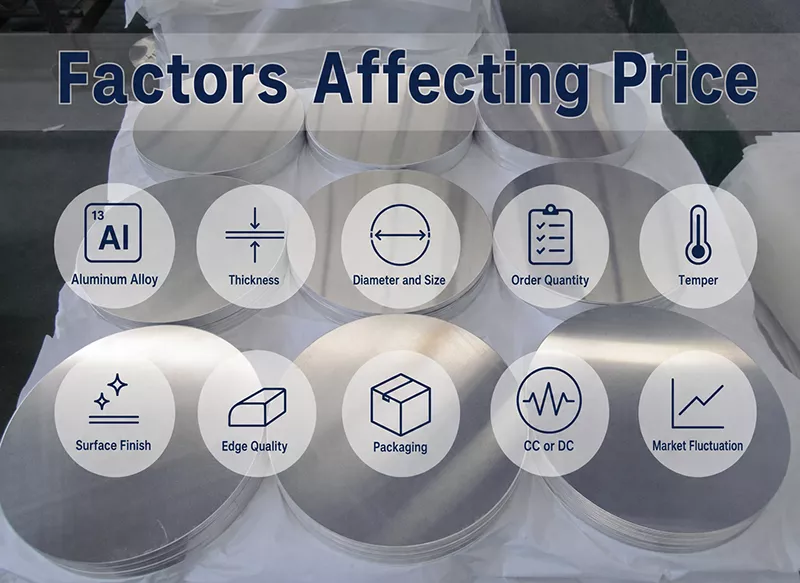
Main Factors Affecting Aluminum Disc Price
Aluminum Alloy
The alloy is one of the most important factors in determining aluminium disc price. Different alloys have different chemical compositions, mechanical properties, processing difficulty and end-use applications.
| Alloy | Common Applications | Price Influence |
| 1050 Aluminum Disc | Cookware, lighting, spinning | Economical, widely used |
| 1060 Aluminum Disc | Deep drawing, cookware, electrical products | Good formability, competitive price |
| 1070 Aluminum Disc | Electrical and high-purity applications | Higher purity requirement |
| 1100 Aluminum Disc | Cookware, lampshades, general drawing | Good corrosion resistance |
| 3003 Aluminum Disc | Cookware, pressure vessels, traffic signs | Higher strength, usually higher cost |
| 3004 Aluminum Disc | Deep drawing cookware, containers | Better strength and drawing performance |
| 5052 Aluminum Disc | Marine, industrial and corrosion-resistant parts | Higher alloy cost |
| 6061 Aluminum Disc | Machined components and structural parts | Higher processing and alloy cost |
- 1000 Series (e.g., 1050, 1060, 1100): This is pure aluminum (99%+) and is the most cost-effective. It's widely used for basic spinning and standard cookware.
- 3000 Series (e.g., 3003, 3004): We add manganese to these alloys to increase strength and rust resistance. Because of the added metals and more complex smelting process, 3000 series discs are slightly more expensive than 1000 series.
For example, a standard 1050 aluminum disc price is usually more competitive than a 5052 or 6061 aluminium circle price. However, if the final product requires higher strength or corrosion resistance, selecting a low-cost alloy may lead to failure during use.
At Haomei Aluminum, we help customers select the suitable alloy according to the forming method, application environment, required strength and surface appearance.
Thickness of Aluminum Disc
Thickness has a direct impact on aluminium disc weight and therefore on the total material cost.
Common aluminium disc thicknesses include:
- 0.4 mm – 1.0 mm for lighting and small drawn products
- 1.0 mm – 2.0 mm for cookware and spinning applications
- 2.0 mm – 4.0 mm for heavy-duty cookware, signs and industrial parts
- Over 4.0 mm for special machining or structural applications
A thicker disc uses more aluminium per piece. However, thickness tolerance is equally important.
For high-end cookware or deep-drawing products, a tight thickness tolerance improves consistency during forming. Producing discs with stable thickness control requires better rolling quality and stricter inspection, which may increase the processing cost.
When comparing aluminum disc prices, customers should confirm whether the supplier is quoting:
- Nominal thickness or guaranteed minimum thickness
- Standard tolerance or customized tight tolerance
- Average thickness or point-by-point thickness control
Two discs with the same stated thickness may not have the same actual weight or forming performance.
Diameter and Disc Size
Aluminium disc diameter affects both material utilization and production efficiency.
Common diameters range from approximately 100 mm to 1, 200 mm, while larger or customized sizes may also be available depending on equipment capability and alloy specification.
The price of aluminium circles can vary based on diameter because of:
- Coil width and material utilization
- Blanking layout and scrap rate
- Tooling requirements
- Production batch size
- Packaging method
- Risk of deformation during transportation
For example, a common cookware disc diameter may be produced efficiently with existing molds. A special diameter requiring customized tooling, lower production efficiency or additional trimming may have a higher price.
For regular long-term orders, Haomei Aluminum can recommend economically efficient diameters based on coil width and production conditions. This helps reduce unnecessary material waste and improve your purchasing cost.
Order Quantity
Quantity is a major factor in factory-direct aluminum disc price.
For small trial orders, the unit price is often higher because the supplier still needs to cover setup, slitting, blanking, quality inspection, packaging and handling costs. For container-scale or regular monthly orders, production can be arranged more efficiently.
Generally, larger quantities can offer advantages in:
- Raw material purchasing
- Production scheduling
- Tooling allocation
- Packaging efficiency
- Shipping cost per kilogram
- Quality consistency from the same production batch
If you order a Full Container Load (FCL) of 20 to 25 tons, those setup costs are spread out, giving you the absolute best wholesale pricing. If you order the Minimum Order Quantity (usually 3 to 5 tons), the setup costs eat into the efficiency, resulting in a higher price per kilogram. However, quantity should not be increased blindly just to obtain a lower price.
Temper and Mechanical Properties
Aluminium disc temper determines hardness, elongation and forming performance.
Common tempers include:
- O temper: Soft annealed condition, excellent for deep drawing and spinning
- H12 / H14: Semi-hard condition, suitable for general stamping and forming
- H16 / H18: Harder material, suitable where higher rigidity is required
For cookware production, particularly for deep drawing, the O temper aluminium disc is commonly required. The disc needs adequate elongation so that it can be formed into pots, pans, bowls or pressure cooker components without cracking.
A high-quality deep drawing aluminium circle should provide:
- Stable grain structure
- Good elongation
- Consistent hardness
- Clean surface
- Smooth edges
- Low earing tendency
- Reliable forming performance
The annealing process has a significant influence on final quality. Therefore, aluminium discs with strict deep-drawing requirements may have a different price from ordinary stamping discs.
Surface Finish Requirement
Surface finish is another important component of aluminum disc price.
Different end uses require different surface conditions. A disc used inside a non-visible industrial part has different requirements from a polished cookware exterior or decorative lighting reflector.
Common finishes include:
- Mill finish
- Bright finish
- Mirror finish
- Color coated finish
- Anodized finish
- Brushed finish
- Embossed finish
- Protective film application
For example, mirror finish aluminium discs require additional surface treatment and careful handling to prevent scratches. Similarly, anodized or color-coated circles need extra processing and stricter packaging.
- Anodizing Quality (AQ): If you plan to anodize the final product, we have to use premium billets and control the surface flawlessly to prevent streaks.
- Teflon/Non-stick Coating Prep: Cookware manufacturers often need a perfectly flat, clean surface to ensure the non-stick coating adheres properly.
Extra quality control and surface tension treatments mean a slightly higher processing fee.
Edge Quality and Burr Control
The edge of an aluminium disc is often overlooked when comparing prices, but it matters greatly for downstream manufacturing.
Poorly cut discs may have:
- Sharp burrs
- Uneven edges
- Small cracks
- Edge dents
- Irregular roundness
- Excessive trimming marks
For spinning, deep drawing and automatic production lines, clean edges improve feeding efficiency and reduce the risk of cracking or scratching.
Haomei Aluminum controls blanking quality according to the customer’s processing requirements. For high-end cookware and automatic forming applications, we recommend confirming requirements for burr direction, edge smoothness, roundness and diameter tolerance before production.
Packaging Requirements
Export packaging also affects the total aluminium disc price.
Aluminium discs must be packed carefully to avoid moisture damage, oxidation, deformation and surface scratches during sea transportation. Standard export packaging may include:
- Interleaving paper between discs
- Moisture-proof plastic film
- Desiccant protection
- Strong wooden pallets
- Fumigated wooden cases, if required
- Steel or plastic strapping
- Clear labels for alloy, temper, size and batch number
For mirror-finish, coated or precision surface discs, packaging requirements are usually higher than for standard mill-finish material.
Although stronger packaging adds some cost, it protects the value of the material during long-distance transportation. For customers importing by sea, proper packaging is especially important.
CC vs. DC Casting Material
- CC (Continuous Cast): Cheaper. Great for shallow stamping, spinning, and basic pots or pans.
- DC (Direct Chill Cast): More expensive. The grain structure of DC material is much tighter. If you are doing deep drawing (like making a pressure cooker), you must use DC material, otherwise, the disc will crack or show "orange peel" on the surface. Don't chase the lowest aluminum disc price if your product requires DC material; the rejection rate will kill your margins.
Aluminum Ingot Market Fluctuation
Aluminium is a commodity material, so the base price changes with the global aluminium market.
The final aluminum disc price may fluctuate due to changes in:
- LME aluminium price
- Shanghai aluminium market price
- Exchange rate
- Energy cost
- Freight cost
- Regional supply and demand
- Trade policies and tariffs
For this reason, quotations are normally valid for a limited period.
Aluminum Disc Price by End-Use Application
Aluminum disc price is closely related to its intended application. Different industries require different alloys, tempers, surface finishes and forming performance, which directly influence manufacturing costs. Choosing the right material for your production process is often more cost-effective than simply selecting the lowest-priced aluminum circle.
Cookware Aluminum Disc Price
Cookware manufacturers generally require aluminum discs with excellent formability and stable material quality. The most widely used alloys include 1050, 1060, 1100, 3003 and 3004, typically supplied in O temper for deep drawing and spinning applications.
- Excellent deep drawing performance
- Uniform thickness across the disc
- Clean, scratch-free surface
- Smooth burr-free edges
- Stable mechanical properties between batches
- Good anodizing and polishing compatibility
Aluminum discs designed for premium cookware, non-stick cookware and hard-anodized products generally cost more because tighter dimensional tolerances and higher surface quality standards require additional production control and inspection.
Lighting Aluminum Disc Price
Aluminum discs for lighting fixtures are widely used to manufacture lampshades, reflectors, LED lighting components and decorative lighting products. Pricing is influenced by both surface finish and spinning performance.
- Excellent spinning capability
- High flatness for precision forming
- Accurate diameter tolerance
- Bright, polished or mirror finish options
- Protective PVC film available when required
Mirror-finish aluminum discs are typically more expensive than standard mill-finish discs because additional polishing or anodizing processes increase production costs while improving reflectivity and appearance.
Traffic Sign Aluminum Disc Price
Aluminum discs for traffic signs are commonly manufactured from 1050, 1060 and 3003 alloys due to their corrosion resistance and excellent outdoor durability. These products must maintain flatness while providing reliable adhesion for reflective films, coatings and printing.
- Excellent corrosion resistance
- High flatness and dimensional accuracy
- Strong coating and reflective film adhesion
- Long outdoor service life
Deep Drawing & Spinning Aluminum Disc Price
Products manufactured through deep drawing or spinning demand consistent forming performance. These aluminum discs are widely used for cookware, pressure vessels, appliance components, fan covers, lighting parts and industrial containers.
Material quality has a direct impact on production efficiency and finished product yield. Important performance indicators include:
- High elongation
- Consistent hardness
- Uniform grain structure
- Low earing rate
- Clean rolling surface
- Smooth cutting edge
- Stable batch-to-batch quality
Although premium deep drawing aluminum discs may have a higher purchase price, they often reduce material waste, minimize cracking and wrinkling, improve production efficiency and lower the overall manufacturing cost.
How to Get an Accurate Aluminum Disc Price Quote
To receive a fast and accurate quotation from Haomei Aluminum, please provide as much of the following information as possible:
- Alloy: 1050, 1060, 1100, 3003, 3004, 5052, etc.
- Temper: O, H12, H14, H16, H18 or customized requirement
- Thickness: For example, 1.0 mm, 1.2 mm or 2.0 mm
- Diameter: For example, 200 mm, 300 mm, 450 mm, etc.
- Application: Cookware, lighting, traffic signs, spinning, deep drawing, etc.
- Surface finish: Mill finish, bright, mirror, anodized, coated or other
- Quantity: Trial order, monthly demand or annual volume
- Tolerance: Thickness tolerance, diameter tolerance and flatness requirement
- Packaging requirement: Pallet, wooden case, interleaving paper, protective film, etc.
- Destination port or delivery location: To calculate freight more accurately
The more complete the information, the more accurate the aluminium disc price quotation will be.
Request Your Aluminum Disc Price Today
If you are looking for a reliable Aluminum Disc Price from a factory-direct supplier, Haomei Aluminum is ready to support your project. Send us your alloy, thickness, diameter, temper, quantity and application details for a practical quotation.
Get Factory Direct QuoteWhy Choose Haomei Aluminum as Your Aluminium Disc Supplier?
Choosing the right aluminium disc supplier is about more than price. Consistent material quality, accurate dimensions, reliable lead times and responsive technical support all have a direct impact on production efficiency and finished product quality. Haomei Aluminum supplies aluminium discs to manufacturers in cookware, lighting, traffic signage, electronics and industrial fabrication across more than 100 countries.
We help customers improve production consistency through:
Wide Alloy Selection
1050, 1060, 1070, 1100, 3003, 3004, 5052, 5754 and other aluminium alloys are available for different forming and performance requirements.
Excellent Formability
O, H12, H14 and H24 tempers are supplied for deep drawing, spinning, stamping and general fabrication with stable mechanical properties.
Custom Manufacturing
Custom diameters, thicknesses, surface finishes, edge conditions and protective films are available according to your drawings or production requirements.
Precise Dimensional Control
Every aluminium disc is produced with strict thickness, diameter and flatness tolerances to improve processing efficiency and reduce material waste.
High Surface Quality
Smooth surfaces, burr-free edges and clean finishes help achieve better results during anodizing, polishing, coating and deep drawing.
Reliable Global Supply
Export-standard packaging protects products during international transportation, while stable production capacity supports both sample and bulk orders.
Factory-Direct Pricing
As a professional aluminium disc manufacturer, we provide competitive factory pricing with consistent product quality and dependable delivery schedules.
Application-Based Support
Our technical team recommends suitable alloys, tempers and specifications based on your forming process and end-use application.
Different applications require different material characteristics. For example, cookware manufacturers often need high-elongation O temper aluminium discs for deep drawing, while lighting producers may focus on excellent surface finish and spinning performance. Instead of supplying standard products only, we work with customers to recommend the most suitable alloy, temper and dimensions for their manufacturing process, helping improve productivity, reduce scrap rates and maintain consistent product quality.
Frequently Asked Questions About Aluminum Disc Price
Is aluminum disc price calculated by piece or by kilogram?
Both pricing methods are commonly used. Aluminum disc prices are typically quoted by weight (per kilogram or per ton) for bulk orders, while standard-size discs may also be priced per piece. A professional quotation should clearly specify the pricing unit, net weight basis, dimensional tolerances, and applicable standards.
Why are deep drawing aluminum discs more expensive?
Deep drawing aluminum discs require tighter control of annealing, grain structure, elongation, surface quality, and edge finish. These additional manufacturing processes improve formability, reduce cracking during deep drawing, and minimize material waste, resulting in a higher product price.
Which aluminum alloy is best for cookware discs?
Common cookware alloys include 1050, 1060, 1100, 3003, and 3004 aluminum. The most suitable alloy depends on the cookware design, drawing depth, strength requirements, heat treatment, coating process, and manufacturing method. Selecting the correct alloy helps balance performance and cost.
Can I order custom aluminum disc sizes?
Yes. Haomei Aluminum manufactures custom aluminum discs based on your required diameter, thickness, alloy, temper, and surface finish. Customized production is available according to technical drawings, application requirements, and order quantity.
How can I reduce the total purchasing cost of aluminum discs?
The best way to reduce overall cost is to select the appropriate alloy and temper, optimize disc diameter and thickness, place stable order quantities, specify practical tolerance requirements, and choose material that matches your manufacturing process. Focusing only on the lowest unit price may increase production costs due to lower forming efficiency or higher scrap rates.
Products you may be interested in