
Color coated aluminum strip is a composite material based on aluminum or aluminum alloy strip. After degreasing cleaning and chemical pretreatment (such as chromate or non-chromate treatment), one or more layers of organic coatings (such as PE, PVDF, etc.) are applied to the surface through continuous roller coating or spraying processes, and then cured by high-temperature baking. While retaining the inherent advantages of aluminum such as light weight, corrosion resistance, and easy processing, the product also features rich colors, strong surface decoration, and excellent weather resistance and protective performance.
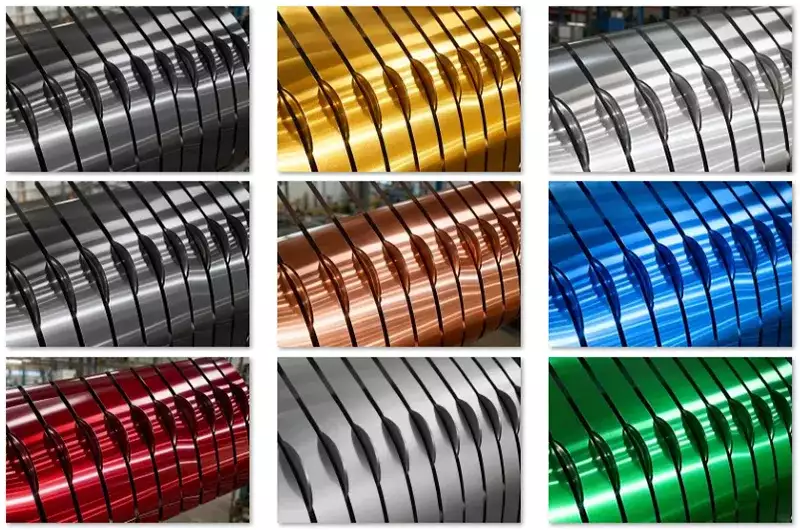
In actual production, color coated aluminum strips commonly use aluminum alloys such as 1100, 3003, and 5052 as base materials. Through a stable continuous coating process, the coating is firmly bonded to the substrate, with uniform surface color and strong adhesion that is not easy to peel off. With its good appearance and durability, color coated aluminum strip is widely used in architectural decoration, appliance housings, transportation, and various fields that combine functional and decorative requirements.
Color Coated Aluminum Strip Specifications
| Item | Parameter Range / Description |
| Thickness | 0.2–3 mm (standard specifications), special requirements up to 6 mm |
| Width | Can be slit into narrow aluminum strips of 20 mm, and the maximum coil width can reach 1600 mm |
| Coating Thickness | 5–25 μm |
| Alloy Grades | 1060, 1100 (pure aluminum); 3003, 3004 (Al-Mn alloy); 5052 (Al-Mg alloy), etc. |
| Single Coating | Coating thickness 4–20 μm, lower cost, suitable for general applications |
| Double Coating | Coating thickness 25–28 μm, better durability and weather resistance |
| Pattern Options | Stone pattern, wood grain, brick pattern and other decorative effects can be produced |
| Temper | According to bending or stamping requirements, conditions from O (soft/annealed) to H14/H24 (half-hard) are available |
Color Coated Aluminum Strip Alloy Materials
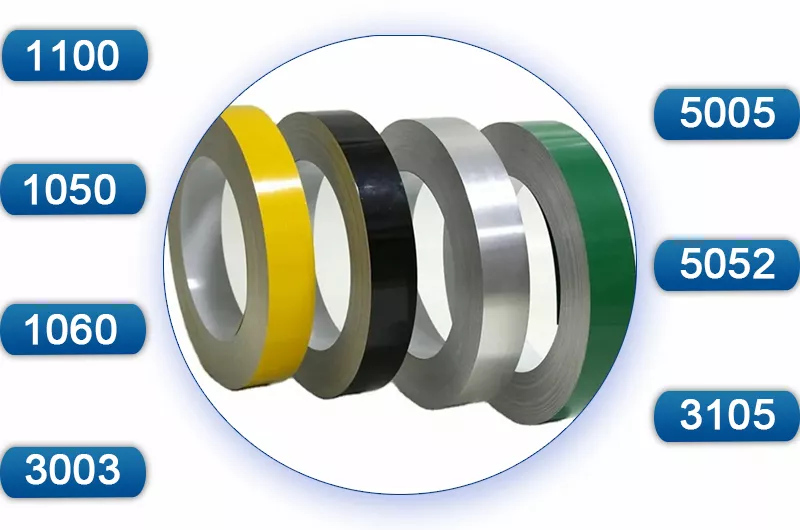
1100 Color Coated Aluminum Coil Strip
1100 color coated aluminum coil strip uses high-purity aluminum as the base material, with an aluminum content usually above 99%. It has good ductility and excellent corrosion resistance. After coating treatment, it not only improves weather resistance but also enhances decorative appearance. It is commonly used in interior decoration, signage, and applications where strength requirements are low but appearance requirements are high.
1050 Color Coated Aluminum Coil Strip
1050 color coated aluminum coil strip belongs to the industrial pure aluminum series, featuring excellent electrical conductivity, thermal conductivity, and good formability. After coating, the surface color is uniform with strong adhesion, making it suitable for lamp reflectors, decorative panels, and product fields requiring good processing performance.
1060 Color Coated Aluminum Coil Strip
1060 color coated aluminum coil strip is based on high-purity aluminum and has excellent flexibility and processing performance, enabling it to adapt to various complex forming processes. After color coating treatment, the surface becomes more corrosion resistant and aesthetically pleasing, and it is widely used in architectural decoration, advertising materials, and appliance housings.
1070 Color Coated Aluminum Coil Strip
1070 color coated aluminum coil strip has a higher aluminum content with outstanding electrical and thermal conductivity. The material is relatively soft and suitable for applications with special performance requirements. After surface coating treatment, it can maintain its functionality while improving environmental resistance, and is often used in electronics, power equipment, and certain decorative applications.
3003 Color Coated Aluminum Coil Strip
3003 color coated aluminum coil strip is an aluminum-manganese alloy material. It increases strength on the basis of pure aluminum while maintaining good corrosion resistance and formability. After coating, it offers good weather resistance and stability, and is commonly used in roofing systems, curtain wall panels, insulation cladding, and various architectural decoration applications.
3004 Color Coated Aluminum Coil Strip
3004 color coated aluminum coil strip further improves strength and load-bearing capacity based on 3003, making it suitable for applications requiring higher material strength. The surface coating is uniform and firmly bonded, with good weather resistance and oxidation resistance. It is widely used in aluminum ceilings, color coated panels, and container materials.
3105 Color Coated Aluminum Coil Strip
3105 color coated aluminum coil strip is one of the commonly used aluminum alloys for architectural decoration. It combines good formability, corrosion resistance, and moderate strength. After coating, the color remains stable and resistant to fading. It is commonly used in roofing panels, wall decoration, rolling shutters, and rainwater systems.
5005 Color Coated Aluminum Coil Strip
5005 color coated aluminum coil strip is an aluminum-magnesium alloy material with good corrosion resistance and medium strength. After anodizing or coating treatment, its surface color becomes uniform with good decorative effect. It is often used for curtain walls, decorative panels, and applications requiring high appearance consistency.
5052 Color Coated Aluminum Coil Strip
5052 color coated aluminum coil strip has relatively high strength and excellent fatigue resistance, along with good resistance to marine corrosion. After color coating treatment, it not only improves appearance quality but also enhances service life. It is suitable for transportation equipment, marine components, outdoor structures, and high-end architectural decoration.
Coating Types of Color Coated Aluminum Strip
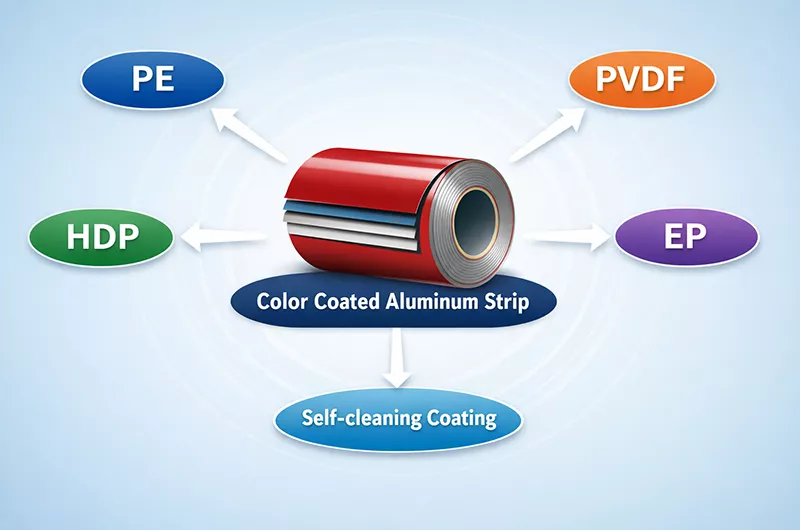
PE Coated Aluminum Strip
PE coated aluminum strip uses polyester (PE) coating for surface treatment. It has good adhesion and decorative effects, with rich colors and stable processing performance. It is suitable for indoor environments or outdoor areas with relatively mild climate conditions, such as ceilings, interior walls, and general decorative materials, offering a balance of economy and practicality.
PVDF Coated Aluminum Strip
PVDF coated aluminum strip uses a fluorocarbon resin system, providing excellent weather resistance, UV resistance, and corrosion resistance. Even after long-term exposure to outdoor environments, it is not prone to fading or chalking. It is widely used in curtain walls, roofing systems, and high-end building facades that require high durability.
HDP Coated Aluminum Strip
HDP coated aluminum strip uses high-durability polyester coatings. Compared with ordinary PE coatings, it offers better weather resistance and color retention while maintaining good cost performance. It is suitable for building exteriors and industrial uses that require a certain service life but have relatively limited budgets.
EP Coated Aluminum Strip
EP coated aluminum strip usually uses an epoxy coating system, which provides strong adhesion and excellent chemical corrosion resistance. It is suitable for environments requiring high protective performance, such as industrial equipment, pipeline cladding, and certain special application fields. However, its weather resistance under long-term outdoor UV exposure is relatively limited.
Self-Cleaning Coated Aluminum Strip
Self-cleaning coated aluminum strip incorporates special functional materials into the surface coating, giving it anti-fouling and easy-cleaning properties. Under rain washing or natural environmental effects, it can reduce dust adhesion and maintain surface cleanliness and gloss. It is suitable for high-rise building facades, roofs, and projects requiring low maintenance of appearance, effectively reducing long-term cleaning costs.
Professional Tip: If you plan to use these products for outdoor construction, be sure to check the coating thickness in microns (μm). For exterior wall building applications, at least a 25 μm PVDF coating is the industry standard to ensure durability.
- PE (Polyester): Economical and suitable for indoor or mild outdoor environments
- PVDF (Polyvinylidene Fluoride): Excellent weather resistance, ideal for outdoor and architectural applications
Color Coated Aluminum Strip Advantages and Disadvantages
Advantages
- Lightweight and high strength: density is only 2.71 g/cm³, about 1/3 of steel, while the strength can meet most application requirements
- Excellent corrosion resistance: the aluminum substrate forms an oxide film, combined with coating protection, and the service life can reach 15–30 years
- Rich and long-lasting colors: any color can be customized, and PVDF coatings can maintain color without fading for more than 15 years
- Easy processing and forming: can be stamped, bent, welded, and cut, suitable for complex shapes
- Environmentally friendly and recyclable: 100% recyclable with low VOC emissions during production
- Fire safety: Class A non-combustible material with no toxic gas release during combustion
- Low maintenance cost: smooth surface, easy to clean, and does not require frequent maintenance
Limitations
- Limited alkali resistance: long-term contact with strong alkali may cause coating peeling or substrate oxidation
- Lower hardness: compared with steel, it has weaker scratch resistance
- Higher cost than ordinary steel: however, considering service life and maintenance costs, it offers better overall cost performance
Color Coated Aluminum Strip Applications
Color coated aluminum strip is widely used in multiple industries due to its lightweight nature, corrosion resistance, diverse appearance, and easy processing characteristics. Among them, the construction industry accounts for the largest proportion, while stable demand also exists in home appliances, transportation, and industrial sectors.
In the field of architectural decoration, color coated aluminum strip is one of the most important materials. It is widely used in roofing systems (such as roof panels, aluminum-magnesium-manganese roofing, and corrugated sheets), exterior wall systems (curtain wall panels, aluminum veneer panels, honeycomb panels, and aluminum composite panels), as well as supporting components (gutters, downspouts, and eaves). In interior decoration, it is commonly used in ceiling systems, decorative wall panels, rolling shutter doors, and blinds.
In the home appliance and electronics industry, color coated aluminum strip is mainly used for manufacturing various housings and panels, such as refrigerator shells, air conditioner housings, washing machine panels, as well as lamp covers, kitchen appliance panels, battery shells, capacitor housings, and heat dissipation components, where high requirements for surface quality and durability are necessary.
In the transportation sector, its applications include interior and exterior panels of box trucks, RV shells, interior decorative panels for rail transit carriages, ship interior decoration, and refrigerated container linings. It is also used in traffic signs and advertising display boards.
In HVAC and industrial fields, color coated aluminum strip is commonly used for air ducts in HVAC systems, insulation cladding, cable sheaths, equipment protective covers, and factory enclosure structures. It can also be used for photovoltaic-related components such as brackets and equipment housings.
In addition, in other application scenarios, color coated aluminum strip can be used in food packaging (such as can lids and pull rings), furniture surface finishes, daily decorative materials, and certain reflective or functional panels, demonstrating excellent versatility and processing adaptability.
Color Coated Aluminum Strip Production Process: Roller Coating
The production of color coated aluminum strip mainly adopts a continuous roller coating process, which is a highly automated process and generally includes the following steps:
- Pretreatment: the aluminum strip undergoes repeated cleaning and chemical treatment to form a chemical conversion film on the surface, improving corrosion resistance and coating adhesion.
- Coating: through precision roller coating equipment, primer and topcoat are evenly applied to the aluminum strip surface. Usually, two coating and baking processes (two-coat two-bake) are required to ensure coating quality.
- Curing: the coated aluminum strip enters a curing furnace and is baked at a high temperature of 200°C to 300°C to fully cure the coating and form a stable protective layer.
- Post-treatment: according to requirements, processes such as waxing or applying protective film may also be carried out to protect the finished product surface.
Color Coated Aluminum Strip Purchasing Suggestions
When purchasing Color Coated Aluminum Strip, as a professional manufacturer, Haomei Aluminum recommends that customers make reasonable selections based on the actual application environment, performance requirements, and project budget to ensure optimal material performance and service life.
Substrate Selection Recommendations
Different application environments have different performance requirements for aluminum materials:
- Indoor applications: it is recommended to use 1-series pure aluminum substrates (such as 1050 and 1060), which provide good formability and cost efficiency, suitable for decorative panels, ceilings, and other indoor scenarios.
- Outdoor applications: it is recommended to select 3-series or 5-series aluminum alloys (such as 3003, 3004, and 5052), which offer higher strength and better corrosion resistance, making them more suitable for building exterior walls, roofing systems, and other long-term outdoor environments.
Coating Type Selection
The coating system directly affects the weather resistance and decorative performance of color coated aluminum strip:
- Indoor or general outdoor environments: PE (polyester) coating is recommended due to its good decorative properties and cost performance.
- Harsh climates or high-end architectural projects: PVDF (fluorocarbon) coating is recommended due to its superior weather resistance and UV resistance. To ensure long-term stability, the PVDF content is recommended to be no less than 70%.
Key Points for Quality Evaluation
When purchasing color coated aluminum strip, quality can be evaluated from the following aspects:
- Coating uniformity: observe whether the surface coating is uniform without sagging, pinholes, or obvious particles.
- Adhesion test: use a cross-cut test to check coating adhesion; high-quality products should show no obvious peeling.
- Color difference control: products from the same batch should maintain consistent color without obvious color variation.
- Surface flatness: both the substrate and coating should be smooth and flat, without obvious waves or indentation marks.
As a professional supplier of color coated aluminum products, Haomei Aluminum adopts advanced coating production lines and a strict quality control system to provide customers with stable and reliable color coated aluminum strip solutions, and can also offer customized products and technical support according to different application requirements.